

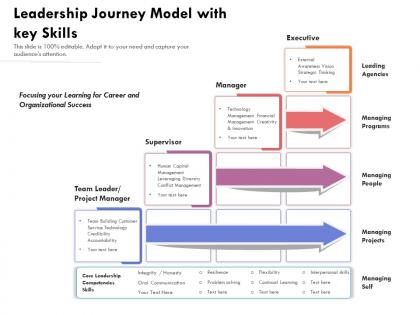
Leadership journey model with key skills




Try Before you Buy Download Free Sample Product
 Impress Your
 Audience
 100%
100% Editable
 Save Hours
 of Time


Our Leadership Journey Model With Key Skills are topically designed to provide an attractive backdrop to any subject. Use them to look like a presentation pro.
People who downloaded this PowerPoint presentation also viewed the following :
Leadership journey model with key skills with all 2 slides:
Use our Leadership Journey Model With Key Skills to effectively help you save your valuable time. They are readymade to fit into any presentation structure.
FAQs for Leadership journey model
Honestly, adaptability is probably the biggest one - things change constantly and you've got to roll with it. Emotional intelligence matters too, like actually reading how people are feeling instead of just bulldozing through meetings. Oh, and being real with your team goes way further than you'd think. Focus on developing people, not just getting tasks done. That's what separates decent managers from leaders people actually want to follow. Active listening is clutch. You'll also need to make calls without having all the info - that's just leadership reality. Start by watching how people react when you talk to them. Small tweaks in your approach can totally change everything.
Look at the hard numbers first - promotion rates, retention, 360 feedback scores. But honestly? The data's only half the picture. Survey people about confidence levels and ask their managers what behavior changes they're actually seeing day-to-day. I'd compare against other companies too if you can swing it. Timing matters - measure right after training, then 6 months out, then yearly. Oh and definitely benchmark wherever possible. Just start with whatever data you've got now and build on it. The key is hitting it from multiple angles since leadership development is kinda hard to pin down with just spreadsheets.
Dude, you can't lead people if you can't read the room or handle your own emotions. I've watched brilliant leaders totally flame out because they had zero people skills - it's honestly painful to see. The basics are knowing yourself, having empathy, and not being socially awkward. Pay attention to how your feelings mess with your judgment. Actually listen to your team instead of just waiting for your turn to talk. Building trust matters way more than being the smartest person around. Oh, and learn to deal with conflict without losing your mind.
Honestly, having a good mentor is a game-changer for leadership stuff. They give you feedback you actually need to hear, not just what sounds nice. I learned way more from my mentor's screw-ups than any business book - she'd tell me exactly how she messed up deals or handled team conflicts badly. Those awkward conversations where they call you out? That's where the real growth happens. Find someone whose style you respect but who won't sugarcoat things. Oh, and go in with specific goals - like "help me get better at difficult conversations" - instead of just wanting general advice. Makes the whole thing way more useful.
So basically, don't make leadership development feel like homework on top of everything else. Peer mentoring circles are honestly way more effective than those formal training things nobody wants to sit through. Give people stretch assignments that push them a bit, and celebrate when someone tries something new - even if they mess up a little. Building that psychological safety is huge so people aren't scared to experiment. Oh, and maybe start small? Like a 30-minute monthly chat where everyone shares leadership wins and fails. Trust me, people learn more from hearing about other people's mistakes than from any PowerPoint.
Honestly? Just ask your people what they actually want first. Survey them about learning styles, career goals, all that stuff. Some hate workshops and want mentors instead. Others need hands-on projects, not boring classroom time. Working parents need flexible schedules - obvious but companies miss this constantly. Build different tracks: leadership circles for underrepresented groups, skill-based paths, whatever fits. Your facilitators should look like your workforce too. Cookie-cutter programs are dead, thankfully. Design around what people tell you they need, not what you think works.
Honestly, I'd focus on a mix of the obvious stuff and the behavioral changes. Promotion rates are big - also 360 feedback scores and engagement surveys. Compare people who did your program vs those who didn't. Retention is huge too (I always forget that one initially). Business metrics matter - team performance, goal completion rates for participants. The trick is getting baseline data before you start, then checking back in like 6-12 months later. Oh and don't go crazy - pick 3-4 metrics max or you'll drown in data.
Honestly, the AI stuff is getting pretty good at figuring out where you're weak and then throwing custom practice scenarios at you. VR training is where it gets interesting though - you can bomb a presentation or handle some angry employee without anyone actually judging you for it. I tried one recently and yeah, the immediate feedback is actually helpful. You just keep doing it until you don't suck anymore. It tracks how you're improving too and makes things harder as you go. Most companies are testing these platforms now, so maybe check if yours has something? Otherwise look into VR leadership sims.
Oh man, remote leadership is tricky! Trust is probably the hardest part - you can't just pop by someone's desk anymore. Plus those video calls where you're squinting at tiny faces trying to figure out if someone's actually confused or just has bad wifi. Focus your training on virtual one-on-ones that actually matter, not just status updates. Digital communication skills are huge too. Team building gets weird when everyone's in their pajama pants, but you've got to find ways to keep people engaged. Honestly, half the battle is just setting super clear expectations from day one.
Honestly, skip the annual review BS and do regular check-ins instead. Start with 360 feedback when people join, then quarterly surveys from their team and peers. Anonymous surveys work great - people actually tell the truth that way. Set up peer coaching circles too, those are surprisingly helpful. After big projects, do structured reflection sessions while everything's still fresh. The real trick? Actually USE the feedback you get. I've seen so many programs fail because leaders collect input then... nothing happens. People catch on quick and stop participating. Oh, and make sure leaders can track their own progress - they need to see what's working and what isn't.
Honestly, ethical leadership is huge right now - trust literally makes or breaks businesses. Your team and customers are watching everything you do, and social media makes bad decisions go viral fast. I've seen companies with ethical leaders get way better employee retention and customer loyalty. The younger crowd especially wants to work for people who actually match their values. Here's what I'd do: be transparent about how you make decisions and always think "would I be cool with this being front-page news?" Sounds cheesy but it works. Better to be overly cautious than deal with a reputation nightmare later.
Honestly, your leadership style makes or breaks how your team feels about work. Autocratic gets stuff done but kills creativity - people just follow orders. I've seen democratic leadership work really well because everyone's involved in decisions, though meetings can drag on forever. Transformational leaders? They get people pumped about the bigger picture and usually see the best engagement. Laissez-faire is perfect for self-starters but leaves some people hanging. Really depends on reading your team and what's happening at the moment.
You can't count on those random coffee chats anymore, so you've gotta be way more intentional. Set up regular one-on-ones that actually dig deeper than just status updates. Give your high-potential people stretch assignments - maybe cross-functional projects where they can practice leading different teams? I've seen breakout rooms work surprisingly well for letting emerging leaders run discussions. The feedback piece is huge since it won't just happen naturally now. Honestly, async training works great because people can actually focus without Zoom fatigue. Pick 2-3 promising folks and start there this quarter.
Honestly, cross-functional projects are like leadership training without the formal title. You're basically herding cats from different departments who all have their own priorities. But that's where you learn the good stuff - how to influence people who don't work for you, manage competing deadlines, and translate between teams that speak totally different languages. I mean, getting engineering and marketing on the same page? That's a skill right there. You can try out different approaches without anyone expecting you to have all the answers. Definitely jump on the next one that comes up, even if it looks like chaos.
Look, DEI training isn't just some corporate checkbox thing anymore - it actually builds better leaders. Your future managers need to work with all kinds of people, right? So when you give them diverse mentorship and cross-cultural experiences early on, they get way better at problem-solving and connecting with different teams. The workforce is getting more diverse anyway, so leaders who "get" inclusion can tap into bigger talent pools and avoid that echo chamber mentality. Honestly, I've seen it reduce groupthink and spark way more innovation. You'll want DEI baked into your leadership programs from the start.
-
Use of different colors is good. It's simple and attractive.
-
Great designs, really helpful.
-
Great designs, Easily Editable.
-
Awesomely designed templates, Easy to understand.