


Logistics Company Organization Chart Courier Delivery Services Company Profile Ppt Microsoft




Try Before you Buy Download Free Sample Product
 Impress Your
 Audience
 100%
100% Editable
 Save Hours
 of Time


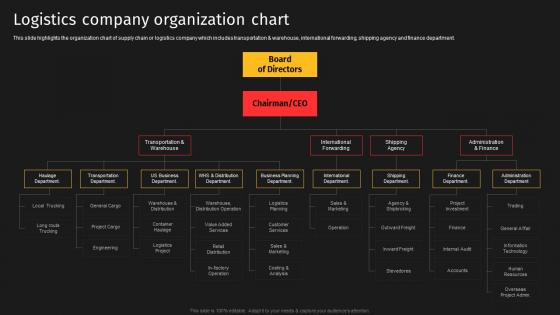
This slide highlights the organization chart of supply chain or logistics company which includes transportation and warehouse, international forwarding, shipping agency and finance department.
People who downloaded this PowerPoint presentation also viewed the following :
Logistics Company Organization Chart Courier Delivery Services Company Profile Ppt Microsoft with all 6 slides:
Use our Logistics Company Organization Chart Courier Delivery Services Company Profile Ppt Microsoft to effectively help you save your valuable time. They are readymade to fit into any presentation structure.





FAQs for Logistics Company Organization Chart Courier Delivery Services Company
So the big ones you'll see are Operations Manager for daily stuff, Transportation/Fleet Manager, Warehouse Manager, and Customer Service Lead. Supply Chain Director usually sits on top - that poor soul definitely lives on caffeine lol. There's also Inventory Controller, Dispatch Coordinator, Safety/Compliance Officer because regulations are insane in this industry. Oh and some places split transportation into inbound/outbound managers which honestly makes sense. If you're mapping this out, I'd start with operations and transportation first. Everything else kind of builds around those two core areas.
Logistics companies are way more layered than most businesses - you've got dispatch centers, warehouses, field supervisors all over the place. The org chart basically revolves around moving stuff and timing instead of normal departments. Route optimization teams and freight coordinators are huge roles you won't find elsewhere. Communication between dispatchers and drivers has to be super flat and fast since trucks don't stop for org charts, you know? I'd honestly start by mapping your supply chain first - that's where you'll actually see who makes decisions.
Honestly, org charts are lifesavers for logistics - they stop that endless "wait, who handles this?" runaround that eats up your whole day. Decision-making speeds up when people actually know their chain of command. Your customers get better service too since everyone knows who deals with shipping vs inventory vs carrier drama. Makes growing the business smoother when you're adding routes or warehouses. I've watched teams burn hours just figuring out who approves what - it's painful to see. Just start by sketching out what you have now, even if it's a hot mess.
Dude, you really need one of these! Your team will finally know who to bug about what instead of passing people around like a hot potato. Shipping issues? Hit up operations. Don't waste the finance person's time, you know? Plus everyone can see the chain of command - who needs approval for stuff vs who can just decide things on their own. Honestly saves so much confusion and those weird "that's not my job" conversations. Stick it somewhere people will actually see it and just remember to update when people move around.
Honestly, just go with Lucidchart for logistics org charts - it's way better at handling those messy cross-functional relationships than most tools. Visio works too if you already have it. PowerPoint's fine for simple stuff but gets clunky fast with matrix reporting (learned that the hard way lol). SmartDraw and draw.io are decent backup options. Whatever you pick, make sure it's cloud-based. Trust me, you'll thank yourself later when someone inevitably wants to reorganize everything and you're not emailing files back and forth like it's 2005.
When you're small, everyone does everything - I've seen ops managers loading trucks at 6am then doing customer calls by lunch. Growth means you'll start carving out real departments: transportation, warehousing, customer service, each with actual managers. Scale up more and suddenly you've got VPs and regional directors everywhere. Honestly, the org charts get pretty wild at that level. The trick is restructuring slightly ahead of when you think you need it. Don't wait until stuff starts slipping through the cracks because that's when it gets messy.
So basically tech teams get their own section now on logistics org charts. You'll see systems analysts, warehouse automation people, data engineers - all sitting right next to the usual operations folks. Makes sense since literally nothing happens without software these days. Route planning, inventory tracking, those crazy automated sorting systems - someone's gotta manage all that stuff. What's wild is how these tech roles aren't just "IT support" anymore, you know? They're working directly with dispatch and warehouse teams daily. Companies need people who actually understand both the logistics side AND the technical side, which honestly isn't always easy to find.
Build cross-functional teams instead of those rigid department silos that never work anyway. When stuff changes fast - like everyone suddenly wanting same-day delivery - you can move people around without blowing up your whole structure. Honestly, I've watched too many companies paint themselves into corners with crazy hierarchical charts. Simple reporting lines work better, but let your managers pull together project teams when needed. Every quarter or so, step back and ask what skills you actually need right now. Then shift roles around, not just job titles. Oh, and start by figuring out which positions could easily jump between different functions.
So supply chain handles the big stuff - procurement, vendor management, inventory planning, demand forecasting. They're basically making sure you've got what you need when you need it. Also deal with supplier relationships and contract negotiations. Some companies have them run warehousing too, but that varies. Logistics and transportation planning falls under them as well. Honestly, they're pretty much the go-to people for anything supplier or inventory related. Plus they track all the analytics and performance metrics - which can get pretty intense depending on your company. Start there if you're having issues.
So basically, a good org chart saves you from all those annoying "who's supposed to handle this?" situations that kill productivity. When everyone knows exactly who owns inventory decisions, transportation stuff, or customer issues, things actually get done instead of sitting in limbo. Communication gets way smoother too. Honestly, I've seen teams waste so much time just figuring out who to ask about what. Start by sketching out what you have now, then look for spots where people are stepping on each other's toes or where nobody's clearly in charge. You'll probably find some obvious fixes pretty quick.
Honestly, the trickiest part is juggling centralized control with letting regional teams make quick calls. Logistics is weird - it's global but also super local at the same time. You need consistent processes, but your warehouse guys can't wait for approval on every little thing. These companies scale messy too (I've seen some absolutely insane org charts). Everyone - warehousing, transport, IT, HR - wants to report directly to the top. My advice? Map out how work actually flows first, not how you think it should. Then build your structure around that reality. Otherwise you'll just keep reorganizing every six months.
Your org chart is basically your roadmap for HR stuff. Each department needs totally different things - warehouse guys aren't gonna have the same career path as dispatch managers, you know? The chart shows you exactly where the skill gaps are hiding and which roles you absolutely can't afford to lose people from. Generic HR approaches are honestly pretty useless in logistics. You need training that actually follows your reporting structure, advancement that makes sense for how things really work, and pay that reflects what each job actually does. I'd start by looking at your current chart and figuring out where people typically get stuck - that'll tell you everything.
Honestly, remote work totally reshapes how your company's structured. Geography stops mattering, so that dispatch guy in Ohio can work straight with the freight manager in Texas - no need for all those regional supervisors in between. Middle management shrinks because direct reporting through digital tools is actually easier than I expected. Cross-department stuff happens way more naturally too. The whole warehouse-to-office chain gets messy in a good way. You'll probably end up organizing around what people actually do instead of where they sit. Start figuring out who needs to report to whom based on workflow, not who's in the same building.
Honestly, it totally depends on your company size. Big companies should probably create a dedicated sustainability manager who reports straight to the C-suite. Smaller places? Just have someone juggle it with their other duties until you can afford more staff. You could also do cross-functional green teams with people from different departments - that actually works pretty well. The main thing is giving someone real accountability for actual metrics, not just some wishy-washy "let's be greener" goal. Figure out where you're doing the most environmental damage first. Then build roles around fixing those specific problems. Operations and procurement managers are usually good candidates to take this on too.
So I'd start with decision-making speed - like how long approvals actually take between departments. Communication is probably your biggest headache though, so track how well cross-functional projects are going and if people are happy collaborating. Check your span of control ratios too because nobody wants managers who are either drowning or bored out of their minds. Oh, and don't forget the actual business stuff - are delivery times and shipping costs still hitting targets? The structure should help, not hurt your operations. Pick maybe 2-3 metrics that'll actually tell you something useful about whatever's bugging you most right now.
-
Templates are beautiful and easy to use. An amateur can also create a presentation using these slides. It is amazing.
-
Kudos to SlideTeam for achieving the high success rate in delivering the top-notch slides.