

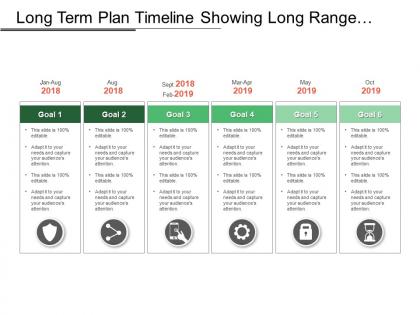
Long term plan timeline showing long range planning with goals




Try Before you Buy Download Free Sample Product
 Impress Your
 Audience
 100%
100% Editable
 Save Hours
 of Time


Out Long Term Plan Timeline Showing Long Range Planning With Goals make it easy to get it into their heads. They help figure it all out.
People who downloaded this PowerPoint presentation also viewed the following :
Long term plan timeline showing long range planning with goals with all 5 slides:
Shake hands with destiny with our Long Term Plan Timeline Showing Long Range Planning With Goals. They allow you to get a firm grip.

FAQs for Long term plan timeline showing long range
Honestly, start with your end goal and work backwards - way less overwhelming that way. You need specific milestone dates, figure out your resources, and build in buffer time because stuff always goes wrong. Map out how different parts depend on each other so you don't get stuck waiting around. I do quarterly check-ins minimum, though monthly is better if it's a big project. Oh and make sure each phase has something you can actually measure - learned that one the hard way! Keep it detailed enough to make real decisions but don't get so rigid that you can't pivot when things change.
Honestly, I'd start with a 3-5 year timeline and work backwards. Map out your big goals first, then break those down into yearly milestones that actually make sense. The tricky part? Making sure your annual budgets line up with these targets instead of just putting out fires (which, let's face it, never stops). Do quarterly check-ins to see if you're still headed in the right direction. Oh, and definitely loop in all departments early - nothing kills a strategic plan like people not understanding how their day-to-day work fits into it. That communication piece is huge but gets overlooked way too often.
Honestly, the biggest mistake is being way too optimistic with timing. Always add buffer time because stuff will go wrong - trust me on this one. Also, your milestones can't be super vague like "improve customer satisfaction." That tells nobody anything useful. Here's what really kills me though - when leadership makes these timelines without talking to the actual people doing the work. Recipe for disaster. Make sure you're checking in regularly and tweaking things as you go. Don't treat your timeline like some sacred document that can never change.
Honestly? Check it every 6 months if possible, but at minimum once a year. Things move so crazy fast now - I swear what made perfect sense in winter can look totally ridiculous by summer. Also update it whenever big stuff happens. New competition pops up, budget gets slashed, your boss leaves - you know, the usual chaos. Oh and actually set that calendar reminder right now or you'll totally forget (speaking from experience here lol). The whole point is keeping it alive, not just writing it once and shoving it in a drawer somewhere.
Look, getting your stakeholders involved early will save you so much headache later. They know where things usually go sideways - like when the IT team gets swamped in Q3 or whatever. When people actually have a say in the timeline, they don't fight it as much. Makes sense, right? You'll catch dependencies you totally missed otherwise. I'd start by mapping out who you really need input from. Don't skip the weird edge cases either - sometimes the person who seems least relevant has the best insight about why things take forever.
Honestly, the right tech tools make long-term planning so much easier. I've been using Asana lately and it's pretty great for visualizing those big multi-year projects with Gantt charts. You can set up milestone alerts, track how different tasks depend on each other, and when things go sideways (they always do), adjusting timelines isn't a nightmare. Monday's another solid option. The scenario planning features are clutch too - you can test out different "what if" situations without screwing up your main plan. Real-time collaboration saves you from those annoying email threads where everyone's talking over each other. Just figure out how your team actually works first, then pick whatever fits that vibe.
Track milestone completion rates and budget stuff first - those show if you're actually on track. Also watch stakeholder engagement (are people showing up to meetings or just ghosting?). Resource utilization matters too. Honestly, don't go crazy with metrics though - pick maybe 3-4 that match your goals and check monthly. If you're constantly having to pivot major things, that's usually a red flag about your initial planning. Some flexibility is normal, but not total chaos. ROI metrics are good if they apply to what you're doing.
Don't treat risk assessment like some separate thing you do once and forget about. Build it right into your planning from day one. Every time you're mapping out strategy, ask "what could go wrong here?" and actually write it down. Most teams I've worked with totally skip this step and then act surprised when stuff hits the fan. Set up those quarterly check-ins to look at new risks plus how old ones might mess with your long-term plans. Honestly, the trick is making it feel routine, not like extra homework. Keep your risk charts simple - if stakeholders can't understand them, they won't use them.
Go with a horizontal timeline - way cleaner than bullet points everywhere. Color-code different teams so people can instantly see what's their problem vs someone else's. Quarter intervals usually work best for longer projects. Oh, and definitely mark your decision points and review meetings on there too. I swear, half the timelines I see look like complete chaos. Buffer time is crucial though - shows you actually get that stuff takes longer than planned. Makes you look way more credible when you're not pretending everything'll go perfectly.
Honestly, it's all over the place depending on what industry you're in. Tech companies usually look ahead maybe 2-3 years max, but utilities? They're planning like 20+ years out. Makes sense though - if you're building power plants or drilling for oil, that stuff takes forever to actually make money. Software and retail move way faster since everything changes so quickly. I'd say match your timeline to how long your investments take to pay off. Stable industries can think long-term, but if you're in something volatile, stick to shorter plans you can actually pivot on. Way more realistic that way.
Honestly, the three things that'll mess you up most are tech disruption, how people buy stuff changing, and workforce shifts. Remote work is here to stay - plan for it. Keep an eye on new regulations too, plus supply chain stuff (ugh, we all know how that goes). Instead of locking yourself into some rigid 5-year plan, build in review points every 6-12 months. That's what actually works. Create three scenarios - best case, worst case, and realistic - then see how your timeline holds up against each. Way better than pretending you can predict everything.
Honestly, I'd map out 3-4 scenarios early on - best case, worst case, most likely, and maybe some curveball situation. Every 6 months or so, check which one you're actually living through. Build these review points right into your timeline so you don't forget. I always throw probability percentages on each scenario too, even though they change constantly. The whole thing falls apart if you only do it once - you need those quarterly check-ins to see if your assumptions are still holding up. Otherwise you're just guessing in the dark.
Think of milestone markers as your sanity check - honestly, without them you're just hoping everything works out in the end (which never goes well). They let you spot problems before they get huge and keep everyone motivated since people can actually see progress happening. I usually space them 3-6 months apart depending on the project length. Each one needs measurable stuff you can evaluate, not vague "we're doing great!" updates. Your stakeholders will love having concrete things to point to instead of you just saying "trust me, it's going fine." Way better than flying blind for months.
Honestly, just bake flexibility into your planning from day one. I do quarterly check-ins to reassess everything—priorities, assumptions, the whole deal. COVID taught me that even "solid" plans can fall apart fast (our 5-year strategy was basically useless overnight lol). Make your goals modular so you can tweak without starting over. Always keep some budget unallocated as a cushion. Here's the key part though: decide ahead of time what specific things would make you pivot. Write them down. That way you're not making desperate decisions when you're stressed and everything feels like it's on fire.
Look, market research is basically your roadmap for long-term planning. It shows you where trends are heading and when customers might actually want what you're building. Without it? You're just throwing darts at a calendar and hoping something sticks. The data helps you time product launches better and figure out when competitors might make moves. I'd definitely build in regular research check-ins throughout your timeline - like every quarter or so. That way when the numbers tell you something different than what you originally thought, you can actually pivot instead of stubbornly sticking to a plan that's not working.
-
Very well designed and informative templates.
-
I discovered this website through a google search, the services matched my needs perfectly and the pricing was very reasonable. I was thrilled with the product and the customer service. I will definitely use their slides again for my presentations and recommend them to other colleagues.