


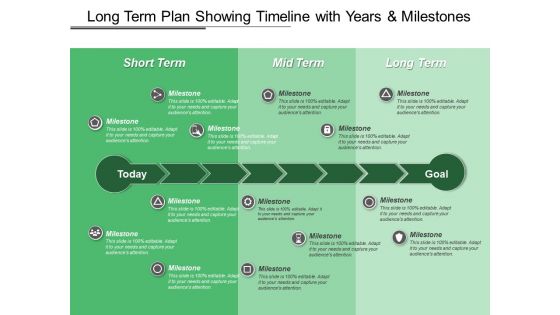
Long term plan showing timeline with years and milestones





Try Before you Buy Download Free Sample Product
 Impress Your
 Audience
 100%
100% Editable
 Save Hours
 of Time


Are you a corporate leader and looking to create the long-term plan for your organization? If yes, then our long-term plan showing timeline with years and milestones PowerPoint slide will serve your purpose. You can use this presentation design to share your short term, mid-term and long-term plans. Our PPT template gives you an opportunity to showcase your business achievements and milestones in front of your investors, stakeholders, clients and even new team members. Besides this, the PowerPoint diagram gives you the clear picture about the company state as where you are standing at this point of time and how you can achieve your business goals with long term planning. This presentation shape is also valuable to show personal milestones and achievements. You can present your accomplishments in the professional manner using this slide. Usually short-term plan involves process that shows success achieved within a year, the mid-term plan aims to look at results that takes few years to achieve whereas the long-term plan includes the overall objectives of the organization set around four to five years. You can elaborate and share the information about them using our PowerPoint diagram. So just start using this design. Fascination is bound to build with our Long Term Plan Showing Timeline With Years And Milestones. They generate exotic creations.
People who downloaded this PowerPoint presentation also viewed the following :
Long term plan showing timeline with years and milestones with all 5 slides:
Evolve brilliantly with our Long Term Plan Showing Timeline With Years And Milestones. You will become the best in your craft.
FAQs for Long term plan showing timeline with
Start by mapping out your deliverables and what depends on what - like you can't launch without testing first, that kind of thing. Figure out realistic timeframes for each piece. Here's where people mess up though - they forget about actual capacity. Just because Sarah's name is on five tasks doesn't mean she can clone herself! I always add 15-20% buffer time because something random will definitely go sideways. Make it visual so everyone can see progress. Oh, and update it regularly or it becomes useless pretty fast. Those are the basics that'll keep you sane.
Honestly, visual timelines are game-changers because your whole team can actually see what's going on and when. No more drowning in email threads or trying to decode those messy Gantt charts. You'll spot who's doing what, catch dependencies, and see potential problems before they blow up. I can't tell you how many pointless "alignment meetings" I've sat through that could've been avoided with just a decent timeline posted somewhere. People get how their stuff connects to everyone else's work way faster when it's visual. Oh, and start simple - you can always jazz it up later once you figure out what works for your team.
Ugh, the worst thing you can do is underestimate everything - like, by a lot. I always add at least 20-30% buffer time because stuff WILL go wrong. Stakeholder reviews? They drag on forever, I swear. Don't pile too many tasks on your team at once either - seems obvious but we've all done it. Map out your critical path first, then pad those estimates. Oh and dependencies are sneaky time-killers too. Honestly, if your initial timeline feels realistic, you're probably being way too optimistic.
Look, picking the wrong software will absolutely derail your whole timeline. I learned this the hard way last year! Trello's perfect for simple stuff, but once you need dependency tracking or resource management, jump to Asana or Monday.com. Don't go too complex right away though - your team needs to actually use the thing. Start with something everyone can figure out without a manual. You can always upgrade later when you hit walls. The trick is matching your tool to what you're actually doing, not what you think you might need someday.
Look, I know timeline planning sounds like it goes against agile, but it actually works pretty well together. High-level roadmaps give stakeholders that big picture view they're always asking for. Meanwhile you keep your sprints flexible underneath - best of both worlds. It's super helpful for release planning and figuring out dependencies between teams. Plus, and this might sound obvious, but it stops executives from constantly bugging you about deadlines. Just make sure you're updating timelines as you go and build in some buffer time. Nobody's perfect at estimating. Treat it like a guide, not some sacred contract you can't change.
Honestly, Gantt charts are a lifesaver for timeline stuff. You get this whole visual overview where you can spot dependencies and bottlenecks right away. Way easier than trying to explain everything in emails to your boss or clients. The cool part? When deadlines shift (and they always do), you'll see exactly how it affects everything else downstream. I'd start simple - maybe just Excel or something free like GanttProject. Don't overthink it at first. Once you see how much clearer your projects become, you won't go back to those messy task lists.
Put your milestones at decision points and big deliverables - basically treat them as checkpoints where you stop and see how things are going. I space mine every 2-3 weeks tops, any longer and you'll definitely lose track. Make sure each one has actual success criteria, not just "check on stuff" - that's useless honestly. Here's what really works though: build buffer time after each milestone for tweaks. Oh, and figure out your biggest risks first, then drop milestones right before those sketchy moments so you can pivot if needed.
Look, you absolutely need stakeholder input if you want realistic timelines. They know stuff you don't - like when the budget committee actually meets or if there's scheduled maintenance that'll block everything. Getting their buy-in upfront is huge because people follow dates they helped create way better than ones you just throw at them. Finance folks will catch budget approval delays, tech teams know about system quirks... each group sees different problems coming. I learned this the hard way on a project last year - should've asked around first. Get them involved during planning, not after you've already decided everything.
Honestly, just bake extra time right into your schedule from day one - like buffer weeks every 2-3 weeks. Scope creep is inevitable, so when it happens you won't be scrambling. I always do this thing called rolling wave planning where you map out the immediate stuff in detail but keep the later phases more general until you actually get there. Figure out what's absolutely critical vs. what would just be nice to have. Your timeline isn't carved in marble, ya know? Treat it like a Google doc that gets updated constantly. Oh, and tell everyone immediately when things change - silence just makes people anxious.
Honestly, the trick is chopping everything into tiny pieces first. Way easier to guess how long "write user stories" takes vs "build the whole damn thing." Buffer time is non-negotiable - I learned that the hard way. Ask whoever's actually doing the work because they'll give you the real deal, not some fantasy estimate. Check what similar stuff took before if you can. Dependencies between tasks will bite you, so map those out early. Don't treat your timeline like gospel either - you'll need to tweak it constantly.
Dude, retrospective analysis is honestly your secret weapon for nailing timelines. Look back at finished projects and you'll spot where you always mess up estimates or which dependencies screw you over every time. I swear it's better than guessing - you're using actual data from how your team works. Short sentences help here. Keep a quick log after each project (like 15 minutes max, don't overthink it). You'll see which estimation tricks worked and which ones were complete trash. Those patterns become gold for your next planning session.
So first thing - match people to tasks based on what they're actually good at and when they're free. Don't pile everything on your best performer because that'll just create a nightmare bottleneck later. Budget is where most of these things crash and burn if you're not being realistic from day one. Dependencies matter too - like, some stuff literally can't happen until other work gets finished first. Oh, and always pad your timeline by 15-20% because I promise something random will go sideways. Trust me on that one.
Honestly, timeline planning is a lifesaver for keeping your marketing stuff organized. I always work backwards from launch day and build in extra time because something always goes wrong lol. Map out when your emails drop, social posts go live, ads launch - all that stuff. Write down every single thing you need to deliver with realistic deadlines. Then share it with your whole team so everyone's on the same page. Trust me, I've watched campaigns crash and burn when PR announcements went out but the landing page wasn't even ready yet. Super embarrassing.
honestly depends what your team's already using but here's what works. Asana's pretty solid for timeline stuff - everyone sees changes right away which is nice. Monday.com does the same thing. Miro's my personal favorite though, way more flexible and you can just drag stuff around (I probably spend too much time making things look perfect on there lol). TeamGantt and Smartsheet are fine if you want traditional Gantt charts but they feel kinda clunky. If you're already on Google Workspace just use their timeline templates in Sheets. They're actually not terrible for basic projects and won't require getting everyone on board with yet another tool.
Honestly, timeline planning is what saves your project from becoming a total disaster. It gives you structure so things don't spiral into chaos. I always work backwards from the final deadline - way easier to figure out what needs to happen when that way. You'll catch problems early instead of scrambling at the end, which is clutch for keeping stakeholders happy (trust me on this one). Breaking big scary tasks into smaller pieces makes everything feel less overwhelming too. Your team will actually thank you for it. Just make sure your deadlines are realistic or you're setting everyone up to fail.
-
Excellent design and quick turnaround.
-
Designs have enough space to add content.