

Manpower Security Services Company Profile Powerpoint Presentation Slides





Try Before you Buy Download Free Sample Product
 Impress Your
Audience
 100%
Editable
 Save Hours
of Time


A Company profile describes all the relevant elements of a business, which helps the investors and stakeholders evaluate the business value and performance. Check out our professionally designed Manpower Security Services Company Profile PowerPoint presentation. Firstly, the profile covers the executive summary, corporate overview highlighting security guard services with quality and certifications, global presence, corporate, industrial, educational institute, hospital, commercial and residential building, retail, shopping complex, and additional security services. Additionally, it includes the team communication layout, weapon and logistics vehicle details, staff recruiting criteria and training center, employee and staff welfare policies, crisis management team, employees rules and regulations, company approach, and business model canvas. Moreover, it covers the timeline, organization chart, management team, government and private sector clients, client reviews, awards, and accolades. At last, this profile emphasizes the revenue and net profit, revenue by customer type, sales by region and services, EBITDA, competitive and SWOT analysis with CSR initiatives and case study. Get access to our powerful Company profile template now.
People who downloaded this PowerPoint presentation also viewed the following :
Content of this Powerpoint Presentation
Slide 1: This slide introduces Manpower Security Services Company Profile. State your company name and begin.
Slide 2: This slide presents Table of Content for the presentation.
Slide 3: This is another slide continuing Table of Content for the presentation.
Slide 4: This slide displays executive summary of security company.
Slide 5: This slide represents security company background information.
Slide 6: This slide showcases security company long term and short term objectives.
Slide 7: This slide shows security guard and manpower services company.
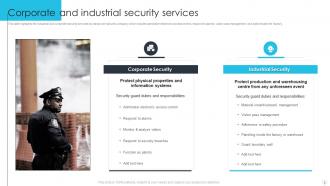
Slide 8: This slide presents industrial and corporate security services by manpower security company.
Slide 9: This slide displays Educational institute and hospital security services.
Slide 10: This slide represents Commercial and residential building security services.
Slide 11: This slide showcases Retail and shopping complex security services.
Slide 12: This slide shows security company additional security services.
Slide 13: This slide presents security guard service company team communication layout.
Slide 14: This slide displays Weapon and logistics vehicle details.
Slide 15: This slide represents security guard company staff recruiting criteria.
Slide 16: This slide showcases staff and employee welfare services.
Slide 17: This slide shows security company crisis management team.
Slide 18: This slide presents security guard company rules and regulations.
Slide 19: This slide displays business approach of security company.
Slide 20: This slide represents business model of security guard company.
Slide 21: This slide showcases Company timeline from 1992 to 2022.
Slide 22: This slide shows organization structure of security company.
Slide 23: This slide presents Executive leadership and management team.
Slide 24: This slide displays Government and private sector clients.
Slide 25: This slide highlights the security guard company client testimonials and reviews.
Slide 26: This slide represents awards and allocates received by security company.
Slide 27: This slide showcases revenue and net profit of security guard company.
Slide 28: This slide shows security company revenue by customer type.
Slide 29: This slide presents Sales revenue by region and services.
Slide 30: This slide displays EBITDA and margin of security guard and manpower services company.
Slide 31: This slide represents security company competitive analysis.
Slide 32: This slide showcases security company SWOT analysis.
Slide 33: This slide shows CSR spend distribution by inhouse and partner spend.
Slide 34: This slide presents case study of security guard company.
Slide 35: This slide contains all the icons used in this presentation.
Slide 36: This slide is titled as Additional Slides for moving forward.
Slide 37: This is Our Mission slide with related imagery and text.
Slide 38: This is About Us slide to show company specifications etc.
Slide 39: This is Our Team slide with names and designation.
Slide 40: This is Our Goal slide. State your firm's goals here.
Slide 41: This slide shows Post It Notes. Post your important notes here.
Slide 42: This slide depicts Venn diagram with text boxes.
Slide 43: This slide describes Line chart with two products comparison.
Slide 44: This is a Timeline slide. Show data related to time intervals here.
Slide 45: This is a Thank You slide with address, contact numbers and email address.
Manpower Security Services Company Profile Powerpoint Presentation Slides with all 50 slides:
Use our Manpower Security Services Company Profile Powerpoint Presentation Slides to effectively help you save your valuable time. They are readymade to fit into any presentation structure.









FAQs for Manpower Security Services Company Profile
So manpower security covers three big areas - physical stuff like guards and cameras, risk assessment, plus emergency planning. Way more than just someone sitting around these days though. They'll do background checks, help with HR compliance, access control, all that. Honestly the biggest win is you don't have to worry about security gaps while you're running your business. My buddy's company uses them and says it's night and day difference. I'd definitely get a consultation if I were you - might catch vulnerabilities you didn't even know about.
So these security services hook you up with trained people who actually know what they're doing - way better than having Bob from accounting try to handle stuff. They're watching for problems, controlling who gets in, and can jump on incidents fast. Plus your regular staff can just do their jobs instead of playing security guard. Honestly, the intimidation factor alone helps keep trouble away. Just make sure you pick a legit company - check their references and ask how they handle emergencies before you commit to anything.
First thing - make sure they've got proper security licenses. Most states require it. Background checks are obviously huge too, criminal history and all that. Training certs matter, like conflict de-escalation and emergency stuff. Honestly though? I'd rather hire someone green with a good attitude than some burned-out guy who's been doing it forever. Physical fitness depends on your setup. But here's what really counts - find people who can actually communicate and show up reliably. They're gonna be the face of your business, so don't mess around with that part.
Look, good security companies treat this stuff like school never ends - they're constantly updating training for new threats. Your team should be getting regular briefings on everything from cyber attacks to drone surveillance (honestly, drones creep me out). They'll cover new scam techniques, workplace violence patterns, all that fun stuff. The smart providers also upgrade their tech and communication systems pretty regularly. I'd ask your provider how often they actually refresh their training materials and when they last did a threat assessment update. Most people don't think to ask, but you should.
So basically the costs work backwards from what you'd think. Guards are cheap to start but then you're paying salaries, benefits, training forever - it adds up fast. Tech stuff hits your wallet hard upfront but then it's just maintenance costs. Most places I've seen do a mix honestly, because humans can actually think but cameras don't call in sick. You should probably crunch the numbers for your timeline though. Oh and scheduling guards is a nightmare - forgot to mention that part.
Honestly, training your security team is huge - they'll handle incidents way better and know actual protocols instead of winging it. Conflict de-escalation and emergency procedures are the big ones. Your guards become way more confident too, which clients pick up on right away. Tech training and legal stuff matter a lot since you don't want liability headaches later. I'd start with role-specific modules first. Oh, and do regular refreshers - skills get rusty fast. Without proper training you're basically crossing your fingers and hoping nothing goes wrong, which is terrifying when you think about it.
First thing - check licensing requirements in your state. Most places need security companies and guards licensed and bonded. Privacy laws matter too since your guards can't just search random people without proper authority. Labor stuff gets tricky with overtime rules and training requirements. The liability side is honestly a nightmare - you'll need bulletproof contracts covering use of force, authority limits, incident reporting. My cousin dealt with this mess last year and said finding a lawyer who actually knows security regulations saved him tons of headaches. Don't try winging the legal stuff yourself.
Honestly, it's all about making people feel safe. When customers see trained security around, they're way more relaxed shopping or hanging out at your place. Your employees aren't constantly looking over their shoulders either - they can actually do their jobs. I didn't realize how big a difference it makes until I saw it firsthand. Professional security also sends a message that you give a damn about protecting everyone. The trick is finding security staff who are friendly but professional, not those scary bouncer types who make everyone nervous. You want people thinking "oh good, I'm protected" not "am I in trouble?"
Honestly, treat your guards like the brains behind the cameras. Nobody can stare at screens for 8 hours without zoning out - that's just human nature. Instead, set up alerts so cameras ping guards when something's happening, then they go check it out in person. Map out what each camera actually sees first, including the blind spots (there's always blind spots). Train them to patrol those gaps strategically. Quick equipment checks should be routine too - broken cameras are obviously useless. The whole thing works when guards know exactly which zones they're covering and can interpret what they're seeing on the feeds.
Track their response times when stuff goes down, plus how consistently they're completing patrols. Customer satisfaction scores matter too - angry clients aren't good for business. I'd also watch punctuality (nobody likes guards showing up late), training compliance, and any security breaches that happen on their shifts. Honestly, surprise audits are clutch for keeping everyone on their toes. You want to measure both the proactive stuff like patrol rounds AND how they actually handle real incidents when they pop up. Set up monthly check-ins with your security company to review everything together. Don't be afraid to tweak expectations if you're consistently seeing problems.
Dude, global security is tricky as hell because of cultural stuff. What flies in New York will totally bomb in Tokyo or Dubai. Sure, language is the obvious barrier, but it's all the little things that'll mess you up - like how strict their hierarchies are, dress expectations, even how your guards should talk to visitors. Made that mistake myself on my first overseas job... wasn't pretty. Partner with local firms who actually get the culture. And honestly? Don't cheap out on cultural training for your managers before you expand anywhere new. Trust me on this one.
Security work is honestly pretty tough - you're dealing with difficult people constantly and making quick decisions that actually matter. The hours suck too. Nights, weekends, holidays... forget about normal family time. There's tons of standing and walking, plus sometimes you gotta physically restrain someone. Long shifts where you need to stay alert are brutal. Oh, and the conflict resolution part? That's like 90% of the job. My take is to invest in good training and learn how to handle stress - seriously, those skills will save you. The pressure gets intense when emergencies hit.
Basically they match guards to whatever your specific industry needs. Healthcare places get people trained on HIPAA stuff and dealing with upset patients. Manufacturing sites? They need guards who get safety protocols and can work weird shifts. Retail's all about loss prevention and not being awkward with customers. Construction sites want guards who won't freak out around heavy equipment - makes sense honestly. The trick is finding a company that'll actually look at your specific risks instead of just sending whoever's available. Each place has totally different compliance requirements too.
Honestly, communication can make or break your whole security setup. Your team needs to know what's going down in real-time - where threats are, how to respond, all that stuff. Radios are your best friend here. Without proper comms, you're basically just people in uniforms looking important (which, let's be real, doesn't help when shit hits the fan). Set up solid protocols for reporting incidents and - this is huge - make sure shift changes actually pass along the important details instead of just "everything's fine." Trust me, invest in decent communication training and equipment now. You'll thank yourself later when everything runs smooth.
So basically, security services jump into action with preset emergency plans when stuff goes sideways. They'll do lockdowns, evacuations, call cops - whatever fits the situation. Quick threat assessment is their thing, plus they keep you in the loop. What's really smart is they work directly with local emergency teams, which honestly can be a lifesaver when time matters. You'll want to check their crisis response plan every few months though - maybe quarterly? And make sure they're doing regular drills. Trust me, you don't want everyone scrambling around confused during an actual emergency.
-
This design is not only aesthetically pleasing but it has many uses making the cost worthwhile. The graphics look stunning, and you can edit them as per your needs.
-
Thank you for offering such fantastic custom design services. The team is really helpful and innovative. In a very short time, I received my personalized template.