


Market entry strategy for nanotechnology industry powerpoint presentation slides




Try Before you Buy Download Free Sample Product
 Impress Your
 Audience
 100%
100% Editable
 Save Hours
 of Time


Introducing Market Entry Strategy For Nanotechnology Industry PowerPoint Presentation Slides. The agenda of this presentation is to provide better performance material at a lower cost and to produce material that is nanoscale in one dimension. The presentation covers the market overview of the nanotech industry at a global level wherein we have discussed the key players, growth drivers, attractive opportunities, and projected contribution of this industry to the US market. Take advantage of business strategy for nanotechnology PPT slideshow, and showcase industry trends by application such as electronics, energy, biomedical, defense, cosmetic, automotive, etc. and by components like nanomaterials, nanotools, and nanosensors. Take the advantage of this nanotechnology organization PowerPoint infographics to present the market entry strategies such as marketing campaigns with online and offline communication styles, strategic alliance approach to have a joint venture with two or more partners, and market diversification to enter a new industry. The presentation also covers nanotechnology challenges along with the solution to overcome them such as set up duration, start-up costs, low awareness, etc. The five-year financial projection has been calculated which covers the income statement, cash flow statement, and balance sheet.
People who downloaded this PowerPoint presentation also viewed the following :
Content of this Powerpoint Presentation
Slide 1: This slide introduces Market Entry Strategy for Nanotechnology Industry. State your Company name and begin.
Slide 2: This slide depicts Nanotechnology Agenda.
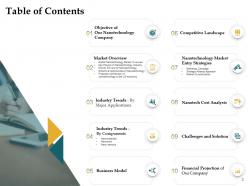
Slide 3: This slide shows Table of Contents.
Slide 4: This slide showacases Table of Contents
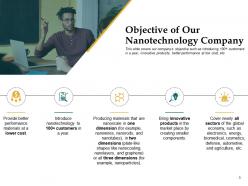
Slide 5: This slide covers our company’s objective such as introducing 100+ customers in a year, innovative products, better performance at low cost, etc.
Slide 6: This slide displays Table of Contents.
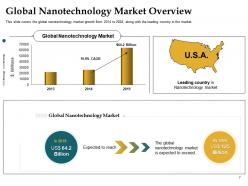
Slide 7: This slide covers the global nanotechnology market growth from 2014 to 2024, along with the leading country in the market.
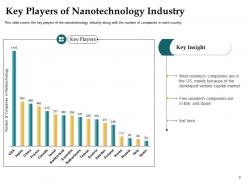
Slide 8: This slide covers the key players of the nanotechnology industry along with the number of companies in each country.
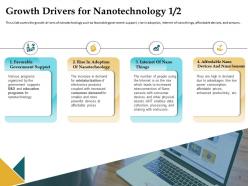
Slide 9: This slide covers the growth drivers of nanotechnology such as favorable government support, rise in adoption, internet of nano things, affordable devices, and sensors.
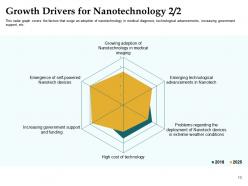
Slide 10: This radar graph covers the factors that surge an adoption of nanotechnology in medical diagnosis, technological advancements, increasing government support, etc.
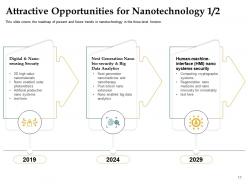
Slide 11: This slide covers the roadmap of present and future trends in nanotechnology in the three-level horizon.
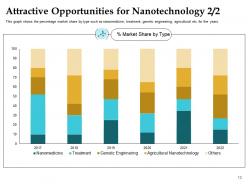
Slide 12: This graph shows the percentage market share by type such as nanomedicine, treatment, genetic engineering, agricultural etc. for five years.
Slide 13: This slide displays Table of Contents
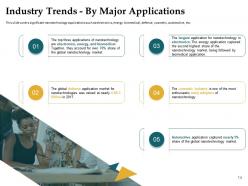
Slide 14: This slide covers significant nanotechnology applications such as electronics, energy, biomedical, defense, cosmetic, automotive, etc.
Slide 15: This slide showcases Table of Contents.
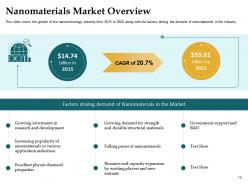
Slide 16: This slide covers the growth of the nanotechnology industry from 2015 to 2022 along with the factors driving the demand of nanomaterials in the industry.
Slide 17: This slide covers the global market for nanotools from 2013 to 2019, focusing on different tools like nanolithography tools, nano manipulators, near field optics, nanomachining tools.
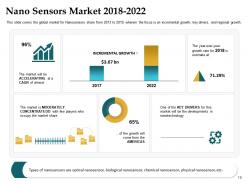
Slide 18: This slide covers the global market for Nanosensors share from 2013 to 2019, wherein the focus is on incremental growth, key drivers, and regional growth.
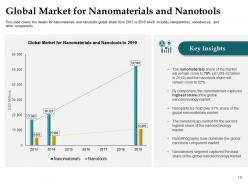
Slide 19: This slide covers the details for nanomaterials and nanotools global share from 2013 to 2019 which includes nanoparticles, nanodevices, and other components.
Slide 20: This slide displays Table of Contents
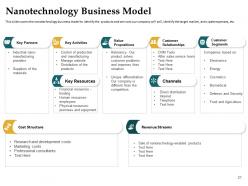
Slide 21: This slide covers the nanotechnology business model to identify the products and services our company will sell, identify the target market, anticipate expenses, etc.
Slide 22: This slide shows Table of Contents.
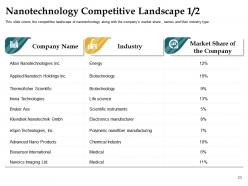
Slide 23: This slide covers the competitive landscape of nanotechnology along with the company’s market share , names and their industry type.
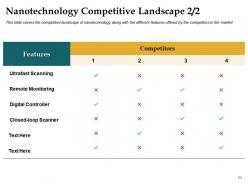
Slide 24: This slide covers the competitive landscape of nanotechnology along with the different features offered by the competitors in the market.
Slide 25: This slide displays Table of Contents
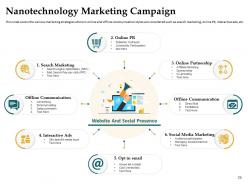
Slide 26: This slide covers the various marketing strategies wherein online and offline communication styles are considered such as search marketing, online PR, interactive ads, etc.
Slide 27: This slide covers the strategic alliance based commercialization strategy is a joint venture approach with two or more partners.
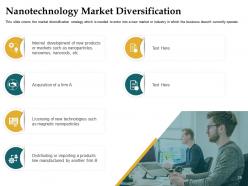
Slide 28: This slide covers the market diversification strategy which is needed to enter into a new market or industry in which the business doesn't currently operate.
Slide 29: This slide displays Table of Contents
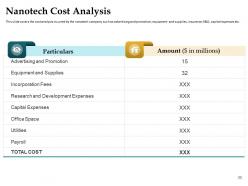
Slide 30: This slide covers the cost analysis incurred by the nanotech company such as advertising and promotion, equipment and supplies, insurance, R&D, capital expenses etc.
Slide 31: This slide displays Table of Contents
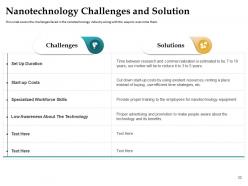
Slide 32: This slide covers the challenges faced in the nanotechnology industry along with the ways to overcome them.
Slide 33: This slide showcases Table of Contents
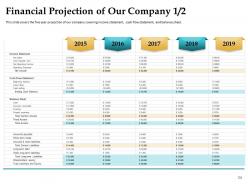
Slide 34: This slide covers the five year projection of our company covering income statement, cash flow statement, and balance sheet.
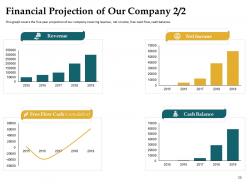
Slide 35: This graph covers the five year projection of our company covering revenue, net income, free cash flow, cash balance.
Slide 36: This is Icons Slide for Market Entry Strategy for Nanotechnology Industry
Slide 37: This slide is titled as Additional Slides
Slide 38: This slide shows Vision, Mission and Goals.
Slide 39: This is About us slide to showcase Company specifications.
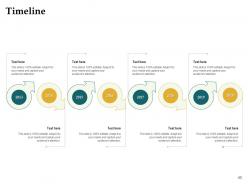
Slide 40: This slide shows Timeline process.
Slide 41: This slide shows Roadmap process.
Slide 42: This is 30 60 90 Days Plan slide.
Slide 43: This slide represents Silhouettes
Slide 44: This is Thank you slide with Contact details.
Market entry strategy for nanotechnology industry powerpoint presentation slides with all 44 slides:
Use our Market Entry Strategy For Nanotechnology Industry Powerpoint Presentation Slides to effectively help you save your valuable time. They are readymade to fit into any presentation structure.
-
Market entry strategy for nanotechnology industry powerpoint presentation slides
-
Market entry strategy for nanotechnology industry powerpoint presentation slides
-
Market entry strategy for nanotechnology industry powerpoint presentation slides
-

Market entry strategy for nanotechnology industry powerpoint presentation slides
-
Market entry strategy for nanotechnology industry powerpoint presentation slides
-

Market entry strategy for nanotechnology industry powerpoint presentation slides
-
Market entry strategy for nanotechnology industry powerpoint presentation slides
-
Market entry strategy for nanotechnology industry powerpoint presentation slides
-
Market entry strategy for nanotechnology industry powerpoint presentation slides
-
Market entry strategy for nanotechnology industry powerpoint presentation slides
-
Market entry strategy for nanotechnology industry powerpoint presentation slides
-
Market entry strategy for nanotechnology industry powerpoint presentation slides
-

Market entry strategy for nanotechnology industry powerpoint presentation slides
-
Market entry strategy for nanotechnology industry powerpoint presentation slides
-

Market entry strategy for nanotechnology industry powerpoint presentation slides
-
Market entry strategy for nanotechnology industry powerpoint presentation slides
-

Market entry strategy for nanotechnology industry powerpoint presentation slides
-
Market entry strategy for nanotechnology industry powerpoint presentation slides
-
Market entry strategy for nanotechnology industry powerpoint presentation slides
-

Market entry strategy for nanotechnology industry powerpoint presentation slides
-
Market entry strategy for nanotechnology industry powerpoint presentation slides
-

Market entry strategy for nanotechnology industry powerpoint presentation slides
-
Market entry strategy for nanotechnology industry powerpoint presentation slides
-
Market entry strategy for nanotechnology industry powerpoint presentation slides
-
Market entry strategy for nanotechnology industry powerpoint presentation slides
-
Market entry strategy for nanotechnology industry powerpoint presentation slides
-

Market entry strategy for nanotechnology industry powerpoint presentation slides
-
Market entry strategy for nanotechnology industry powerpoint presentation slides
-

Market entry strategy for nanotechnology industry powerpoint presentation slides
-
Market entry strategy for nanotechnology industry powerpoint presentation slides
-

Market entry strategy for nanotechnology industry powerpoint presentation slides
-
Market entry strategy for nanotechnology industry powerpoint presentation slides
-

Market entry strategy for nanotechnology industry powerpoint presentation slides
-
Market entry strategy for nanotechnology industry powerpoint presentation slides
-
Market entry strategy for nanotechnology industry powerpoint presentation slides
-
Market entry strategy for nanotechnology industry powerpoint presentation slides
-

Market entry strategy for nanotechnology industry powerpoint presentation slides
-

Market entry strategy for nanotechnology industry powerpoint presentation slides
-

Market entry strategy for nanotechnology industry powerpoint presentation slides
-
Market entry strategy for nanotechnology industry powerpoint presentation slides
-

Market entry strategy for nanotechnology industry powerpoint presentation slides
-

Market entry strategy for nanotechnology industry powerpoint presentation slides
-

Market entry strategy for nanotechnology industry powerpoint presentation slides
-

Market entry strategy for nanotechnology industry powerpoint presentation slides
FAQs for Market entry strategy for nanotechnology industry
Key market trends influencing the nanotechnology industry include increased healthcare applications, sustainable manufacturing processes, electronics miniaturization, energy storage innovations, and regulatory framework development. These trends enable organizations to deliver enhanced medical treatments, reduced environmental impact, and improved product performance, with many companies finding that strategic nanotechnology integration provides significant competitive advantages across multiple sectors.
Companies can effectively assess the nanotechnology competitive landscape by analyzing patent portfolios, monitoring R&D investments, tracking regulatory approvals, evaluating partnership networks, and studying commercialization timelines across target sectors. Through comprehensive competitor intelligence platforms, organizations can identify market gaps, anticipate technological shifts, and benchmark their capabilities against industry leaders, ultimately positioning themselves strategically in emerging applications like healthcare diagnostics, electronics manufacturing, and materials engineering.
Intellectual property rights serve as both strategic assets and competitive barriers for nanotechnology firms, influencing patent portfolios, licensing agreements, market positioning, and entry timing decisions. While strong IP protection enables companies to secure market exclusivity and attract investment, it also requires navigating complex patent landscapes and potential infringement risks, with many firms finding that strategic IP management ultimately delivers sustainable competitive advantage and enhanced valuation in this innovation-driven sector.
A startup can evaluate its technological readiness by assessing its intellectual property portfolio, prototype development stage, manufacturing scalability potential, regulatory compliance capabilities, and competitive differentiation strength. These evaluations enable organizations to identify gaps in research infrastructure, production processes, and market positioning, with many nanotechnology startups finding that strategic partnerships ultimately accelerate market entry while minimizing resource risks.
Critical regulatory considerations include environmental impact assessments, product safety documentation, manufacturing compliance standards, intellectual property protections, and international harmonization requirements across target markets. These regulations vary significantly between sectors like healthcare, electronics, and materials manufacturing, with companies finding that early engagement with regulatory bodies, comprehensive toxicology studies, and strategic partnerships with established players help navigate complex approval processes while minimizing market entry delays.
Companies should approach nanotechnology partnerships through strategic alliances with research institutions, cross-industry collaborations, and joint ventures that combine complementary expertise in materials science, manufacturing, and market applications. These partnerships enable shared R&D costs, accelerated innovation cycles, and enhanced market access, with many organizations finding that collaborative approaches deliver faster commercialization timelines and reduced technical risks.
Effective customer outreach channels in nanotechnology include specialized trade publications, industry conferences, direct B2B sales teams, research partnerships with universities, and targeted digital marketing through LinkedIn and industry platforms. These channels enable companies to reach diverse stakeholders by building credibility through thought leadership, demonstrating applications at sector-specific events, and fostering collaborative relationships, ultimately delivering qualified leads and strategic partnerships.
Market segmentation in nanotechnology enables firms to identify target audiences by analyzing application sectors, customer size, geographic markets, and technology readiness levels. Healthcare companies developing drug delivery systems, electronics manufacturers requiring precise components, and energy firms seeking efficiency solutions represent distinct segments with specific needs, budgets, and procurement processes, ultimately allowing focused marketing strategies and accelerated market penetration.
**INPUT**: What funding opportunities are available for companies seeking to enter the nanotechnology market? **OUTPUT**: Funding opportunities for nanotechnology market entry include government grants, venture capital, angel investors, corporate partnerships, and specialized nanotechnology funds from organizations like the National Science Foundation and Department of Energy. These funding sources enable companies to accelerate research and development, scale manufacturing capabilities, and navigate regulatory requirements, with many startups finding that strategic partnerships with established corporations ultimately deliver both capital and market access advantages. [Word count: 60 words]
Firms balance innovation with market demand in nanotechnology by conducting thorough market research, developing minimum viable products for testing, and maintaining close customer feedback loops throughout development cycles. This strategic approach enables companies to align cutting-edge nanoscale innovations with real-world applications, while pharmaceutical, electronics, and materials companies increasingly find that iterative development reduces risks and accelerates market acceptance.
Best practices for nanotechnology SWOT analysis include evaluating regulatory compliance frameworks, intellectual property portfolios, manufacturing scalability, research partnerships, and competitive positioning within emerging applications. Organizations should assess market readiness across sectors like healthcare, electronics, and materials science, while examining funding accessibility and talent acquisition challenges, ultimately delivering strategic insights that enable informed investment decisions and sustainable competitive advantage in this rapidly evolving industry.
Market entry barriers in nanotechnology can be navigated through strategic partnerships with established players, phased market entry targeting niche applications, robust intellectual property portfolios, and comprehensive regulatory compliance frameworks. Companies increasingly find success by focusing on specific sectors like healthcare diagnostics or electronics manufacturing, while building credibility through pilot programs and industry collaborations, ultimately delivering competitive differentiation and sustainable market positioning.
Sustainability plays a central role in nanotechnology market entry strategies by enhancing regulatory compliance, attracting environmentally conscious investors, and meeting growing consumer demand for eco-friendly solutions. Companies leveraging green nanotechnology applications in water purification, renewable energy, and sustainable materials often find accelerated market acceptance, with sectors like pharmaceuticals and electronics increasingly prioritizing sustainable innovations that deliver both environmental benefits and competitive advantage.
Companies can adapt their marketing strategies by emphasizing nanotechnology's precision capabilities, enhanced performance metrics, cost efficiency benefits, and sustainability advantages through targeted industry messaging. Through sector-specific campaigns, organizations successfully demonstrate measurable outcomes like reduced material usage in manufacturing, improved drug delivery in pharmaceuticals, and enhanced product durability, ultimately delivering competitive differentiation and market leadership.
Optimal pricing for nanotechnology products depends on development costs, intellectual property value, competitive landscape, target market willingness to pay, and regulatory compliance expenses. Manufacturing companies in sectors like electronics, healthcare, and automotive find that value-based pricing often works best, emphasizing performance improvements and cost savings delivered to customers, ultimately enabling premium positioning while maintaining competitive advantage.
-
Great quality product.
-
Unique research projects to present in meeting.
-
Best Representation of topics, really appreciable.
-
Great product with highly impressive and engaging designs.
-
Thanks for all your great templates they have saved me lots of time and accelerate my presentations. Great product, keep them up!
-
Nice and innovative design.
-
It saves your time and decrease your efforts in half.
-
Innovative and Colorful designs.
-
Top Quality presentations that are easily editable.
-
I discovered this website through a google search, the services matched my needs perfectly and the pricing was very reasonable. I was thrilled with the product and the customer service. I will definitely use their slides again for my presentations and recommend them to other colleagues.