


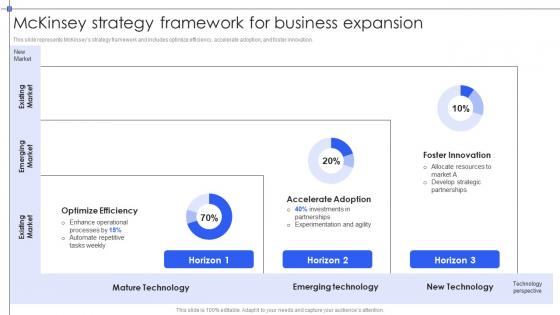
Mckinsey Strategy Framework For Business Expansion




Try Before you Buy Download Free Sample Product
 Impress Your
 Audience
 100%
100% Editable
 Save Hours
 of Time


This slide represents McKinseys strategy framework and includes optimize efficiency, accelerate adoption, and foster innovation.
People who downloaded this PowerPoint presentation also viewed the following :
Mckinsey Strategy Framework For Business Expansion with all 10 slides:
Use our Mckinsey Strategy Framework For Business Expansion to effectively help you save your valuable time. They are readymade to fit into any presentation structure.








FAQs for Mckinsey Strategy Framework
The McKinsey Strategy Framework comprises three core components: strategic position assessment, strategic choice evaluation, and implementation planning with performance tracking. These interconnected elements enable organizations to analyze competitive landscapes, evaluate multiple strategic options, and execute decisions systematically, with many corporations finding that this structured approach ultimately delivers measurable competitive advantage and sustainable growth.
The McKinsey 7S Framework enhances organizational performance by aligning strategy, structure, systems, shared values, skills, style, and staff into a cohesive operational model. This strategic alignment streamlines decision-making, eliminates organizational silos, and accelerates execution, with many companies finding that synchronized elements deliver improved efficiency, faster market responsiveness, and sustained competitive advantage.
The McKinsey Strategy Framework adapts for digital transformation through strategic pillar assessment, capability gap analysis, technology roadmap development, organizational change management, and performance metric alignment. Digital-focused organizations leverage this structured approach to evaluate current digital maturity, prioritize automation investments, and streamline implementation timelines, ultimately delivering enhanced operational efficiency and competitive advantage in increasingly technology-driven markets.
The McKinsey Strategy Framework assists alignment by systematically evaluating organizational capabilities against strategic objectives, identifying performance gaps, and creating structured implementation roadmaps. Through capability assessments and resource mapping, companies in manufacturing, healthcare, and financial services streamline operations, optimize resource allocation, and enhance execution efficiency, ultimately delivering measurable performance improvements and sustained competitive advantage.
Stakeholder analysis within the McKinsey Strategy Framework identifies key internal and external parties, assesses their influence and interests, and maps their potential impact on strategic initiatives. This systematic evaluation enables organizations to anticipate resistance, build coalition support, and design implementation approaches that address stakeholder concerns, ultimately ensuring smoother strategy execution and higher success rates.
Businesses leverage the McKinsey Strategy Framework for market entry by systematically evaluating market attractiveness, competitive positioning, and internal capabilities through structured analysis tools. This approach enables companies to assess entry barriers, competitive dynamics, and resource requirements across sectors like retail expansion or technology markets, ultimately delivering data-driven entry strategies that minimize risk while maximizing competitive advantage.
Tools that complement the McKinsey Strategy Framework include SWOT analysis, Porter's Five Forces, balanced scorecards, scenario planning, and value chain analysis. These methodologies enhance strategic planning by providing deeper market insights, competitive positioning, and performance measurement capabilities, with many consulting firms and corporations finding that combining multiple frameworks delivers more comprehensive strategic assessments and actionable business recommendations.
The McKinsey Strategy Framework addresses competitive analysis through industry structure assessment, competitor positioning evaluation, and market dynamics analysis, enabling comprehensive competitive landscape understanding. This systematic approach helps organizations identify competitive advantages, anticipate market shifts, and develop strategic responses, with many consulting firms finding that structured competitive analysis ultimately delivers enhanced market positioning and sustainable competitive differentiation.
The McKinsey Strategy Framework delivers structured change management through clear diagnostic tools, stakeholder alignment processes, and phased implementation roadmaps that minimize resistance and maximize adoption rates. Organizations across industries, from manufacturing to financial services, find that this systematic approach accelerates transformation timelines, reduces implementation risks, and ultimately enhances operational efficiency while delivering measurable competitive advantages.
Organizations measure strategy effectiveness through key performance indicators aligned with framework objectives, regular milestone assessments, financial metrics like ROI and revenue growth, and stakeholder feedback mechanisms. Many companies establish quarterly review cycles that track both quantitative outcomes and qualitative progress, while conducting post-implementation analyses to refine future strategic initiatives, ultimately delivering measurable competitive advantage and sustainable growth.
The McKinsey Strategy Framework may be less effective in highly volatile markets, startups requiring rapid pivoting, creative industries where innovation trumps structure, and situations demanding immediate crisis response rather than systematic analysis. While comprehensive strategic planning delivers competitive advantage, organizations facing disruptive technologies, regulatory upheaval, or resource constraints often find that streamlined, agile approaches enable faster adaptation and market responsiveness.
Small and medium enterprises can utilize the McKinsey Strategy Framework by adapting its structured problem-solving approach, hypothesis-driven analysis, and MECE (mutually exclusive, collectively exhaustive) principles to their scale and resources. These methodologies enable SMEs to systematically analyze market opportunities, optimize operational efficiency, and develop strategic roadmaps, with many finding significant improvements in decision-making speed and competitive positioning.
**INPUT**: What training or resources are recommended for teams implementing the McKinsey Strategy Framework? **OUTPUT**: Recommended training includes structured problem-solving workshops, case study analysis sessions, MECE principle development, and hypothesis-driven thinking modules. These educational approaches enhance strategic capabilities by building analytical rigor, improving decision-making frameworks, and developing systematic thinking skills, with many organizations finding that comprehensive training ultimately delivers faster strategy execution and more effective cross-functional collaboration. [Word count: 56 words]
Common challenges include aligning diverse stakeholder perspectives, gathering comprehensive market data, managing implementation complexity, and maintaining strategic focus during execution phases. Many organizations find that while the framework provides structured analysis, translating insights into actionable initiatives requires significant change management capabilities, cross-functional collaboration, and sustained leadership commitment to achieve meaningful competitive advantage.
McKinsey's structured problem-solving approach integrates with agile methodologies by providing strategic direction during sprint planning, hypothesis-driven testing in iterative cycles, and data-backed decision points at each agile milestone. This strategic combination enables teams to maintain long-term vision while adapting quickly to market changes, with many organizations finding that structured frameworks enhance agile velocity and deliver more focused outcomes.
-
Excellent Designs.
-
You know what? I'm so glad I opted for this PPT design. It has been a total game-changer for me and my presentations. Thank you!