


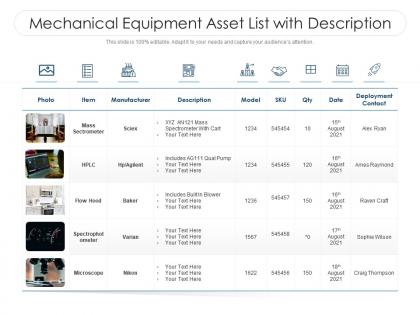
Mechanical equipment asset list with description




Try Before you Buy Download Free Sample Product
 Impress Your
 Audience
 100%
100% Editable
 Save Hours
 of Time


Our Mechanical Equipment Asset List With Description are topically designed to provide an attractive backdrop to any subject. Use them to look like a presentation pro.
People who downloaded this PowerPoint presentation also viewed the following :
Mechanical equipment asset list with description with all 2 slides:
Use our Mechanical Equipment Asset List With Description to effectively help you save your valuable time. They are readymade to fit into any presentation structure.
FAQs for Mechanical equipment asset
Honestly, start with cataloging what you actually own - most people think they can skip this but it always bites them later. Build your preventive maintenance around manufacturer specs and how hard you're running things. Real-time monitoring catches problems early, whether that's sensors or just regular walk-throughs. Track your total costs too so you'll know when something's worth fixing vs. replacing. The whole thing falls apart without good data though. Once you've got accurate asset info, everything else gets way easier. Oh, and don't overthink the condition monitoring part - even basic inspections beat flying blind.
Dude, predictive maintenance is a game changer - you catch problems way before stuff actually breaks down. Sensors and vibration analysis show you early warning signs instead of waiting for catastrophic failure. Your equipment lasts so much longer this way, honestly. You fix things during planned downtime rather than scrambling with emergency repairs, which is way less stressful on components. Oh, and you replace parts based on their actual condition instead of some random schedule. Start with your most critical equipment first - that's where you'll see the biggest impact. The data doesn't lie.
Dude, tech has completely changed the game for managing equipment. Those IoT sensors? They track vibration and temperature so you can catch problems before stuff breaks down. CMMS platforms are clutch - all your maintenance schedules and work orders in one spot instead of digging through random paperwork. Machine learning analyzes everything to figure out the best maintenance timing. Honestly, the analytics part is what really sold me on it. You're making decisions based on real data instead of just winging it. My advice? Pick one system first and expand from there. Don't try to do everything at once.
Look, compliance sounds like a pain but it actually makes you way more organized with your equipment. You'll have to document everything - maintenance schedules, inspections, how stuff's holding up. Oil & gas, manufacturing, utilities - they don't mess around with this. Get caught slacking and you're looking at massive fines or they'll shut you down completely. Here's the weird part though: following all these rules usually means your equipment breaks down less. I'd start by figuring out which regulations hit your specific gear, then build your maintenance around that.
Honestly, start with availability and reliability - those are your bread and butter metrics. Availability shows your uptime, reliability tracks mean time between failures. Then add maintenance cost ratio (what you're spending vs what it'd cost to replace the whole thing). OEE is pretty much everywhere these days, so might as well jump on that bandwagon if you want the complete picture. Oh, and definitely watch your planned vs unplanned maintenance ratio - tells you real quick if you're just putting out fires all day. Those five should give you enough data to catch problems before they drain your budget.
Pick software that actually plays nice with what you're already using - barcode or RFID, whatever works. Honestly, half these systems are total garbage once you try using them in real life, so test the scanning part first. Get your data fields and numbering sorted out before you tag anything (learned that one the hard way). Training is huge - everyone needs to know the check-in/check-out drill, and someone's gotta own each category of stuff. Focus on your most important assets first. Once people see it working, they'll stop complaining about the new process.
Honestly, the worst part is when equipment just dies on you out of nowhere - total nightmare. Your old machines are falling apart but replacing them costs a fortune. Can't see what's actually happening with your assets either, which makes everything harder. Skills are another mess - good techs retire and suddenly you're scrambling. Compliance keeps changing too, because why wouldn't it? Everyone wants you to squeeze more life out of equipment while staying safe. Start with some decent monitoring systems first - at least then you'll know what's breaking before it actually does. Gives you time to think instead of just reacting constantly.
Dude, these IoT sensors are game-changers. They monitor vibration, temp, pressure - all that stuff 24/7 so you're not flying blind anymore. No more guessing when equipment might fail or doing maintenance "just because." The data shows you exactly when parts start wearing down, which honestly beats the old-school approach by miles. Analytics can spot trouble weeks ahead, so you schedule fixes during downtime instead of scrambling during emergencies. My advice? Start with your most critical gear - even basic temp sensors on important motors will save your butt later.
Think of lifecycle management as your game plan for squeezing every bit of value out of your equipment. Track acquisition costs, maintenance schedules, performance trends - all that stuff. Most companies just wait for things to break, which is honestly pretty dumb. With proper lifecycle tracking, you'll predict when major repairs are coming and budget for replacements before catastrophic failures mess up your whole schedule. Oh, and those surprise breakdowns that everyone hates? Way fewer of those. Start by figuring out where your critical assets stand right now in their lifespan.
Look, data analytics just takes all that equipment info you're already collecting and turns it into something you can actually use. Check the vibration readings and temperature logs - you'll start seeing patterns that tell you when stuff's about to break. Way better than playing the guessing game, honestly. Plus you can finally ditch those "maintenance every 6 months whether it needs it or not" schedules. Figure out what decisions you're making all the time first. Then see what data might help you not wing it so much. Trust me, having actual numbers when you need budget approval makes everything easier.
Start with a full inventory of everything - pumps, motors, HVAC, all of it. Document condition, age, maintenance history, performance data. Honestly, just walk the whole facility because stuff always gets missed on spreadsheets. Check if your maintenance schedules actually make sense and spot equipment that's bleeding money on repairs. I'd do quarterly audits for critical stuff, yearly for the rest. The whole point is catching problems before they bite you instead of scrambling when things break down. My old boss used to say "reactive maintenance is expensive maintenance" and he wasn't wrong.
Look, training is honestly a game-changer for asset management. Your techs start catching problems way before they turn into massive headaches. Better decisions, fewer breakdowns - you know the drill. Equipment lasts longer when people actually know what they're doing with it. Safety improves too, which obviously matters. The payback usually shows up within a year, sometimes sooner. My advice? Don't try to train on everything at once - that's just overwhelming. Figure out where your team's struggling most and hit those areas first. Way more effective.
Dude, your equipment choices totally mess with your profit margins. Repair vs replace? That's always about weighing quick cash hits against whether the thing will actually work long-term. I've watched companies get absolutely crushed by surprise breakdowns - their budgets just imploded from emergency fixes. Energy bills, labor, compliance stuff - it all adds up fast. You really can't just look at sticker prices either. The whole lifetime cost matters way more. Honestly, most people skip the systematic planning part and that's where they screw themselves. Short-term thinking kills budgets.
Honestly, remote monitoring is pretty sweet - you get eyes on all your equipment without actually being there. Track stuff like vibrations, temps, pressure, whatever matters most. The cool part? You'll spot problems way before they turn into expensive disasters. No more guessing games about maintenance schedules since you've got real data showing when things start acting up. I mean, beats the old "fix it when it breaks" approach by miles. You can watch multiple sites from your desk too, which cuts down on all that driving around. My advice? Pick your most important equipment first and test it out there.
Look, industry standards basically become your maintenance bible. ISO 55000, API, ASME - they're total lifesavers when you're figuring out where to start. These give you proven methods for inspection schedules, failure analysis, all that stuff. You'll want to match your maintenance intervals and condition monitoring to whatever standards fit your assets. They keep you compliant and help benchmark against what everyone else is doing. Honestly, some of the documentation is pretty dry, but the frameworks are solid. Just find which standards apply to your specific equipment first, then use those as your roadmap for building out processes.
-
Graphics are very appealing to eyes.
-
Designs have enough space to add content.
-
Very well designed and informative templates.
-
I discovered this website through a google search, the services matched my needs perfectly and the pricing was very reasonable. I was thrilled with the product and the customer service. I will definitely use their slides again for my presentations and recommend them to other colleagues.
-
Great product with highly impressive and engaging designs.
-
Design layout is very impressive.