

Diapositives de présentation Powerpoint de proposition de développement d'applications mobiles






Try Before you Buy Download Free Sample Product
 Impress Your
Audience
 100%
Editable
 Save Hours
of Time


Présentez vos services de manière élaborée et persuadez vos clients en incorporant nos diapositives de présentation PowerPoint de proposition de développement d'applications mobiles très avantageuses. Vous pouvez mettre en évidence les options de développement d'applications, les fonctionnalités et les limites pour informer vos prospects de l'importance des services proposés par votre entreprise. Montrez votre excellence dans la création d'une application pour téléphone portable en incorporant ce deck complet PPT d'accord d'application mobile conçu par des professionnels. Vous pouvez mentionner les objectifs de votre entreprise, tels qu'une interface utilisateur efficace et un design attrayant qui correspond à l'image de marque du client. En outre, vous pouvez répertorier les défis rencontrés par les utilisateurs finaux et les solutions recommandées par votre entreprise. À l'aide de notre thème PowerPoint de contrat de développement d'applications Web, des services tels que le test en temps réel de l'application sur différentes plates-formes et l'amélioration de la visibilité de l'application auprès du public peuvent être expliqués efficacement aux clients. Les sujets abordés dans cet exemple de diaporama PowerPoint d'offre d'application mobile incluent des livrables tels que les buts du projet, les objectifs, les capacités, la procédure, le calendrier, l'investissement, les témoignages de clients, la vue d'ensemble de l'organisation, etc. feuille de route avec des phases à savoir découverte, fonctionnalités et architecture, conception, développement, assurance qualité, lancement et marketing, etc. Vous pouvez indiquer le calendrier que votre organisation propose pour l'achèvement des différentes étapes du processus et l'estimation des dépenses à vos clients dans notre application accord de développement thème PPT. Ce graphique PPT d'offre de développement d'applications mobiles de commerce électronique peut être téléchargé pour convaincre vos prospects et augmenter vos revenus de manière multiple.
People who downloaded this PowerPoint presentation also viewed the following :
Contenu de cette présentation Powerpoint
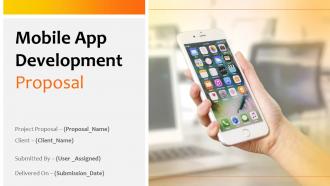
Diapositive 1 : Cette diapositive présente la proposition de développement d'applications mobiles. Indiquez le nom de la proposition, le nom du client, le nom d'utilisateur et la date de soumission.
Diapositive 2 : Cette diapositive affiche la lettre de motivation.
Diapositive 3 : Cette diapositive affiche la table des matières de la présentation.
Diapositive 4 : Cette diapositive représente l'aperçu du projet avec le contexte du projet et les objectifs du projet.
Diapositive 5 : Cette diapositive présente le contexte du projet pour la proposition de développement d'applications mobiles.
Diapositive 6 : Cette diapositive décrit les objectifs du projet pour la proposition de développement d'applications mobiles.
Diapositive 7 : Cette diapositive décrit nos capacités avec - l'offre de services, notre processus, le calendrier.
Diapositive 8 : Cette diapositive présente l'offre de services avec application Web mobile, application hybride, application native.
Diapositive 9 : Cette diapositive présente notre processus contenant la découverte, les fonctionnalités et l'architecture, la conception, le développement, l'assurance qualité, le lancement et la commercialisation, la maintenance, la formation et le support.
Diapositive 10 : Cette diapositive décrit le calendrier pour le développement d'applications mobiles.
Diapositive 11 : Cette diapositive décrit également le calendrier de la proposition de développement d'applications mobiles.
Diapositive 12 : Cette diapositive présente votre investissement pour afficher des informations connexes.
Diapositive 13 : Cette diapositive présente votre investissement pour présenter les informations connexes.
Diapositive 14 : Cette diapositive se poursuit avec votre proposition d'investissement pour le développement d'applications mobiles.
Diapositive 15 : Cette diapositive présente l'aperçu de l'entreprise.
Diapositive 16 : Cette diapositive décrit pourquoi nous pour la proposition de développement d'applications mobiles.
Diapositive 17 : Ceci est la diapositive À propos de nous pour présenter des informations sur l'entreprise.
Diapositive 18 : Ceci est la diapositive Notre équipe avec les noms et les désignations.
Diapositive 19 : Ceci est également la diapositive Notre équipe avec les noms et les désignations.
Diapositive 20 : Cette diapositive représente notre expérience passée.
Diapositive 21 : Cette diapositive affiche des témoignages de clients avec des noms et des désignations.
Diapositive 22 : Cette diapositive présente des témoignages de clients avec des noms et des désignations.
Diapositive 23 : Cette diapositive présente une étude de cas pour une proposition de développement d'applications mobiles.
Diapositive 24 : Cette diapositive illustre l'énoncé des travaux et le contrat.
Diapositive 25 : Cette diapositive présente l'énoncé des travaux et le contrat pour la proposition de développement d'applications mobiles
Diapositive 26 : Cette diapositive présente les prochaines étapes.
Diapositive 27 : Cette diapositive décrit également les prochaines étapes de la proposition de développement d'applications mobiles.
Diapositive 28 : Il s'agit de la diapositive Contactez-nous avec l'adresse, le numéro de contact et l'adresse e-mail.
Diapositive 29 : Cette diapositive est intitulée Diapositives supplémentaires pour aller de l'avant.
Diapositive 30 : Ceci est la diapositive À propos de nous avec des informations sur l'entreprise.
Diapositive 31 : Ceci est la diapositive Notre mission avec vision, objectif et mission.
Diapositive 32 : Ceci est la diapositive de la chronologie.
Diapositive 33 : Il s'agit de la diapositive du plan 30 60 90 jours.
Diapositive 34 : Cette diapositive présente la feuille de route pour le flux de processus.
Diapositives de présentation PowerPoint de proposition de développement d'applications mobiles avec les 34 diapositives :
Vous avez la foi et la foi en vos plans futuristes. Présentez-les à votre équipe avec nos diapositives de présentation Powerpoint de proposition de développement d'applications mobiles.


FAQs for Mobile app development proposal
Start with the technical basics - scope, timeline, tech stack, team setup. Budget breakdown and deliverables come next. Your development process matters too. Definitely throw in wireframes or mockups if you've got them - clients go crazy for visuals. Post-launch support is huge because everyone forgets about app store maintenance until they're screwed. I always add competitor analysis to look like I actually researched stuff. Oh, and pricing needs to be super transparent. Hidden fees kill deals faster than anything else. That's honestly where most proposals succeed or tank.
Dude, your timeline is literally make-or-break for the whole thing. Rush it and your team starts skipping tests, pushing buggy code that'll destroy your ratings. Developers get burned out too - seen way too many good people quit over impossible deadlines. But here's the thing, go too slow and suddenly everyone's adding "just one more feature" until you're way over budget. I always tell people to add like 25% extra time to whatever they think it'll take. Mobile stuff always has weird surprises. Find that middle ground where there's pressure but not panic.
Scope and platform choice are gonna be your biggest factors - iOS, Android, or both? Complex features like integrations and custom stuff obviously cost more. Testing is where people always get burned though, that plus ongoing support can tack on like 30% easy. App store fees, third-party services, all that adds up too. Oh and scope creep is real - clients always want "just one more thing." I'd honestly pad whatever number you land on by 20-25% minimum. Something weird always pops up that nobody saw coming.
Honestly, you've gotta get way more specific than just "millennials with phones" - that's like half the planet lol. Dig into actual demographics, behaviors, and what's bugging them daily. What age ranges? How tech-savvy are they really? What problems keep them up at night? Interview real people or stalk competitor reviews to build solid user personas. Your whole dev strategy depends on this stuff. UI choices, which features to build first, how you'll market it - everything flows from knowing your audience. I've seen too many apps fail because they thought they knew their users but never actually talked to them.
Honestly, start with surveys and interviews - nothing beats hearing directly from people who'd actually use your app. Check out competitor apps too, see what they're doing right or wrong. App store reviews are where it's at though, people get brutally honest there about what sucks. Focus groups work if you can swing them, or just test a basic prototype with friends. Oh and if you already have data from other platforms, definitely use that. Pick like 2-3 of these methods and you'll have a pretty solid case to present.
Start with platforms - iOS, Android, or both? That's gonna drive everything else. Native means Swift/Objective-C for iOS, Kotlin/Java for Android. React Native or Flutter save tons of time if you're working with a tight budget (honestly, cross-platform is pretty solid these days). You'll need backend stuff too - Node.js, Firebase, AWS for APIs and data. Oh, and definitely mention testing frameworks and your CI/CD setup. Clients eat that quality assurance talk up. Just match the tech stack to what they actually need, not whatever's trending on Twitter.
Dude, skip the fancy talk and just show them what you've built. Screenshots from your best apps are everything - especially if they're similar to what this client wants. Throw in some real numbers too, like downloads or ratings, because clients go crazy for that stuff. The tech stack you used? Yeah, mention it briefly. Any certifications or awards your team has are worth including, but don't go overboard. I always pick like 2-3 portfolio pieces that actually match what they're asking for. Trust me, your actual work sells way better than promises ever will.
So first thing - wireframes, then get sign-off on the UI/UX designs. After that, tackle each major feature's core functionality one by one. Testing is gonna be brutal (it always takes way longer than you plan for), so build in separate milestones for beta release, user acceptance testing, and app store deployment. Each milestone needs concrete deliverables your client can actually review. I learned this the hard way - space them like 2-3 weeks apart tops. Otherwise scope creep sneaks up on you and suddenly your timeline's completely shot.
Dude, UX can literally make or break your app. I've watched so many promising apps crash and burn just because navigating them felt like solving a puzzle - super frustrating to see. Users will bail in like 3 seconds if they can't figure out what to do. Good design keeps people around longer, cuts down on angry support emails, and gets you way better ratings. You want that intuitive feel where people just *get* it without thinking. Oh and definitely budget for actual UX people from the start. Don't try to slap it on later - trust me, you'll regret it.
So basically, you don't want to pitch something that already exists everywhere. Download like 5-10 apps that do similar stuff and actually use them - not just look at screenshots. See what they're charging, what features people love vs. hate in reviews. Honestly, it's kind of depressing how many "brilliant" ideas are already out there lol. But this research helps you figure out what's missing and how to make yours different. You'll know what features to focus on first. Plus it gives you real examples when you're explaining why your app won't flop like the others.
Okay so basically you want to call out the big risks right upfront. Technical stuff first - API changes, device compatibility, third-party services crashing. Then show your backup plans for each one. Budget-wise, definitely pad it with 15-20% extra because scope creep is inevitable (learned this the hard way). Timeline risks matter too - map out dependencies and where things might get stuck. Oh and team risks! What happens if your lead dev bails halfway through? The whole point is being honest about what could blow up and proving you've actually thought through how to handle it.
So for monetizing your app, I'd go with freemium first - give away basic stuff, charge for the good features like analytics or extra storage. Subscriptions are honestly where it's at though, that recurring revenue is *chef's kiss*. You can also do in-app purchases for consumables or unlocking content. Ads work but don't make them annoying - learned that the hard way with another project. Start freemium to get users hooked, then once they see the value you can hit them with subscription options. That's been the winning combo for most apps I've seen blow up.
Dude, you gotta get way more specific than just "better user experience" - that's basically meaningless fluff. Break it down into actual numbers: "cut checkout time by 30%" or "boost daily users by 25% in 6 months." Think about it from both angles too - what you're fixing for users AND what the business gets out of it (money, retention, whatever). The whole point is making everything measurable so you can actually prove it worked later. Honestly, stakeholders eat up concrete numbers way more than vague promises. Give them something they can visualize and get pumped about.
So downloads are obvious, but retention is where the magic happens - check your 1, 7, and 30 day numbers religiously. Session length matters too. People don't keep opening apps they hate, you know? App store reviews are huge for discoverability. Crash rates will destroy you faster than anything else though - learned that one the hard way. If you're trying to make money, definitely track conversions. Oh and set up analytics before you launch! I always forget this step and then spend forever trying to backtrack data. Such a pain.
Get customer feedback and weave it straight into your proposal - shows you're actually listening. Survey your current users about what sucks, then call out those exact problems. Nothing makes me cringe more than generic proposals that could be for literally any app. Throw in real quotes from user interviews to back up your features. User personas work great too if they're based on actual feedback patterns you've spotted. Honestly, it stops feeling like you're just trying to sell them something. More like you've done your homework already. Start gathering that stuff now before you lock everything down.
-
Informative design.
-
Great product with highly impressive and engaging designs.
-
Understandable and informative presentation.
-
Super
-
Super