


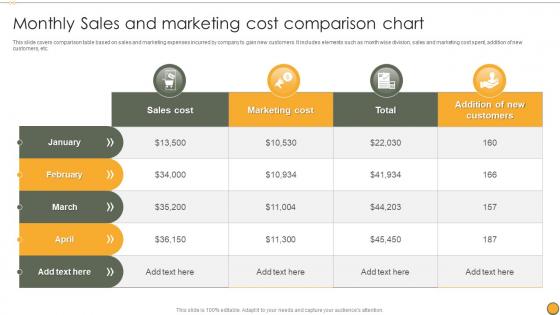
Monthly Sales And Marketing Cost Comparison Chart




Try Before you Buy Download Free Sample Product
 Impress Your
 Audience
 100%
100% Editable
 Save Hours
 of Time


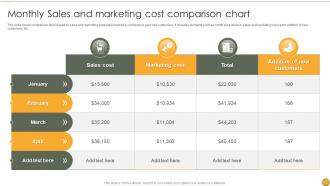
This slide covers comparison table based on sales and marketing expenses incurred by company to gain new customers. It includes elements such as month wise division, sales and marketing cost spent, addition of new customers, etc.
People who downloaded this PowerPoint presentation also viewed the following :
Monthly Sales And Marketing Cost Comparison Chart with all 6 slides:
Use our Monthly Sales And Marketing Cost Comparison Chart to effectively help you save your valuable time. They are readymade to fit into any presentation structure.





FAQs for Monthly Sales And Marketing
So you've got the obvious stuff - salaries, commissions, benefits for your sales and marketing people. Then advertising, lead gen tools, CRM software, trade shows. Content creation too. But honestly, the little things kill you - business meals, travel, all those marketing materials. Training new hires is expensive and most people forget about that. Third-party agencies or freelancers you're paying? Yeah, track those separately. Actually, track everything in different buckets so you can figure out what's working and what isn't. Trust me on this one.
Get your tracking sorted from the start - trust me on this. Use your CRM for sales costs and set up marketing automation to watch campaign spend. Our CAC went crazy once because we had zero visibility into what was happening. Break it down by channel so you actually know if Instagram's working better than email or whatever. Track cost per lead and ROI for each campaign. Then here's the key part - sit down monthly with your team and use the data to decide where your money goes next quarter. Otherwise you're just throwing cash around hoping something sticks.
Honestly, tech is gonna save you so much headache here. CRM systems show you which leads actually turn into money instead of just sitting there. Marketing automation handles the follow-up stuff automatically - game changer. Analytics tools? They'll tell you exactly which campaigns are worth it vs total money pits. AI's getting pretty wild at predicting what customers will do next too. Stop guessing and start using actual data to figure out what's working. Look at your current tools first and find that one blind spot where you're just winging it. Then grab something to fix it.
Dude, track everything. Seriously - if you can't measure ROI, you're basically throwing money into a black hole. Most small biz owners do this "spray and pray" thing with ads when they should just focus on what actually converts. Email marketing is your best friend, way cheaper than paid ads. Social media engagement works too if you're consistent about it. Oh, and don't sleep on referral programs - people trust their friends more than your fancy marketing anyway. I've seen friends barter services instead of paying cash when they're tight on budget. Start small, test what works, then do more of that stuff.
Track your CAC and CLV first - those are make-or-break numbers. The CLV-to-CAC ratio tells you if you're actually profitable. Revenue attribution shows which channels aren't just burning money, and conversion rates help you spot where people drop off. Here's the thing though - don't get caught up chasing tons of leads if they're trash quality. I'd rather have 50 solid MQLs than 200 garbage ones. Check your MQL to SQL conversion rates monthly. Oh, and make sure your CAC payback period doesn't exceed your cash runway or you'll be in trouble.
Dude, this varies SO much by industry it's crazy. SaaS companies basically light money on fire - like 40-50% of revenue goes to sales and marketing. Manufacturing's way more chill at 5-10%. Tech startups? Don't even get me started, some of them spend ridiculous amounts when they're trying to grow fast. Consumer goods hit around 15-25%, B2B services usually land at 20-30%. It really depends on how hard it is to get customers in your space. You should definitely look up benchmarks for your specific industry though - way more useful than generic numbers.
Honestly, content marketing and email are where I'd put my money first. Blog posts, social media content - that stuff actually works. Email to people who already know you is gold. SEO takes forever but it's free traffic once it kicks in. Social media is weird though - it can totally eat your time if you're not strategic about it. Don't try to be on every platform. Just pick where your people actually are and get good at that first. I'd say commit to one thing for a month before you decide if it's working. Otherwise you'll just keep bouncing around.
Okay so here's the deal with content marketing - it's way cheaper than running ads because you're attracting people who actually want to hear from you. Instead of interrupting someone scrolling Instagram, they're finding you through Google searches or friend recommendations. The best part? That blog post you write today will still bring in leads next year, while paid ads die the moment you stop paying. I always tell people to start with whatever question customers ask you most - just answer that really well. Your sales team will love you too since these leads already know what you do and aren't total cold contacts.
Look, CAC basically eats your profits alive - the more you spend getting customers, the longer you wait to see that money back. You've gotta compare it to lifetime value (CLV) to know if you're even making money. Most people say aim for 3:1 CLV to CAC, but honestly? That's tough when you're scaling fast and ads are expensive. High CAC will kill your cash flow even when everything looks good on spreadsheets. I'd track it every month and focus on whatever channels convert best first. Just don't get too obsessed with perfect ratios early on.
Dude, social media is honestly a game-changer for cutting costs. Instead of blowing money on expensive TV ads, you can post organic content and run targeted ads for way cheaper. Building relationships directly with customers through comments and stories? It's basically a free focus group that actually responds. The magic happens when people share your stuff - free word-of-mouth right there. You can target super specific audiences without those crazy minimum spends traditional media demands. Oh, and pick ONE platform where your customers actually are. Don't spread yourself thin. Focus on posting valuable content consistently there first.
Look, budgeting saves you from doing stupid stuff with your money. I've watched teams blow their whole quarter's budget on some fancy campaign in like two weeks - total disaster. You need to know your customer lifetime value first, then figure out what you can actually spend per lead. Map everything back to your sales targets so you're not just guessing. Otherwise you're basically gambling with company money. The budget becomes your reality check when someone pitches the next "amazing" idea that costs way too much.
Dude, automation is a game changer for cutting those manual marketing costs. Email sequences, social media posts, lead scoring - all that tedious stuff gets handled without you babysitting it. Set up the workflows once and you're golden. Your team stops doing mind-numbing tasks and actually gets to work on strategy and creative stuff instead. Honestly, clicking "send" fifty times a day makes me want to scream. The payback happens pretty fast too. I'd start with whatever's eating up the most time - probably email campaigns? Then just build from there as you get comfortable with it.
Oh man, vanity metrics will absolutely wreck you - like getting excited about impressions when your bank account says otherwise. Attribution is another nightmare. Half the time you can't even figure out which ads actually made you money, so you keep throwing cash at stuff that doesn't work. And honestly? Everyone gets shiny object syndrome with new platforms. Just because your competitor posted a TikTok doesn't mean you need to be there too. I'd stick to maybe 2-3 channels tops. Track everything back to real sales, not just clicks. Resist the urge to be everywhere - that spray and pray thing never works.
Honestly, just follow where your customers actually hang out and what's bringing in real money. Track which channels get you actual leads that convert - forget about clicks and all that surface-level stuff. Digital's usually easier to track and you can change direction fast when things aren't working, but there's something to be said for offline building real trust with people. I'd test small amounts everywhere first, then throw more money at whatever's actually working. Focus on ROI, not the vanity numbers that look pretty but don't pay bills.
Look, cutting sales and marketing budgets is like shooting yourself in the foot. Your competitors will crush you while you're penny-pinching. Market share drops, nobody knows your brand exists, and good luck getting new customers. It's this brutal cycle too - less money coming in means even smaller marketing budgets next year. Plus your best salespeople will bail for companies that actually give them decent tools and support. Honestly, I've seen this kill businesses faster than almost anything else. Track your customer costs and lifetime value, then spend whatever it takes to at least hold your ground.
-
Best Representation of topics, really appreciable.
-
Great combination of visuals and information. Glad I purchased your subscription.