

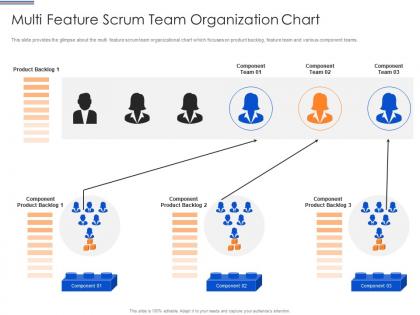
Multi feature scrum team organization chart scrum team organization chart it




Try Before you Buy Download Free Sample Product
 Impress Your
 Audience
 100%
100% Editable
 Save Hours
 of Time


This slide provides the glimpse about the multi feature scrum team organizational chart which focuses on product backlog, feature team and various component teams.
People who downloaded this PowerPoint presentation also viewed the following :
Multi feature scrum team organization chart scrum team organization chart it with all 2 slides:
Use our Multi Feature Scrum Team Organization Chart Scrum Team Organization Chart IT to effectively help you save your valuable time. They are readymade to fit into any presentation structure.
FAQs for Multi feature scrum team organization chart scrum team
So your Product Owner handles prioritizing stuff across all the features - pretty much the main decision maker. Each feature squad usually gets their own Scrum Master, though sometimes one covers multiple teams. Developers should be cross-functional so they can hop between features when needed. The Scrum Masters need to sync up daily or you'll get messy dependencies. Trust me on this one. Cross-team retrospectives help catch integration problems before they blow up. Oh, and make sure communication flows well between squads - that's honestly half the battle right there.
Okay so basically you mix people with different skills instead of putting all the payment folks together, UI people together, etc. Get developers who can jump between features - someone who knows both payments AND interface stuff. Honestly it's a total mess initially compared to specialized teams, but trust me on this. Rotate people through different features each sprint, do pair programming, knowledge shares, the usual. Map out what skills each feature needs first, then figure out where you're missing people. The whole point is having someone on the team who can tackle any feature you're stuck with.
Honestly, it comes down to whether you want speed or flexibility. Dedicated teams are great - they know their stuff inside and out, ship features fast. But god, when priorities change (and they always do), you're screwed. Multi-feature teams can actually pivot without all the territorial BS. Sure, they might take longer to get up to speed on complex stuff since everyone knows a little about everything instead of being the expert. But if your roadmap's constantly shifting or features need to work together, go multi-feature. Way less headache.
So basically your org chart gets way flatter and messier when you scale Scrum. Multiple Product Owners have to coordinate constantly, Scrum Masters collaborate across teams, and dev teams actually chat with each other daily. Teams become self-organizing which looks chaotic at first - I won't lie, it's overwhelming initially. You'll add new roles like Release Train Engineers to help coordinate everything. The trick is mapping communication flows, not just who reports to who. Honestly, forget the traditional pyramid structure entirely. Start by figuring out which teams need daily contact with each other.
Honestly, I'd go with Miro for multi-team Scrum stuff. Super collaborative and doesn't make you want to throw your laptop when things get messy. Lucidchart's solid too - both handle cross-team dependencies way better than most tools. Visio's fine if you're already drowning in Microsoft everything, but it feels clunky for agile work. Draw.io or Figma work for simpler setups. The real trick is finding something everyone can actually edit without losing their minds, since you'll be updating these charts constantly. Start with Miro though - it just gets how chaotic multi-feature teams actually are.
So you want those T-shaped people - broad skills but deep in one area. Cross-train your specialists so they can help outside their main thing. Keep at least one expert per critical skill on each team though. Pair programming works really well for this, plus knowledge sharing sessions. Honestly, the Swiss Army knife analogy is overused but it fits here - each tool actually needs to be good! Don't try making everyone identical. Just kill those single points of failure. I'd start by finding your biggest knowledge gaps first, then create rotation plans around those.
Ugh, the worst part is definitely info silos. Everyone gets tunnel vision on their own feature and stops talking to other teams. You'll get duplicate work, conflicting decisions, the whole mess. Dependencies between features become absolute chaos when teams aren't syncing up regularly. Standups turn into these endless novels too - honestly, some people need to learn when to shut up. Set up cross-team liaisons and maybe some shared ceremonies. Visual boards help a ton for showing how everything connects. Trust me, invest in that early before things get really messy.
Your Scrum Master needs to run regular sync meetings between teams and knock down those cross-team blockers. Set up shared communication channels so everyone can see dependencies - honestly, this is where most teams mess up. Daily "Scrum of Scrums" works great. Each team sends someone to share updates and call out issues. Also have your SM coach teams on self-organizing and coordinating releases together. Quick win: map out where teams currently talk to each other. You'll probably find obvious communication gaps that are causing headaches.
Track your usual stuff - velocity, sprint goals, cycle time from idea to deployment. Burndown charts aren't dead yet. But here's what really matters: how often are teams blocking each other? That dependency tracking will save your sanity. Defect rates between team boundaries are telling too. Customer satisfaction by feature area gives you the real story. Oh, and measure how fast you can shuffle people around when priorities inevitably change (they always do). Balance individual team health with keeping things flowing across the whole org. Cross-team collaboration frequency is probably more important than most people think.
Ugh, multi-feature teams are a whole different beast - way more stakeholder chaos since you're dealing with multiple product owners who all think their stuff is priority
-
Use of icon with content is very relateable, informative and appealing.
-
Designs have enough space to add content.
-
Out of the box and creative design.