


Open RAN IT Powerpoint Presentation Slides





Try Before you Buy Download Free Sample Product
 Impress Your
 Audience
 100%
100% Editable
 Save Hours
 of Time


This PowerPoint presentation gives a brief idea about the evolution of telecommunication networks from 1G to 5G and an overview of the traditional RAN system and its problems. In this Open RAN PowerPoint Presentation, we have covered the introduction of the open RAN system, the terminologies used, and the benefits of an open RAN. It also entails the open RAN components and building blocks, its three main pillars, and a comparison between them. In addition, this Open RAN Alliance PPT contains the working of open RAN, reference architecture, service management, and orchestration framework functions. Also, it covers slides related to RAN intelligent controller near-real-time function layer, multi-RAT CU protocol stack function, distributed unit, remote radio unit function, and so on. Additionally, the Open RAN Technology PPT presentation includes an open RAN security section that comprises the role of security in the open RAN standards, the O-RAN risk-based approach to cybersecurity, and the importance of artificial intelligence and machine learning for open RAN. Furthermore, this Open RAN 5G template caters to the current status of open RAN, including the current state, organizations working on open RAN, and challenges and limitations of the open RAN. It also covers the relationship between open RAN and 5G technology. Download our 100 percent editable and customizable template, which is also compatible with Google Slides.
People who downloaded this PowerPoint presentation also viewed the following :
Content of this Powerpoint Presentation
Slide 1: This slide displays the title Open RAN (IT).
Slide 2: This slide displays the title Agenda for open RAN.
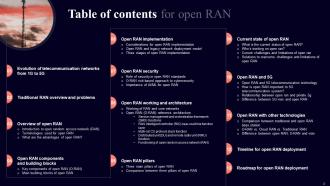
Slide 3: This slide exhibit table of content.
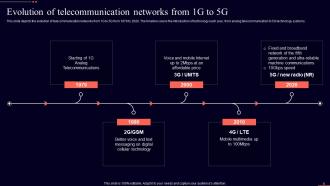
Slide 4: This slide exhibit table of content- Evolution of telecommunication networks from 1G to 5G
Slide 5: This slide depicts the evolution of telecommunication networks from 1G to 5G from 1979 to 2020.
Slide 6: This slide exhibit table of content- Traditional RAN overview and problems.
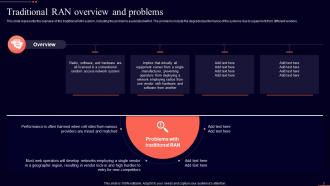
Slide 7: This slide represents the overview of the traditional RAN system, including the problems associated with it.
Slide 8: This slide exhibit table of content- Overview of open RAN.
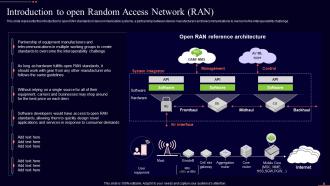
Slide 9: This slide represents the introduction to open RAN standards in telecommunication systems.
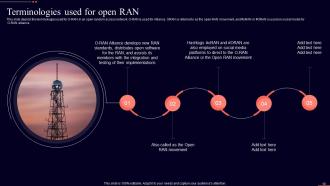
Slide 10: This slide depicts the terminologies used for O-RAN in an open random access network.
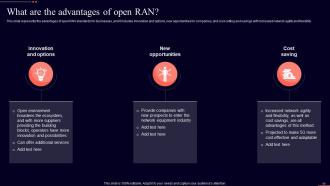
Slide 11: This slide represents the advantages of open RAN standards for businesses.
Slide 12: This slide exhibit table of content- Open RAN components and building blocks.
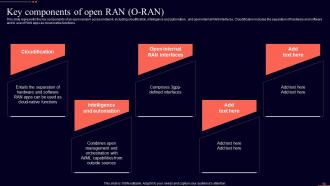
Slide 13: This slide represents the key components of an open random access network.
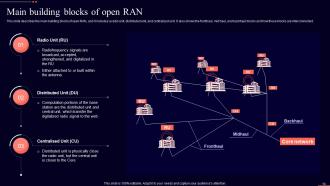
Slide 14: This slide describes the main building blocks of open RAN, and it includes a radio unit, distributed unit, and centralized unit.
Slide 15: This slide exhibit table of content- Open RAN pillars
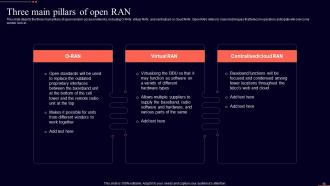
Slide 16: This slide depicts the three main pillars of open random access networks, including O-RAN, virtual RAN, and centralized or cloud RAN.
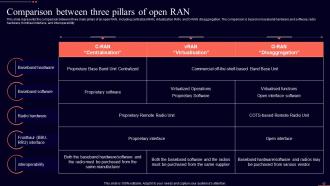
Slide 17: This slide represents the comparison between three main pillars of an open RAN, including centralized RAN, virtualization RAN, and O-RAN disaggregation.
Slide 18: This slide exhibit table of content- Working of RAN and core networks
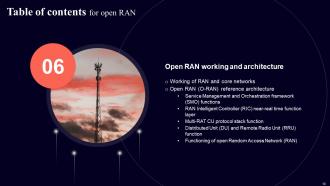
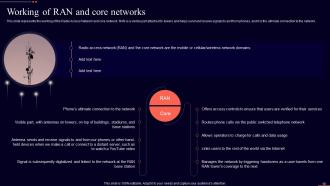
Slide 19: This slide represents the working of the Radio Access Network and core network.
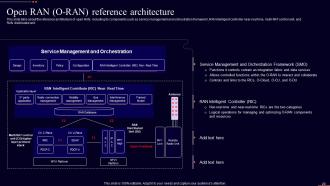
Slide 20: This slide talks about the reference architecture of open RAN.
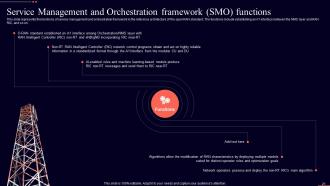
Slide 21: This slide represents the functions of service management and orchestration framework in the reference architecture of the open RAN standard.
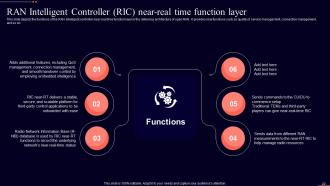
Slide 22: This slide depicts the functions of the RAN intelligent controller near-real time function layer in the reference architecture of open RAN.
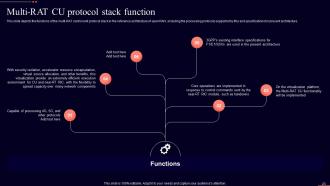
Slide 23: This slide depicts the functions of the multi-RAT control unit protocol stack in the reference architecture of open RAN.
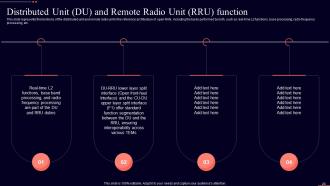
Slide 24: This slide represents the functions of the distributed unit and remote radio unit in the reference architecture of open RAN.
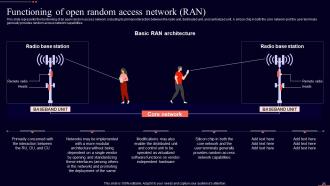
Slide 25: This slide represents the functioning of an open random access network.
Slide 26: This slide exhibit table of content- Open RAN security.
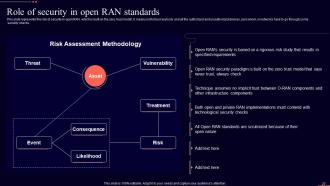
Slide 27: This slide represents the role of security in open RAN, which is built on the zero trust model.
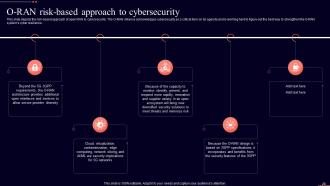
Slide 28: This slide depicts the risk-based approach of open RAN to cybersecurity.
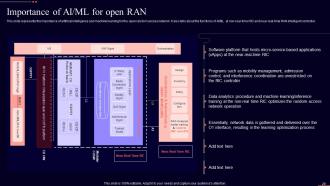
Slide 29: This slide represents the importance of artificial intelligence and machine learning for the open random access network.
Slide 30: This slide exhibit table of content- Open RAN implementation.
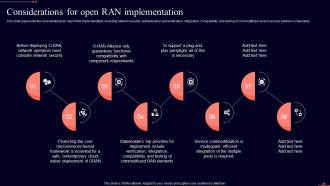
Slide 31: This slide represents the considerations for open RAN implementation.
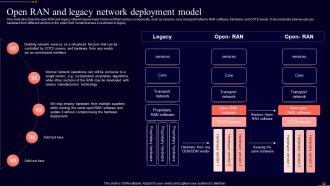
Slide 32: This slide describes the open RAN and legacy network deployment model and their various components.
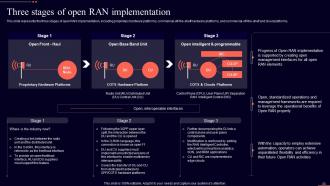
Slide 33: This slide represents the three stages of open RAN implementation.
Slide 34: This slide exhibit table of content- Current state of open RAN.
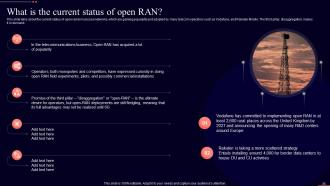
Slide 35: This slide talks about the current status of open random access networks.
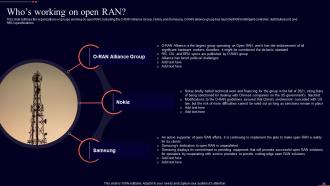
Slide 36: This slide outlines the organizations or groups working on open RAN.
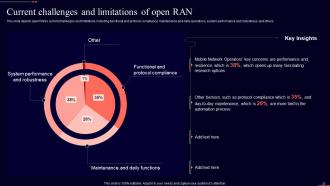
Slide 37: This slide depicts open RAN's current challenges and limitations.
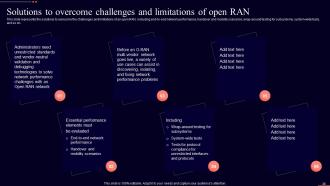
Slide 38: This slide represents the solutions to overcome the challenges and limitations of an open RAN.
Slide 39: This slide exhibit table of content- Open RAN and 5G.
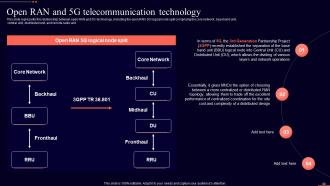
Slide 40: This slide represents the relationship between open RAN and 5G technology.
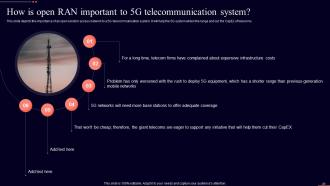
Slide 41: This slide depicts the importance of an open random access network to a 5G telecommunication system.
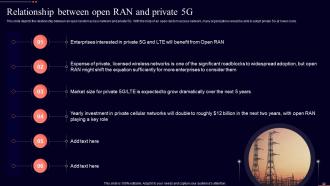
Slide 42: This slide depicts the relationship between an open random access network and private 5G.
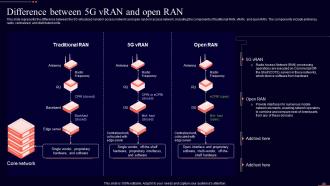
Slide 43: This slide represents the difference between the 5G virtualized random access network and open random access network.
Slide 44: This slide exhibit table of content- Open RAN with other technologies.
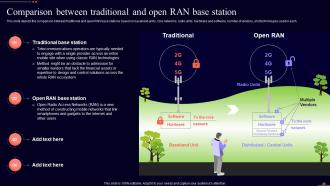
Slide 45: This slide depicts the comparison between traditional and open RAN base stations.
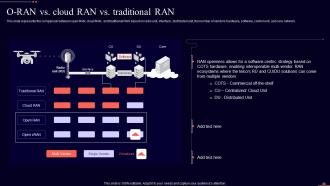
Slide 46: This slide represents the comparison between open RAN, cloud RAN, and traditional RAN based on radio unit, interface, distributed unit, the number of vendors hardware, software, control unit, and core network.
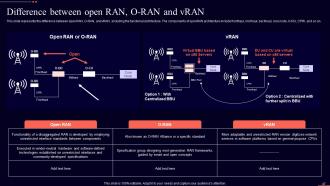
Slide 47: This slide represents the difference between open RAN, O-RAN, and vRAN.
Slide 48: This slide exhibit table of content- Timeline for open RAN deployment.
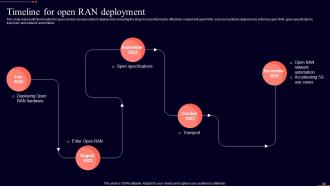
Slide 49: This slide represents the timeline for open random access network deployment.
Slide 50: This slide exhibit table of content- Roadmap for open RAN deployment.
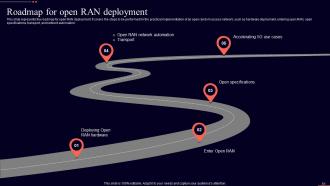
Slide 51: This slide represents the roadmap for open RAN deployment.
Slide 52: This is the icons slide.
Slide 53: This slide presents title for additional slides.
Slide 54: This slide presents Circular process.
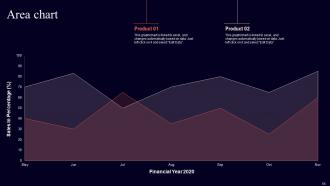
Slide 55: This slide presents Area chart for different products.
Slide 56: This slide display Venn diagram.
Slide 57: This slide shows puzzle for displaying elements of company.
Slide 58: This slide display Magnifying glass.
Slide 59: This slide display Our goal.
Slide 60: This is thank you slide & contains contact details of company like office address, phone no., etc.
Open RAN IT Powerpoint Presentation Slides with all 65 slides:
Use our Open RAN IT Powerpoint Presentation Slides to effectively help you save your valuable time. They are readymade to fit into any presentation structure.











FAQs for Open RAN IT
So Open RAN basically has three key things going for it. You can mix and match gear from different vendors - no more getting stuck with one supplier's whole setup. The interfaces between components are actually standardized now, which honestly saves so much headache. Plus everything runs on cloud-native architecture, so network functions work like regular software apps. The flexibility is pretty sweet - better costs, faster innovation, all that. Oh, and here's a tip: figure out where vendor lock-in is screwing you over the most right now. That's where you'll want to start.
So Open RAN basically lets you escape vendor lock-in hell. You're not stuck buying everything from one company anymore - mix Nokia radios with someone else's software, whatever works. Way more flexible since you can swap pieces without rebuilding everything. Honestly, the telecom industry needed this years ago. Scaling gets simpler too because you're not waiting around for one vendor's timeline (ugh, we've all dealt with that). You can upgrade specific parts when needed or bring in niche companies for AI stuff. Bottom line - you actually control your network instead of being hostage to vendor roadmaps.
So basically open interfaces are what make Open RAN actually "open" - they're standardized connections that let different vendors' gear work together instead of locking you into one company's proprietary stuff. Like having universal USB ports vs every device needing its own weird cable (ugh, remember those days?). You've got fronthaul, midhaul, and backhaul connecting your radio units to distributed and centralized units. The whole point is flexibility - you can mix vendors and tell vendor lock-in to kick rocks.
So basically Open RAN breaks you free from vendor lock-in - you can finally mix different suppliers instead of getting trapped with one crazy expensive vendor. Competition drives prices way down. You'll use regular off-the-shelf hardware too, not those ridiculously overpriced proprietary telecom boxes. I mean, we're talking generic servers vs specialized equipment that costs like 10x more. Everything follows open standards so integration gets way easier. The long-term savings are honestly huge. I'd say start with a pilot in some non-critical areas first, just to see how it goes before going all-in.
Honestly, the integration stuff is gonna be your biggest pain. Instead of dealing with one vendor, now you're managing like five different companies who all blame each other when things break. Your team better be ready to level up their skills too - this isn't plug-and-play like the old systems. Oh, and don't believe the "open standards" hype completely. Just because everything's supposed to work together doesn't mean it actually will without tons of testing. I'd definitely start with a small pilot first and get your engineers trained up before you commit to anything big.
So Open RAN breaks up that whole monopoly thing with Ericsson and Nokia controlling everything. Now you can actually mix and match gear from different companies since they standardized all the interfaces. Think USB ports - any device works with any computer, right? Smaller vendors can finally compete instead of getting crushed by the big guys. Innovation moves faster, costs drop. Your procurement people will actually have real options for once instead of just accepting whatever overpriced stuff their main vendor pushes. Pretty smart move honestly.
Yeah, Open RAN definitely opens up more attack surfaces - you're juggling multiple vendors now instead of one. Those standardized APIs are awesome for mixing and matching, but honestly they're also new doorways for hackers. Security becomes trickier because you're only as strong as your weakest vendor. Though I guess the upside is you're not stuck with whatever security approach one company decides to use. You'll want to map out all those new interfaces first, then set up monitoring around each connection point. Oh, and vendor vetting becomes super critical now.
Honestly, Open RAN is a game-changer for 5G rollouts because you're not stuck with one vendor anymore. Mix and match components from different suppliers - way faster than waiting on a single company to deliver everything. The interfaces are standardized too, so integration doesn't suck like it used to. Think buying regular parts vs custom manufacturing each piece. More competition means better prices and innovation happens quicker. Oh, and suppliers actually have to compete for your business now, which is refreshing. If you're planning deployments, definitely start looking at Open RAN options. You'll thank yourself later for the flexibility.
So Open RAN breaks up the whole vendor lock-in thing by making all the network pieces talk to each other through standard interfaces. You can actually mix different vendors now - like Vendor A's radios with Vendor B's software. Think USB ports, but for telecom equipment. Pretty cool concept honestly. This gives you way more flexibility when buying stuff, plus vendors have to innovate faster since they're competing harder. And you're not stuck following one company's timeline anymore when they decide to update things. Negotiations get easier too since you've got options.
Start with the obvious stuff - throughput, latency, coverage, connection reliability. Those are what users actually feel. Then add Open RAN specifics like vendor interoperability (honestly the most critical part since that's why you went open in the first place). Energy efficiency matters too, plus xApp performance on your RIC platform. Oh and operational stuff - deployment speed, cost per site, how easy it is to swap components. I'd set up dashboards tracking everything together so you catch trade-offs before they bite you. The combo view really helps.
So Open RAN breaks apart the old school radio network setup, which is honestly genius. Instead of being stuck with one vendor's expensive equipment, you get standardized hardware that can run apps right at the cell tower level. That puts computing power way closer to users - think millisecond response times for VR or self-driving cars. The whole thing runs on containers, so you can actually customize what services you deploy based on what people in that area need. Way more flexible than the old "take it or leave it" approach from big telecom companies.
Look, Open RAN is gonna make your network management way more complicated - you're dealing with multiple vendors now instead of one. The standardized interfaces sound amazing on paper, but trust me, you'll be doing integration testing forever. Your ops team needs to learn cloud-native functions and automated management tools pretty much immediately. Real-time analytics become crucial since you're managing this whole disaggregated mess. Honestly? Start training everyone on intent-based management platforms now because doing anything manually just won't work anymore. It's a totally different world from traditional RAN.
So basically Open RAN lets you cherry-pick the best stuff from different vendors instead of being stuck with one company's whole setup. You can mix and match - maybe use one vendor's software for ultra-low latency stuff and another's for IoT. Pretty cool honestly. The whole disaggregated thing means spinning up new slices happens way faster, and you can throw AI into the mix more easily. I'd probably start by figuring out which slices you're running now that could really benefit from having more vendor options. Makes the whole network way more flexible.
Honestly, AI and ML are game-changers for Open RAN - they basically turn your network into this self-tuning machine. The algorithms automatically tweak parameters, predict traffic spikes, and balance loads across all those disaggregated components. It's like having a genius network engineer working 24/7, except they never get tired or miss anything. What's cool is the system gets better over time by learning your specific network patterns. My advice? Figure out what's bugging you most first - maybe it's capacity issues or interference problems. Then hunt for AI solutions that specifically tackle those headaches instead of trying to fix everything at once.
So Open RAN basically lets you pick energy-efficient hardware instead of being stuck with whatever your vendor ships you. The whole thing's software-defined, which means way better resource optimization - honestly the control you get is pretty sweet. When upgrades happen, you're not junking entire systems just to swap one piece. Plus you can actually work with vendors who care about green tech rather than those legacy power hogs. Oh and the disaggregated setup? Total game changer for hitting those sustainability targets. Much smarter way to build networks if you ask me.
-
Stunning collection! With a wide variety of options available, I was able to find a perfect slide for my presentation. Thank you, SlideTeam!
-
“I've always gotten excellent slides from them and the customer service is up to the mark.”