


ANN Powerpoint Presentation Slides





Try Before you Buy Download Free Sample Product
 Impress Your
 Audience
 100%
100% Editable
 Save Hours
 of Time


ANNs are sophisticated computer programs that draw inspiration from human biological systems. Check out our insightfully designed template on ANN. It helps in Recognizing business trends, collaborating with teams to learn, and forecasting future data are their significant responsibilities. Our Artificial Neural Networks template introduces the ANN learning institute, its significance, and benefits. The institutes overview and the education needed to learn ANN are both shown in this PowerPoint Presentation. It also provides information about ANN and its benefits. Additionally, Our ANN deck demonstrates the layers and operational patterns of artificial neural networks. It also teaches about Artificial Neural Network Learning Techniques, including activation functions, types, and cost functions. The application and use case of ANN, learning methodologies, details for the two processes to minimize the cost function, and other information are also illustrated in this effective template. Lastly, it emphasizes the drawbacks of ANN, the training schedule and course costs, the 30 60 90 day course schedule, and the road map. Get access to this powerful template now.
People who downloaded this PowerPoint presentation also viewed the following :
Content of this Powerpoint Presentation
Slide 1: This slide introduces ANN. Commence by stating Your Company Name.
Slide 2: This slide depicts the Agenda of the presentation.
Slide 3: This slide elucidates the Table of contents.
Slide 4: This slide highlights the Title for the Topics to be covered in the next template.
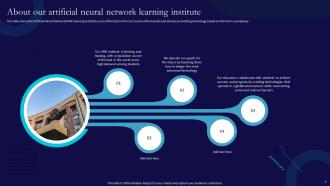
Slide 5: This slide shows the Artificial Neural Network(ANN) learning institution, one of the best in the US; it works with students and advises on building technology based on the brain's complexity.
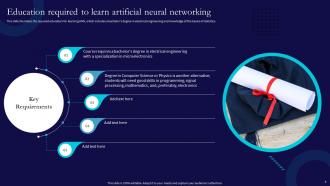
Slide 6: This slide illustrates the required education for learning ANN, which includes a bachelor's degree in electrical engineering and knowledge of the basics of statistics.
Slide 7: This slide mentions the Heading for the Components to be discussed further.
Slide 8: This slide provides an overview of ANN, the network similar to the human brain; dendrites represent inputs, nodes represent the cell nuclei, and so on.
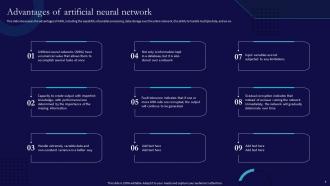
Slide 9: This slide showcases the advantages of ANN, including the capability of parallel processing, data storage over the entire network, the ability to handle multiple data, etc.
Slide 10: This slide reveals the Title for the Ideas to be covered further.
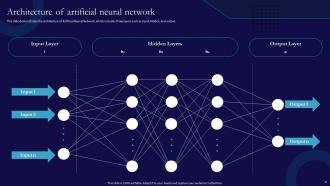
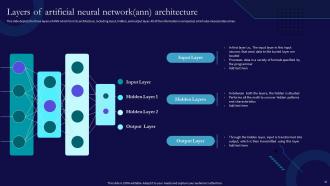
Slide 11: This slide demonstrates the architecture of Artificial Neural Network, which includes three layers such as input, hidden, and output.
Slide 12: This slide depicts the three layers of ANN which form its architecture, including input, hidden, and output layer.
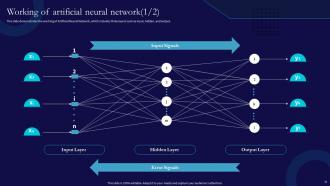
Slide 13: This slide displays the working of Artificial Neural Network, which includes three layers such as input, hidden, and output.
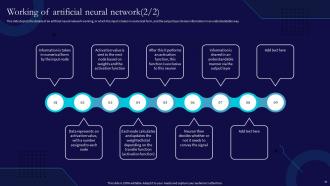
Slide 14: This slide continues the Working of artificial neural network.
Slide 15: This slide reveals the Heading for the Ideas to be discussed in the upcoming template.
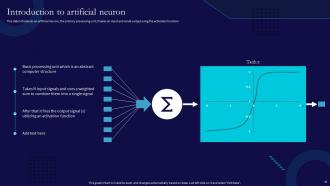
Slide 16: This slide introduces an artificial neuron, the primary processing unit; it takes an input and sends output using the activation function.
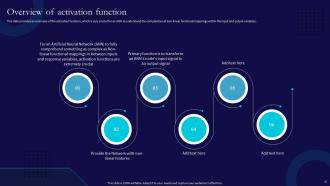
Slide 17: This slide provides an overview of the activation function, which is very crucial for an ANN to understand the complexities of non-linear functional mappings within the input and output variables.
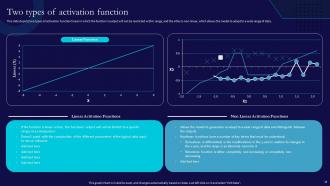
Slide 18: This slide depicts two types of activation function linear in which the function's output will not be restricted within range, and the other is non-linear, which allows the model to adapt to a wide range of data.
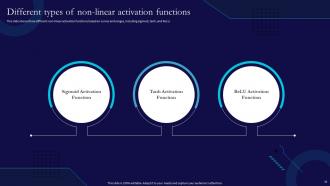
Slide 19: This slide shows three different non-linear activation functions based on curves and ranges, including sigmoid, tanh, and ReLU.
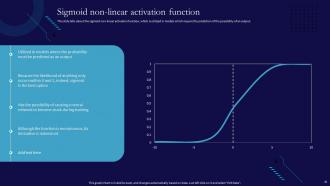
Slide 20: This slide talks about the sigmoid non-linear activation function, which is utilized in models which require the prediction of the possibility of an output.
Slide 21: This slide presents the tanh Activation Function ranging from -1 to 1, and both tanh and sigmoid are used in feedforward networks.
Slide 22: This slide demonstrates the rectified linear unit activation function, which is the most utilized function in the current world and is both derivative and monotonic.
Slide 23: This slide portrays the Title for the Components to be covered next.
Slide 24: This slide shows feedforward, one of the types of Artificial Neural Networks(ANN) in this; signals can go in only one way, and outputs of the previous layer become the input of the next one.
Slide 25: This slide depicts the feedback network, which is the other type of ANN; this contains feedback loops; in this, neurons, just like the brain, it can have any number of connections.
Slide 26: This slide mentions the Heading for the Topics to be covered next.
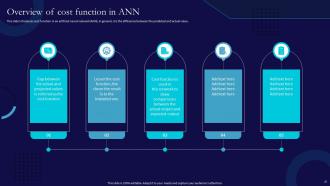
Slide 27: This slide introduces cost function in an artificial neural network(ANN); in general, it is the difference between the predicted and actual value.
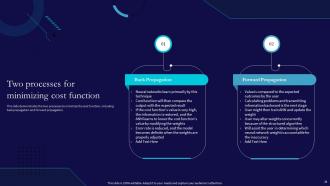
Slide 28: This slide demonstrates the two processes to minimize the cost function, including backpropagation and forward propagation.
Slide 29: This slide highlights the Title for the Topics to be covered further.
Slide 30: This slide represents the applications of artificial neural networks such as paraphrase detection, forecasting, image processing, and so on.
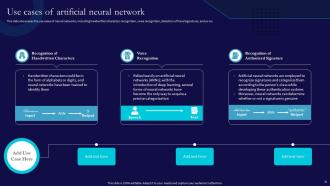
Slide 31: This slide showcases the use cases of neural networks, including handwritten characters recognition, voice recognition, detection of fraud signatures, etc.
Slide 32: This slide indicates the Title for the Topics to be covered in the upcoming template.
Slide 33: This slide illustrates the two types of ANN techniques, including learning under supervision, and learning without supervision.
Slide 34: This slide outlines the Heading for the Components to be discussed further.
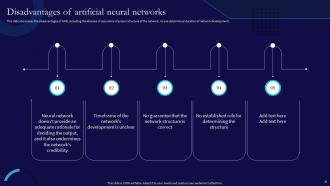
Slide 35: This slide shows the disadvantages of ANN, including the absence of assurance of proper structure of the network, no pre-determined duration of network development.
Slide 36: This slide indicates the Title for the Topics to be covered next.
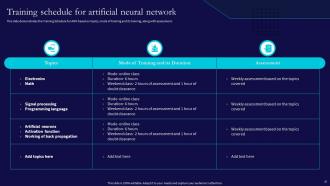
Slide 37: This slide demonstrates the Training Schedule for ANN based on topics, mode of training and its training, along with assessment.
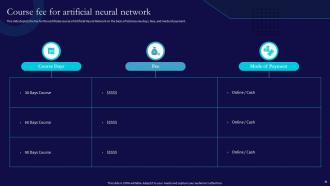
Slide 38: This slide depicts the fee for the certificate course of Artificial Neural Network on the basis of total course days, fees, and mode of payment.
Slide 39: This slide mentions the Heading for the Contents to be covered further.
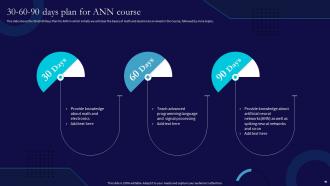
Slide 40: This slide shows the 30-60-90 Days Plan for ANN course.
Slide 41: This slide elucidates the Title for the Components to be discussed next.
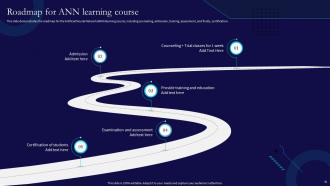
Slide 42: This slide portrays the roadmap for the Artificial Neural Network(ANN) learning course.
Slide 43: This is the Icons slide containing all the Icons used in the plan.
Slide 44: This slide is used to depict Additional information.
Slide 45: This slide represents the vision, mission & goal of the Company.
Slide 46: This slide incorporates the Bar chart.
Slide 47: This slide contains the Post it notes for reminders and deadlines.
Slide 48: This is the Thank You slide for acknowledgement.
ANN Powerpoint Presentation Slides with all 53 slides:
Use our ANN Powerpoint Presentation Slides to effectively help you save your valuable time. They are readymade to fit into any presentation structure.




























FAQs for ANN
So basically you've got neurons that take inputs and multiply them by weights - those weights change as the network learns stuff. Then there's activation functions that decide if a neuron should "fire" or not. All this happens across different layers (input, hidden, output) where info flows through. Training is where it gets interesting - you keep tweaking the weights based on mistakes until everything clicks. Honestly reminds me of learning to drive, lots of small adjustments until muscle memory kicks in. I'd mess around with a basic feedforward network first since it's way easier to wrap your head around.
Think of activation functions like on/off switches for neurons - they decide what info gets passed forward. Without them, you're stuck with linear relationships no matter how deep your network goes. Pretty useless, honestly. ReLU works great most of the time because it's dead simple and doesn't suffer from vanishing gradients like sigmoid or tanh do. Those older functions can make training crawl to a halt in deep networks. Your choice here affects everything - gradient flow, training speed, what patterns you can learn. I'd go with ReLU first. It's boring but it works.
So backprop is how neural networks actually learn stuff - they figure out which weights messed up the prediction and fix them. You run data through the network, see how wrong the output is, then trace backwards through each layer adjusting things. The math behind it is actually pretty cool once you wrap your head around it. Without this process, your network would just keep guessing randomly since it wouldn't know what to change. Definitely try coding a basic version yourself if you can - watching those gradients flow backwards made it finally make sense for me.
So CNNs have these filters that slide across your data looking for patterns - edges, textures, that kind of stuff. Way different from regular networks that just connect everything to everything else. They're honestly perfect for anything visual. Medical scans, self-driving cars, image recognition - you name it. Even works for audio sometimes, which is kinda cool. Think of it like having special glasses that spot patterns instead of just staring at a bunch of random pixels. If your data has spatial relationships (like images obviously do), CNN's probably what you want to use.
So regularization is basically adding penalties to stop your model weights from blowing up and overfitting. L2 regularization (ridge) shrinks weights down toward zero, while L1 (lasso) can actually kill off weights completely - which is honestly pretty neat for picking features. Then there's dropout, where you randomly shut off neurons during training so they don't get too dependent on each other. I'd start with L2 and dropout first since they work great together. Oh and don't overthink it at first, just try L2 with like 0.01 and see what happens.
So basically, transfer learning means grabbing a pre-trained model and tweaking it for whatever you're working on. Way smarter than starting from zero. These networks already learned tons of useful stuff from huge datasets like ImageNet - why throw that away, right? What you do is freeze those early layers (they pick up general patterns anyway) and just retrain the end parts with your own data. Honestly saves so much time and usually works better too, especially if you don't have massive amounts of training data. Oh, and pick something somewhat related to your domain if possible.
Oh man, the costs will kill you - we're talking thousands for weeks of GPU time. Memory's another pain since you can't cram huge datasets into RAM, so batching becomes this whole thing. Debugging sucks when each test run takes forever. Plus there's all the distributed training headaches across multiple machines. Network bottlenecks, keeping everything synced... it's honestly a mess. My advice? Start with a small data subset first. Test your setup before you blow your budget on the full run. Trust me on this one.
So the main thing with RNNs is they've got this "memory" feature - the hidden state that carries info forward as it processes each part of your sequence. Regular neural networks just look at each input separately, but RNNs actually remember what happened before. It's kinda like how you understand a sentence by keeping track of earlier words, not just the current one. Perfect for anything sequential - translations, predicting stock prices, speech stuff. Honestly, if your data has any time element or order that matters, you'll probably want RNNs or LSTMs. They're built for exactly that.
So there's a bunch of ways to actually see what your neural networks are doing under the hood. Grad-CAM is probably your best starting point - especially for image stuff since it shows you exactly what the model's paying attention to. Saliency maps work similarly. LIME and SHAP are solid for getting local explanations too. Oh, and if you're curious what different neurons are actually "hunting for," activation maximization can show you these crazy patterns they respond to - honestly some of them look like trippy art. LRP is another option that traces relevance back through layers. I'd definitely start with Grad-CAM though, it's pretty straightforward to implement and you'll get results that actually make sense visually.
Yeah, neural networks basically run everything in NLP now. Google search, Siri, chatbots - you've definitely used them already. They're crazy good at figuring out context between words, which is why stuff like translation and sentiment analysis actually works well these days. Transformers (GPT, BERT) totally changed the game here. Oh, and if you want to try building something, just grab pre-trained models from Hugging Face - seriously don't build from scratch unless you hate yourself. Way easier to start there.
So GANs are two neural networks basically fighting each other - one creates fake data, the other tries to catch it. Think counterfeiter vs detective, which is honestly pretty cool when you think about it. The generator keeps getting sneakier while the discriminator gets sharper at spotting fakes. You see them everywhere now - realistic images, deepfakes, art generation, music. Computer vision stuff mostly. Oh and if you're stuck with a tiny dataset, GANs can generate more training data for you. That actually works way better than you'd expect for boosting performance.
Dude, hardware changes have been insane for neural network training. What used to take weeks now happens in hours. GPUs made everything way faster by handling all those matrix calculations in parallel, and Google's TPUs are even better for the tensor stuff. A decade ago we were stuck with tiny models - now you can train networks with billions of parameters, which still blows my mind honestly. If you're doing anything heavy computationally, cloud GPU/TPU rentals are worth it. The time you'll save pays for itself, trust me.
Honestly, neural networks are amazing for complex stuff like images and text, but they're total data hogs. You'll need massive datasets and serious computing power to make them work. Random forests or SVMs? Way better for smaller projects - plus your boss can actually understand what they're doing, which saves everyone headaches later. The cool thing about neural networks is they just keep getting better as you throw more data at them. My take: got tons of data and budget? Go neural. Otherwise, try the traditional stuff first and see how far it gets you.
Bias is the big one - if your training data has historical discrimination baked in, your AI will just repeat those patterns. Like rejecting loans based on zip codes that happen to correlate with race. Healthcare's even messier because neural networks are total black boxes, so doctors can't explain why it suggested some treatment. Who gets sued when the AI messes up? That's still being figured out honestly. You've gotta audit your data constantly, use explainability tools when you can, and set up governance rules early. Otherwise you're just asking for trouble down the road.
Neural networks are getting crazy efficient and specialized. The hardware alone is nuts - these new AI chips make training way faster and cheaper. Neuromorphic computing is trying to copy how our brains actually work, which is pretty cool if you ask me. Transformers aren't just for language anymore either. Oh, and federated learning is becoming huge since models can train on distributed data without compromising privacy. Honestly though? Start learning edge AI deployment now. That's where most real-world stuff is headed, and you don't want to be playing catch-up later.
-
Definitely a time saver! Predesigned and easy-to-use templates just helped me put together an amazing presentation.
-
Excellent products for quick understanding.