

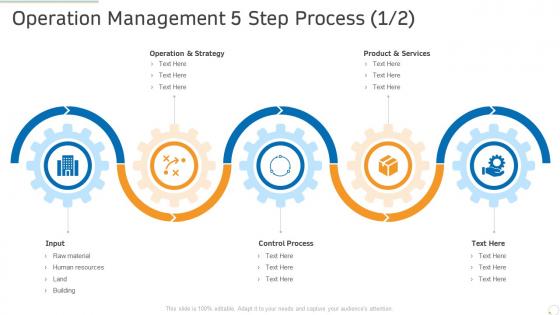
Operation management 5 step process production management ppt infographics samples




Try Before you Buy Download Free Sample Product
 Impress Your
 Audience
 100%
100% Editable
 Save Hours
 of Time


Our Operation Management 5 Step Process Production Management Ppt Infographics Samples are topically designed to provide an attractive backdrop to any subject. Use them to look like a presentation pro.
People who downloaded this PowerPoint presentation also viewed the following :
Operation management 5 step process production management ppt infographics samples with all 2 slides:
Use our Operation Management 5 Step Process Production Management Ppt Infographics Samples to effectively help you save your valuable time. They are readymade to fit into any presentation structure.

FAQs for Operation management 5 step process production management
Operations management focuses on ongoing, repetitive processes like production, quality control, inventory management, and daily workflow optimization, while project management centers on temporary initiatives with defined start and end dates. Operations managers streamline continuous business functions across departments, ensuring efficiency and consistency, whereas project managers coordinate specific deliverables, timelines, and resources, with many organizations finding that combining both approaches delivers sustained competitive advantage.
AI and automation optimize supply chain operations by enhancing demand forecasting, streamlining inventory management, and accelerating decision-making processes through real-time data analytics. These technologies enable manufacturers and retailers to reduce operational costs, minimize stockouts, and improve delivery times, with many organizations finding that automated systems deliver significantly faster responses to market changes and ultimately enhance competitive advantage.
Data analytics transforms operations management decision-making by providing real-time insights, predictive modeling, demand forecasting, performance optimization, and risk assessment capabilities. Through advanced analytics platforms, organizations streamline inventory management, enhance supply chain efficiency, and improve resource allocation, with manufacturing and retail sectors finding that data-driven approaches ultimately deliver reduced costs and significantly faster operational responses.
Effective JIT inventory strategies include demand forecasting integration, supplier partnership development, kanban pull systems, safety stock minimization, and real-time inventory tracking technologies. These approaches streamline operations by reducing carrying costs, eliminating waste, and synchronizing production flows, with manufacturing sectors like automotive and electronics finding that strategic supplier collaboration ultimately delivers faster turnaround times and enhanced operational efficiency.
Organizations balance efficiency and quality by implementing lean methodologies, standardizing processes, investing in employee training, utilizing automation strategically, and establishing continuous improvement cycles. Through quality management systems and performance metrics, companies like Toyota and Amazon optimize workflows while maintaining standards, ultimately delivering faster services and reduced costs without compromising customer satisfaction.
Lean manufacturing significantly enhances operational performance by reducing waste, improving quality, accelerating production cycles, and optimizing resource utilization. Through streamlined processes and continuous improvement methodologies, organizations achieve lower operational costs, faster delivery times, and enhanced customer satisfaction, while manufacturing companies increasingly find that lean principles enable greater flexibility and competitive advantage in dynamic markets.
Operations management drives sustainability through resource optimization, waste reduction, energy-efficient processes, sustainable supply chain practices, and circular economy integration. These strategic approaches enable organizations to minimize environmental impact while enhancing operational efficiency, with many manufacturing and retail companies finding that sustainable operations ultimately deliver cost savings, regulatory compliance, and competitive advantage in an increasingly environmentally-conscious marketplace.
Service operations managers face challenges like demand variability, quality consistency across human interactions, inventory management of intangible services, and real-time customer feedback management, unlike manufacturing's predictable production cycles. These service complexities require flexible staffing models, enhanced training protocols, and dynamic resource allocation, with many hospitality and financial services organizations finding that technology integration ultimately streamlines operations while maintaining personalized customer experiences.
Effective communication enhances cross-functional collaboration by establishing clear channels for information sharing, aligning team objectives across departments, and creating standardized processes for decision-making. Through regular cross-departmental meetings and integrated communication platforms, organizations streamline project coordination, reduce operational silos, and accelerate problem resolution, ultimately delivering improved efficiency and faster time-to-market outcomes.
Tools for measuring operational efficiency include Six Sigma, Lean methodologies, Key Performance Indicators (KPIs), process mapping, and data analytics platforms. These approaches streamline operations by identifying bottlenecks, eliminating waste, and optimizing resource allocation, with many manufacturing and service organizations finding that strategic implementation delivers faster cycle times, reduced costs, and enhanced competitive advantage.
Global supply chain disruptions significantly reshape operations management strategies by forcing organizations to prioritize resilience, diversification, and agility over traditional cost-efficiency models. Companies increasingly adopt multi-sourcing approaches, nearshoring initiatives, and enhanced inventory buffers, while leveraging predictive analytics and real-time monitoring systems to anticipate and mitigate risks, ultimately delivering greater operational stability and competitive advantage.
Capacity planning ensures organizations can meet demand while optimizing resource utilization, involving demand forecasting, resource allocation, bottleneck identification, and strategic scalability planning. Through methods like statistical forecasting, simulation modeling, and lean principles, manufacturers, hospitals, and service providers streamline operations, reduce costs, and enhance customer satisfaction, ultimately delivering competitive advantage in increasingly dynamic markets.
Organizations leverage process mapping to identify inefficiencies by visualizing workflows, documenting each step, analyzing resource allocation, measuring cycle times, and pinpointing bottlenecks or redundancies. Through detailed mapping, manufacturing companies streamline production lines, healthcare systems reduce patient wait times, and financial institutions accelerate loan approvals, ultimately delivering enhanced operational efficiency and competitive advantage.
Service-oriented businesses should track customer satisfaction scores, service delivery time, first-call resolution rates, employee productivity metrics, and cost per service transaction. These operational indicators enable organizations to streamline customer experiences, optimize resource allocation, and enhance service quality, with many retail and financial services companies finding that consistent monitoring ultimately delivers competitive advantage and improved profitability.
Kaizen can be integrated through daily team huddles for problem identification, regular process audits, employee suggestion systems, standardized improvement cycles, and cross-functional collaboration sessions. These methodologies enhance operational efficiency by fostering a culture of incremental change, reducing waste, and empowering workers to optimize workflows, with many manufacturing and service organizations finding that consistent small improvements ultimately deliver significant competitive advantages.
-
Amazing product with appealing content and design.
-
Awesome use of colors and designs in product templates.
-
Use of different colors is good. It's simple and attractive.
-
Use of different colors is good. It's simple and attractive.
-
Helpful product design for delivering presentation.