

Operations management ppt presentation




Try Before you Buy Download Free Sample Product
 Impress Your
 Audience
 100%
100% Editable
 Save Hours
 of Time


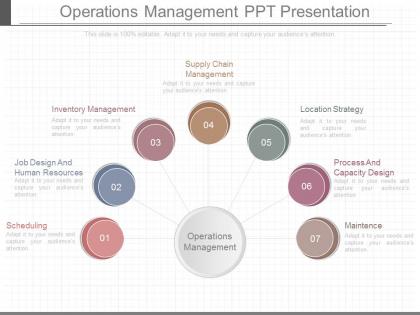
We bring home our latest: "Operations Management Ppt Presentation" for representing your operations management related presentations. This PPT slide is crafted with the graphics of operation management points circumcised through a semicircle figure. The topics in this process displayed with iconic colors, this is a seven stage process and the stages in this process are supply chain management, location strategy, process and capacity design, maintenance, scheduling, job design and human resources and inventory management. This PPT template is a classic design specially designed by keeping in mind the old school ways of describing business and finance fundamentals and other operations taking place in an organization. Each design created at SlideTeam is dedicated to work for the best of a client and works with a problem-solving motive. So just click on the download button and own our "Operations Management Ppt Presentation" and use it for operation management related presentations and leaves a remarkable impression on your clients, get it right away.Face the day fearlessly with our Operations Management Ppt Presentation. They make everything easier to contend with.
People who downloaded this PowerPoint presentation also viewed the following :
Operations management ppt presentation with all 7 slides:
Enhance ability to anticipate with our Operations Management Ppt Presentation. Always begin with a firm advantage.






FAQs for Operations
Okay so the main stuff you gotta nail down: quality control, supply chain management, capacity planning, and process optimization. Inventory management too, obviously. Performance metrics are huge - you can't fix what you don't measure, right? I know it sounds overwhelming but honestly once you get the foundation solid, everything else kind of clicks into place. The trick is getting all these pieces to actually talk to each other instead of running them like separate departments. I'd start by mapping your current workflow and spotting your worst bottlenecks. That'll show you exactly where to put your energy first.
Honestly, tech has completely transformed how operations work. Automating boring tasks, getting instant supply chain updates, making decisions based on actual data instead of gut feelings - it's pretty wild. Like, we used to count inventory by hand (what a nightmare), now there's IoT sensors and AI that predicts demand better than most humans. Cloud systems tie everything together too. But here's the thing - don't just grab whatever's trending. Figure out what's actually broken in your operations first, then find tech that fixes those specific problems. Otherwise you're just burning money on fancy tools.
So basically manufacturing = physical stuff you can touch and store. Services are the opposite - totally intangible and happen in the moment. Like, you can't exactly save up a bunch of doctor visits for later, right? Manufacturing loves standardization and machines doing the work. Services? Way more personal and hands-on. Quality control gets tricky too - with products you test everything beforehand, but services happen live with your customer watching. Honestly, timing is probably the biggest difference when you're planning your whole operation around one or the other.
Data analytics can definitely help you find those annoying bottlenecks and predict when demand's gonna spike. Track stuff like cycle times, quality rates, inventory turnover - you know, metrics that actually matter. Honestly, I've watched too many teams obsess over fancy dashboards that look amazing but don't change anything. Total waste of time. Start with your biggest headache first, then figure out what data might fix it. Sometimes just plotting basic trends shows you things you never noticed. Oh, and don't forget customer wait times - that one bites people more than they realize.
Honestly, your supply chain is what makes or breaks everything else. It's how materials and info move from suppliers to customers, and when it's messed up, your whole operation suffers. Production gets delayed, inventory costs go crazy, quality drops - the usual nightmare. But here's the thing: most people don't realize how much it affects customer satisfaction too. Get it right and you'll see better delivery times and lower costs almost immediately. My advice? Map out what you've got now first. You can't fix bottlenecks if you don't know where they are.
Focus on getting your demand forecasting right first - that's honestly half the battle. Set decent reorder points and don't go crazy with safety stock, just enough to cover your butt. ABC analysis helps a ton here, spend your energy on the expensive stuff and let the small items coast. Regular cycle counts are way better than doing one big inventory nightmare once a year. JIT is cool if your suppliers actually show up on time (mine don't always). Get some inventory software to automate the boring stuff and track your turnover ratios. Oh, and clean up your data first - crappy data makes everything worse.
Think of quality control as catching stuff before it becomes a headache. Nobody wants another checklist, I get it. But you'll save way more time than you spend because you're stopping problems early instead of fixing disasters later. Less rework, less waste, smoother operations overall. Your team can focus on actual productive work rather than constantly putting out fires. Honestly, the upfront investment is worth it - I'd start with whatever's causing you the biggest pain points right now and build simple checks around those areas first.
Honestly, the hardest parts are dealing with cultural differences and all the regulatory stuff that changes country to country. Your supply chain becomes this crazy web of vendors and shipping routes - total headache. Currency swings will mess with your budget constantly. Oh, and get ready for those brutal 6am calls when your team's scattered across time zones (seriously, invest in good coffee). Quality control is tough when you can't just walk over and check things yourself. Different labor laws everywhere make HR complicated too. My advice? Find solid local partners first - they'll save you so much pain later.
So Lean is basically about cutting out all the crap that doesn't add value - like overproduction, waiting around, moving stuff unnecessarily. The whole point is focusing on what customers actually want. I've watched teams slash their cycle times by 30-40% just from mapping out their workflow and finding where things get stuck. Quality improves too since you're doing it right upfront instead of scrambling to fix mistakes later. Oh, and don't try to overhaul everything at once - that's a recipe for chaos. Just grab one process, map it, find your biggest time-wasters. That's where you'll see results fast.
Honestly, operations management is where you can make the biggest environmental impact. Start by auditing one area - you'll probably find tons of waste right away. Lean processes cut down on everything unnecessary. Supply chain optimization reduces those crazy transportation emissions. Even boring stuff like switching energy sources or cutting packaging makes a real difference (and usually saves cash too). Build sustainability metrics into how you actually track performance - otherwise it's just nice intentions. Quick wins are everywhere once you start looking. Most companies don't realize how much money they're literally throwing away through inefficient processes.
Focus on four main areas: efficiency stuff (cycle time, throughput), quality metrics (defect rates, customer satisfaction), cost management (per-unit costs, waste), and delivery performance (on-time rates, lead times). Here's the thing though - most companies go overboard and track like 20 different metrics. Total waste of time. Pick maybe 3-5 that actually matter to your customers and profits. Then use them to make real decisions instead of just creating pretty dashboards. Start with whatever's causing you the biggest headaches right now. That's where you'll actually see results from measuring stuff.
Look, training your people is honestly make-or-break for operations. I've watched companies crash and burn when they skimp on it - total false economy. Your team makes fewer mistakes when they actually know what they're doing, processes run smoother, and they don't panic when you throw new tech at them. Quality goes up across the board. Also keeps people around longer since nobody wants to feel clueless at their job. Here's what I'd do: figure out where your biggest skill gaps are first, then throw your training budget at those areas. Way more bang for your buck that way.
Don't overcomplicate stuff when basic solutions work perfectly fine. Talk to your actual workers before changing anything - they know what's broken better than anyone. Chasing shiny new tech without understanding your real problems? Recipe for disaster. Poor inventory kills businesses too - you're either drowning in stock or frantically scrambling for basics. But honestly, the absolute worst thing is making big calls based on hunches instead of looking at the numbers. Oh, and map out what you're currently doing first. Figure out where things actually get stuck before you start "fixing" everything.
Honestly, you've gotta make everyone feel like they own this stuff, not just the bosses. Set up regular meetings where people can actually voice problems without getting in trouble - I've watched so many great ideas get buried because nobody wanted to make waves. When someone suggests something doable, actually do it and make a big deal about it publicly. Give your team some basic training on figuring out root causes so they don't feel clueless. But here's the key thing - if you ask for feedback and then ignore it? You're basically telling people to shut up forever.
Dude, cross-functional collaboration literally saves you from operational chaos. When procurement, production, quality, and logistics actually communicate, you'll spot bottlenecks way earlier and solve problems faster. I've watched so many projects crash because teams worked in silos - honestly such a waste. The good stuff happens when departments share info constantly, catching issues before they explode. Oh and those regular check-ins between key departments? Total game changer. You'll be shocked how much smoother everything runs once people start talking to each other instead of just doing their own thing.
-
Colors used are bright and distinctive.
-
Visually stunning presentation, love the content.