


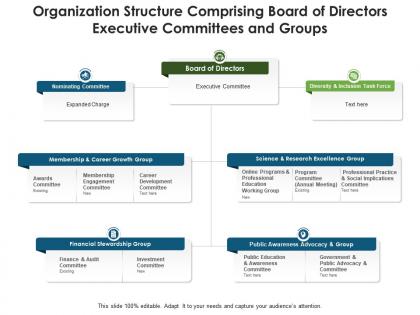
Organization structure comprising board of directors executive committees and groups




Try Before you Buy Download Free Sample Product
 Impress Your
 Audience
 100%
100% Editable
 Save Hours
 of Time


Our Organization Structure Comprising Board Of Directors Executive Committees And Groups are topically designed to provide an attractive backdrop to any subject. Use them to look like a presentation pro.
People who downloaded this PowerPoint presentation also viewed the following :
Organization structure comprising board of directors executive committees and groups with all 2 slides:
Use our Organization Structure Comprising Board Of Directors Executive Committees And Groups to effectively help you save your valuable time. They are readymade to fit into any presentation structure.

FAQs for Organization structure comprising board of directors executive
Honestly, you'll want to nail down transparency, accountability, fairness, and responsibility first. Independence is key - your board can't just be management's buddies. Financial reporting has to be spot-on and timely, plus protect all shareholders equally (not just the big guys). Leadership behavior matters way more than people think - it literally shapes your whole culture. Don't forget proper risk management and solid conflict-of-interest policies. Oh, and definitely audit what you've got now against these basics. You'd be surprised how many gaps most companies have lurking around.
Good governance actually makes a huge difference for performance. You get clearer accountability and way better decision-making when there's solid board oversight and transparent reporting. Investors eat this up too - it literally lowers your borrowing costs. Risk management becomes so much easier, and you'll allocate resources more strategically. Honestly, most companies are terrible at this stuff initially. I'd start by figuring out where your biggest governance gaps are. Then focus on the ones that'll move the needle on your core metrics first.
So the board of directors? They're like the company's watchdogs at the top. Major decisions, hiring/firing CEOs, making sure nothing shady happens - that's their job. They also handle executive pay and big mergers. Honestly, I've seen great companies tank because of terrible boards. When you're looking at investments, definitely check out who's on the board. You want people with real experience who aren't just buddies with the CEO. Oh, and diverse perspectives help too - groupthink kills companies faster than you'd think.
So shareholder engagement is basically your watchdog for corporate behavior. Active shareholders show up to meetings, grill executives about their ridiculous pay packages, and push for stuff like board diversity. Management can't just ignore them without losing support. It's honestly pretty effective - companies with engaged shareholders tend to have way better risk oversight and decision-making. Oh, and ESG stuff too if you're into that. Quick tip: check out a company's meeting attendance and voting patterns before investing. Tells you everything about how accountable they actually are.
Honestly, the biggest pain is always people hating change - doesn't matter what company, they'll fight new processes tooth and nail. Getting everyone on board takes forever. Board members who don't actually understand their duties? That's another headache, especially around compliance stuff. Smaller companies get hit hardest because they're trying to match what big corporations do but without the budget. Oh, and accountability gets messy fast when roles aren't clear. My advice? Get leadership truly bought in first - like actually committed, not just nodding along. Then focus on training and communication that doesn't suck.
Oh man, governance varies SO much by culture. Anglo-American places like the US are all about shareholder rights and independent boards. Germany's totally different though - they actually put employees on boards, which is kinda cool. Japan and South Korea? Family conglomerates everywhere, plus companies owning pieces of each other. Scandinavian countries are obsessed with transparency reports (honestly good for them). But seriously, do your homework before going international. What flies in New York could be a disaster in Tokyo.
So here's the deal with transparency and accountability - they're what stop companies from totally screwing up. Transparent decisions and financials? That builds actual trust with investors, employees, all those people. Accountability creates real consequences when stuff goes sideways (opposite of Enron, basically). Together they prevent boards and executives from doing whatever the hell they want. Honestly, I always check for clear reporting and accessible info when I'm looking at companies - it's like a built-in BS detector. Missing those? Red flag central.
So basically when new regulations drop, companies have to scramble and upgrade their whole governance game. You'll see stricter reporting rules, board changes, new compliance stuff - the works. Honestly, it's like clockwork after every big corporate scandal hits the news. Risk management gets overhauled, executive pay structures change, even how shareholders vote can shift. The smart move? Watch what's coming down the pipeline in your industry so you're not caught off guard later. Way better than playing catch-up when everyone else is already panicking about deadlines.
Honestly, I'd just start with a board self-assessment - it's cheap and you'll catch the obvious problems right away. Board evaluation surveys work great too since directors usually give pretty honest feedback about what's actually working. If you want to go deeper, governance audits give you the whole picture. Third-party assessments cost more but they're worth it when internal drama makes things weird. You could also try governance scorecards or just compare yourself to similar companies - sometimes that's all you need. The self-assessment thing though? Definitely do that first before spending big money on consultants.
Honestly, tech can be a game-changer for governance stuff. Board portals are great for sharing docs securely and tracking what gets decided. Real-time compliance monitoring beats waiting around for quarterly reports - analytics tools handle that nicely. There's AI now that automatically spots risks and conflicts of interest, which is pretty neat. Digital voting opens up shareholder meetings to more people. Oh, and blockchain creates those permanent audit trails that can't be messed with. Just don't go crazy buying every shiny new tool - focus on what'll actually fix your biggest headaches first.
Okay so first thing - get a proper risk committee going at the board level. Map out your biggest 5-10 risks and actually assign someone to own each one (this is where most places totally mess up). Set up regular risk assessments across the whole company, plus clear rules about what level of risk you're cool with taking. The best companies I've seen make this stuff feel almost boring because it's so systematic. Your board should get risk updates every quarter, not just when shit hits the fan. Oh and don't forget escalation procedures - you need clear paths for when things go sideways.
So basically, good governance makes companies think beyond just next quarter's numbers. Board oversight forces them to actually consider environmental and social stuff when making decisions. It's kinda like having a conscience built in, you know? The transparency requirements mean leadership can't just talk about sustainability - they have to put money behind it. You'll see exec pay tied to green goals, regular environmental reporting, all that. Honestly, some companies hate the accountability but it works. Start by looking at your current governance setup and figure out where you can weave in sustainability metrics.
Honestly, ethics is what stops corporate governance from being total BS. Your board can have all the rules in the world, but people will just game the system without real ethical standards backing them up. It builds trust with shareholders and stakeholders - plus it actually guides decisions when you're stuck in those weird gray areas where there's no clear regulation. Good governance isn't just about ticking compliance boxes (though my old boss used to think that was enough). Ethics shapes your whole company culture and drives accountability from the top down. Make sure you've got ethical guidelines baked into your framework, not just legal stuff.
Honestly, you'll want to set up different ways for people to actually talk to you throughout the whole process. Board meetings are obvious, but also try stakeholder surveys or maybe quarterly forums. Digital platforms work great too - way less hassle than in-person stuff. Make sure you're getting input from everyone who matters: investors, employees, customers, community people. The thing is, you gotta be upfront about what feedback you can actually use versus what you're just collecting to hear people out. Map out your key stakeholders first. Then pick like 2-3 methods that actually fit how your company operates.
Investors trust companies way more when they can actually see what's going on behind the scenes. Good governance means independent board members, clean financial reports, solid internal controls - all that stuff that shows you're not hiding anything sketchy. Think of it like... you wouldn't lend money to someone who won't show you their bank account, right? Bad governance scares people off fast and your stock price will definitely feel it. Honestly, if I had to pick just two things to focus on first, it'd be board independence and being super transparent with communication. Those make the biggest difference in how investors see you.
-
Easily Understandable slides.
-
Awesomely designed templates, Easy to understand.
-
Much better than the original! Thanks for the quick turnaround.
-
Illustrative design with editable content. Exceptional value for money. Highly pleased with the product.
-
Excellent design and quick turnaround.