


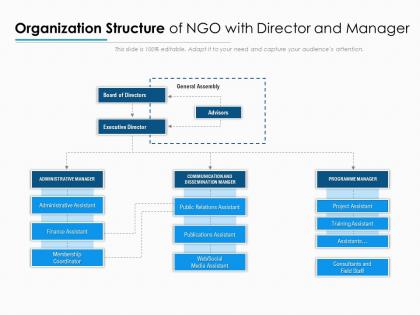
Organization structure of ngo with director and manager




Try Before you Buy Download Free Sample Product
 Impress Your
 Audience
 100%
100% Editable
 Save Hours
 of Time


Apprise them of every angle with our Organization Structure Of NGO With Director And Manager. Give them a fair idea of it all.
People who downloaded this PowerPoint presentation also viewed the following :
Organization structure of ngo with director and manager with all 5 slides:
Our Organization Structure Of NGO With Director And Manager assure full assistance. They keep hard at it endlessly.




FAQs for Organization structure of ngo with
Okay so you need four main things sorted out. First, get your board structure locked down - that's where most nonprofits mess up honestly. Then map out your program areas so they actually match what you're trying to do. Don't forget the boring stuff like finance and HR systems. Oh, and make sure everyone knows who reports to who because that gets weird fast. I'd start by drawing out what you have now and see where things overlap or don't make sense. Your org chart should show how decisions really happen, not just what sounds official. Trust me, clarity upfront saves so much drama later.
Here's my take: grassroots community work? Go flat. Fewer layers mean faster decisions and everyone stays plugged into the mission. But complex multi-country programs are different beasts entirely - you'll need departments and clear reporting lines or things get messy real quick. Honestly, I see too many NGOs just copying whatever structure sounds "professional." Don't do that. Think about how your specific mission actually gets done day-to-day. What decision-making process will serve your goals and the people you're trying to help? Structure should follow function, not the other way around.
So your board handles the big picture stuff - setting direction, making sure you don't go off the rails. Legally they're on the hook for oversight: budgets, hiring/firing your ED, compliance with all that regulatory nonsense. Most also help with fundraising and connections, though honestly some board members are total deadweight on that front. They should be asking hard questions about your programs and money, not just nodding along to everything you say. Oh, and define expectations clearly from day one. Trust me on this - it'll save you so many awkward conversations later.
Oh definitely go flat! Decision-making becomes so much faster without all those approval layers - super important when you're dealing with urgent stuff. Your team will feel way more empowered too, which honestly makes people way more creative. I've seen it happen. Plus you're not spending tons on management salaries, so more money goes to actual programs. Just heads up though - you really need solid communication systems in place first. Otherwise it gets messy fast. But yeah, the flexibility is totally worth it for most NGOs.
Ugh, the biggest pain is how slow everything gets. Approvals drag on forever while your field teams are stuck waiting to actually help people. Hierarchies also mess with NGO culture - people join expecting collaboration, not corporate BS. You'll lose that mission-driven vibe pretty fast. Plus there's this weird disconnect where leadership makes decisions without understanding what's happening on the ground. Honestly, I've seen orgs completely kill their startup energy this way. My take? Stay flat but make sure someone's still accountable for decisions.
Honestly, cross-functional teams are a game changer for breaking down those stupid departmental walls. Instead of program staff never talking to finance people, suddenly they're all working together on the same stuff. Decisions happen way faster since you don't need approval from like 50 different managers - that alone makes it worth it. Plus you get actually creative solutions when different people collaborate from the start instead of passing things back and forth forever. The marketing person might have an idea that totally changes how operations thinks about something. I'd definitely test it on one project first though before you blow up your whole structure.
Honestly, start by figuring out who talks to who about what - sounds basic but it's where most places mess up. Map out your current setup first and see where stuff gets lost. Regular check-ins help, plus use Slack or whatever for the daily back-and-forth. Your field people need a way to speak up when things go sideways, so don't skip that part. Oh, and actually write down big decisions somewhere everyone can see them. Simple rules that people will follow beat complicated systems every time.
So basically, small NGOs under 20 people can stay super flat - everyone does everything and reports straight to the top. Once you hit medium size though, you'll start needing actual program managers and fundraising people. Big ones? They're basically corporations at that point with HR departments and all that bureaucracy. I swear some lose their soul completely when they get that big. You want just enough structure so people can actually coordinate without turning into a slow-moving machine. Start simple and only add management layers when things genuinely start falling apart communication-wise.
Local NGOs are way more scrappy - everyone does like three different jobs. Program managers end up doing comms, fundraising, you name it. International ones? They've got the budget for actual specialists. UN agencies have dedicated M&E people, regional coordinators, the whole thing. Here's the weird part though - big international NGOs still partner with local ones anyway, so you'll probably work with both structures eventually. For job hunting, local gives you crazy broad experience super fast. International has better pay and benefits but you'll be more specialized. Really depends where you're at career-wise, I guess.
Managing volunteers is basically like running a second organization inside your main one - way more complex than it looks on paper. You'll need someone dedicated to recruiting, training, and keeping track of everyone. Plus all the systems to log hours and match skills to tasks. Yeah, volunteers expand what you can do without paying salaries, but honestly? You're swapping budget headaches for logistical ones. Role boundaries get messy fast when volunteers start doing staff-level work. If you're going heavy on volunteers, seriously budget for a full-time coordinator. Trust me on this one.
Honestly, start by timing how long basic approvals take - that'll shock you. Survey your staff about role clarity and whether they actually feel empowered (most don't, sadly). Track decision-making speed and how well info flows between departments. Staff satisfaction scores matter too, but don't forget your program results and beneficiary outcomes. Those external metrics are really what counts at the end of the day. Watch for bottlenecks where information gets stuck or teams doing duplicate work. Map out your current decision-making process first though - you'll probably find some weird redundancies you didn't know existed.
So during crises, you basically want to throw normal hierarchy out the window temporarily. Set up quick cross-functional teams and let your frontline people make decisions without waiting for approval from five different managers. Rapid response protocols help too - though honestly, I've seen some organizations get too caught up in the "protocol" part and forget the "rapid" bit. Partnership with other NGOs can stretch your resources way further. The communication thing is huge - everyone needs to know what's happening. Oh, and document everything that actually works so you're not reinventing the wheel next crisis.
Honestly, regulations are gonna dictate way more of your structure than you think. The IRS has super specific rules about board makeup and conflict policies - like, you can't just wing it. Each state throws their own curveballs too (seriously, why is the paperwork so different everywhere?). You'll end up needing people dedicated to financial reporting, grants management, all that compliance stuff. Donors want their own reports, which usually means separate staff for tracking impact. Oh, and board governance becomes this whole thing. Start by figuring out what you absolutely have to do legally, then build around that. Trust me, it's way easier than scrambling to fit compliance into whatever structure you already created.
Honestly, tech is completely changing how NGOs work now. Your team doesn't need those old-school hierarchies anymore - Slack lets you coordinate globally, apps handle volunteers, social media runs campaigns. It's crazy how much a tiny team can accomplish. Structure becomes way more fluid too. Project teams can pop up and disappear fast, or you'll work so closely with partners it feels like one big organization. Oh, and don't just copy corporate structures because that's "how it's done." Pick whatever tech actually serves your mission and build around that instead.
Honestly, you've got to build this stuff in from day one - can't just bolt it on later. Get specific about board diversity targets and actually recruit from communities you haven't tapped before. Mentorship programs help too, but here's what really matters: do diverse voices actually get heard in your big meetings? That's the real test. Start with a brutal audit of where you stand now. Then set real deadlines for change. Oh, and check if your "flexible" policies actually work for everyone or just look good on paper. Most companies mess this part up completely.
No Reviews