


Organization Structure Video Production Company Profile Ppt Summary




Try Before you Buy Download Free Sample Product
 Impress Your
 Audience
 100%
100% Editable
 Save Hours
 of Time


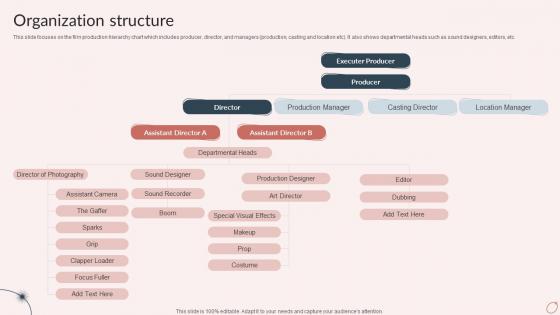
This slide focuses on the film production hierarchy chart which includes producer, director, and managers production, casting and location etc. It also shows departmental heads such as sound designers, editors, etc.
People who downloaded this PowerPoint presentation also viewed the following :
Organization Structure Video Production Company Profile Ppt Summary with all 6 slides:
Use our Organization Structure Video Production Company Profile Ppt Summary to effectively help you save your valuable time. They are readymade to fit into any presentation structure.





FAQs for Organization Structure Video Production Company
Honestly, start by figuring out what you're actually trying to accomplish as a company - your structure should make that easier, not harder. Map out where your current workflows are completely broken first. Don't give managers too many direct reports or they'll burn out fast. If you've got offices in different cities, that obviously changes things. Communication is huge too - info has to flow smoothly between teams and levels. Your company culture plays into this more than people realize. Some teams work better with tight hierarchy, others need more flexibility. Also think about how decisions actually get made day-to-day, not just on paper.
Honestly, your org structure makes or breaks team morale. When people know who reports to who and understand their actual role, they feel way more engaged - like their work matters. Too many layers though? That's where things get messy. People can't make decisions or figure out who to ask, so they just check out mentally. I've seen this happen so many times. You want enough structure so nobody's confused, but not so much bureaucracy that everything takes forever. Maybe sketch out how decisions actually get made right now? You'll probably spot where things are getting stuck pretty quickly.
So flat structures cut out middle management, which speeds up decisions and gets info flowing better between teams. People feel more empowered too since they can actually reach leadership. The downside? It gets chaotic when you're growing - nobody knows who's responsible for what, and some managers get buried under like 20 direct reports (I've seen it happen, not pretty). Plus you lose those promotion steps people want. Oh, and your communication has to be absolutely bulletproof or the whole thing crumbles. Worth trying if you're small, but have a solid plan first.
So matrix structures mean your people report to two managers - their regular department head plus a project manager. Pretty neat way to smash those department walls since everyone's working cross-functionally by default. Marketing, engineering, finance - they're all on the same team pushing toward shared goals. Yeah, having two bosses gets messy sometimes (honestly who thought that was a great idea?), but the collaboration boost is usually worth it. I'd say try it on a smaller project first to see how your team handles the whole dual authority situation before going all-in.
Honestly, tech completely changes how teams can actually work together. Information moves way faster now - no more waiting for stuff to trickle down through like five different managers. Remote tools mean you can build teams based on skills instead of just whoever's in the same office. A lot of middle management jobs are getting automated away (which makes sense since half of them just passed messages around anyway). You can organize around specific projects now rather than those old department silos. I'd start by figuring out where tech could fix your biggest communication headaches first.
Honestly? Start with just one or two teams - don't try to flip the whole company at once. Breaking down those departmental silos has to come first, otherwise you're just setting yourself up to fail. Get your managers trained as coaches instead of the usual micromanagement thing. Give teams clear goals but let them figure out the "how" part themselves. Communication's gonna be your biggest headache, not gonna lie. Find the teams that are already open to change and use them as your proof of concept. Some people will push back hard - that's just how it goes with culture stuff. Be patient though, this isn't a quick fix.
So functional structure basically means grouping people by what they do - marketing together, finance together, HR, operations, all that. Everyone reports up through their own department chain. It's pretty straightforward and honestly makes a lot of sense since people with similar skills can learn from each other and get really good at their thing. But here's the catch - departments can totally become their own little bubbles. Cross-department projects? Good luck with that mess. You'll definitely need solid communication between teams or you're gonna hate your life when trying to coordinate anything big.
So the main thing is that nonprofit boards actually run the show - they're not just there to look important like at most companies. With for-profits, the executives have the real power and boards are more like fancy advisors. Nonprofits are way flatter too since there's no profit motive driving all that competitive BS. They have to be super transparent with donors and the public, which is honestly refreshing compared to corporate secrecy. For-profits stick with traditional top-down structures because they're focused on returns. Just build in more collaborative stuff if you're dealing with nonprofits.
Honestly, start with decision-making speed - like how long does it take to get a simple approval? That'll tell you everything. Employee engagement surveys are huge too, plus checking if managers aren't drowning with too many direct reports. Communication flow matters - are people actually getting the info they need or playing telephone all day? I'd also look at role clarity through quick surveys and whether teams can actually work together on projects. Oh, and customer satisfaction scores are brutal but honest - if your structure's messing up service, customers won't stay quiet about it. Pick maybe 2-3 of these that match your biggest headaches right now.
Honestly? Your leadership style totally dictates what structure will actually work. Detail-oriented leaders usually go hierarchical - gives them that control they crave. But if you're more of a delegator (which, let's be real, is usually the smarter move), then flatter or matrix structures are your friend. Love collaborating? Cross-functional teams are perfect. More directive? Stick with clear chains of command. The trick is being brutally honest about how you actually lead - not some idealized version of yourself - then choose whatever amplifies those natural strengths.
Oh man, the worst thing you can do is rush it without getting everyone on board first. People will fight you hard if they don't get why stuff's changing. Most places just shuffle the org chart around but never actually fix what's broken underneath - so dumb, right? Same mess, different boxes. Communication during transitions is where things really fall apart. Nobody knows who does what anymore and suddenly everyone's battling over territory. I'd definitely map out responsibilities before you tell anyone anything. Give folks time to wrap their heads around it too.
Honestly, just ask people what's broken. Surveys work, but I'd do one-on-ones too - people open up more that way. Focus on the stuff that actually matters: where decisions get stuck, who's drowning in work, communication nightmares between teams. Leadership has to genuinely listen though, not just go through the motions. Once you have feedback, redesign your reporting structure around fixing those specific problems. Oh, and definitely test it in one department first before going all-in company-wide. People hate change, so be upfront about what you can and can't act on from their suggestions.
Remote work totally flattens org charts - way fewer middle managers needed when everyone's already chatting digitally. Geography stops mattering, so teams mix way more across departments. The hierarchy thing gets less rigid too. But here's the catch - you can't just walk over and ask quick questions anymore, so everything needs clearer processes. Document how decisions get made ASAP. Also invest in good collaboration tools that keep everyone in the loop. It's honestly crazy how much this shifts team dynamics - like, completely changes how people work together day to day.
Honestly, flat structures crush hierarchical ones for innovation. Ideas don't get buried under layers of approvals. People can actually experiment without asking permission from like six different bosses. Decision-making happens way faster too. Matrix structures work okay since teams share knowledge across departments, but they're kinda messy if you don't handle them right. The real problem with traditional orgs? Too much bureaucracy kills creative momentum before it even starts. Check how many hoops your ideas jump through - that's usually where innovation goes to die. Less layers = more breakthrough moments.
Honestly, having clear structure is a game-changer for making decisions fast. When everyone knows who's in charge of what, you don't get stuck playing phone tag asking "wait, who approves this?" Information flows better too since people know exactly where to send stuff. Short decisions can get handled at the right level instead of everything landing on your boss's desk – which they probably hate anyway. The key is figuring out where your current bottlenecks are. Half the time it's just because nobody knows who's supposed to decide what.
-
The customer care of SlideTeam is very responsive. I was having a payment issue and they fixed it for me in no time.
-
Design layout is very impressive.