


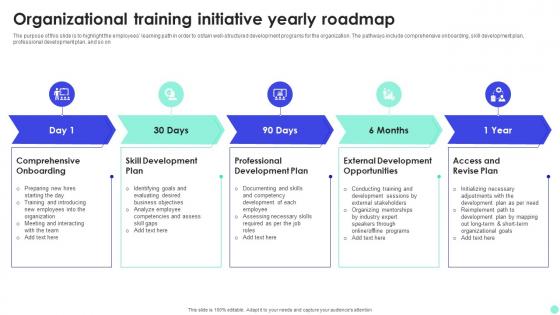
Organizational Training Initiative Yearly Roadmap




Try Before you Buy Download Free Sample Product
 Impress Your
 Audience
 100%
100% Editable
 Save Hours
 of Time


The purpose of this slide is to highlight the employees learning path in order to obtain well structured development programs for the organization. The pathways include comprehensive onboarding, skill development plan, professional development plan, and so on
People who downloaded this PowerPoint presentation also viewed the following :
Organizational Training Initiative Yearly Roadmap with all 6 slides:
Use our Organizational Training Initiative Yearly Roadmap to effectively help you save your valuable time. They are readymade to fit into any presentation structure.





FAQs for Organizational Training
Start with your skills gap analysis - figure out what people actually need vs what they have now. Then map out learning paths for different roles with clear objectives that tie back to business goals. Mix up your delivery methods too - online, in-person, hands-on stuff. Here's what most people mess up though: they skip building in milestones and metrics from the start. You'll never prove ROI without them. Also build feedback loops so you can pivot when things aren't working. Honestly, just work backwards from your end goal and you'll be fine.
Start with a skills gap analysis - figure out where your team is versus where they need to be. Survey employees about what they think they're missing, but also dig into performance data and customer feedback. Honestly, managers usually catch different issues than what people self-report, so ask them too. I'd work backward from your strategic goals for the next couple years - helps you see what's actually coming. Oh, and don't skip compliance stuff if that's relevant. Multiple perspectives are key since everyone has blind spots. Once you've got all that info, just prioritize by business impact and how urgent things are.
Look, strategic alignment is your north star for building training roadmaps. Map every program back to your company's actual goals and priorities. Otherwise you're just creating busy work that doesn't move anything forward. I've watched entire teams burn months on "important" skills that had zero connection to where the business was headed - such a waste! Check your org's strategic plan first. Find the capability gaps that could mess up those goals. Customer satisfaction tanking? Productivity issues? Prepping for market expansion? That's where your training focus should be. Don't get distracted by shiny skills that sound cool but won't actually help.
Track completion rates and test scores, but honestly? The real gold is seeing if people actually use what they learned back at work. Post-training surveys are whatever - wait 90 days for the follow-up, that's where you'll see real impact. Performance reviews should show improvement in areas you trained on. Fewer mistakes too. Oh, and set up your success metrics before launching anything, otherwise you're just guessing. Leadership loves seeing actual ROI numbers, so don't skip that part.
Honestly, just make a simple grid - impact on one side, effort on the other. Sounds basic but trust me, it works. Rank everything by how much it actually fixes critical problems or skills gaps that are tanking performance. Budget and time constraints obviously matter too. I'd look at which teams need it most urgently first - some programs have to happen before others anyway. The trick is being brutal about cutting the fluff. Like, does this training actually solve a real problem or is it just "professional development" that sounds good? Focus on what genuinely moves things forward, not the nice-to-have stuff that looks impressive on paper.
Honestly, feedback is like having GPS instead of just wandering around lost. Ask people what they actually need through surveys or just talking to them - you'll find out if they want more tech skills or soft skills training. Most folks will also tell you if you're overloading them with too many sessions (which happens way more than managers think). I'd start with maybe 2-3 simple questions about your current training stuff. The trick is actually doing something with their suggestions. When people see you listened, they'll keep being honest with you instead of just saying everything's fine.
Pick tools that fix actual training headaches, not whatever's trending on LinkedIn. Match your tech to what you're trying to teach - VR works great for hands-on stuff, mobile apps for quick reference. I've watched companies waste stupid amounts of money on shiny platforms that collect dust. Keep it simple and make sure it works on everyone's devices. Always pilot test with a few people first because something will break (trust me on this). Your learners need to navigate without wanting to throw their laptop out the window. Pretty features don't matter if the thing's impossible to use.
Quarterly reviews are the sweet spot, then do a big overhaul once a year. I'd put those check-ins on your calendar now - seriously, even 30 minutes helps catch skill gaps before they become problems. Most places just create these roadmaps and never touch them again, which is honestly pretty dumb. Your business changes, people give feedback, new priorities pop up. The annual review is when you really dig into what bombed vs what worked and figure out next year's focus. It's kinda like updating your phone - those small regular updates keep everything from crashing later.
Honestly, the worst part is always getting leadership to actually fund it properly - they never budget enough time or money upfront. Employee pushback is rough too, people already feel swamped so training feels like punishment. ROI is nearly impossible to measure quickly, which makes selling it even harder. Oh, and don't get me started on keeping everything updated when tech changes every five minutes. I'd say start with something tiny first - maybe just one team or department. Prove it works before going big. And seriously, make sure you have at least one exec who's actually excited about it, not just going through the motions.
Don't wait until the end to think about accessibility - build it in from the start. Survey your team about what barriers they're hitting, then actually fix those issues. Add captions to videos, make sure screen readers work, offer content in different formats. Plain English beats corporate speak every time. Also factor in learning styles, time zones (if you're spread out), cultural stuff. I mean, this should be basic by now but companies still slap it on as an afterthought. Your training's useless if half your people can't even access it properly.
Honestly, you need to check both right away and way later - that's the trick most people miss. Hit them with knowledge tests immediately after training, but the real gold is tracking their actual performance at 30, 60, 90 days out. Watch productivity scores, quality ratings, whether they're actually using the new skills daily. I'd throw in some behavioral stuff too - better teamwork, problem-solving, initiative levels. Confidence surveys help since sometimes people learn but don't feel ready to apply it yet. Peer feedback's clutch too. Just don't go crazy with data - pick like 5-6 key things and track them consistently.
Honestly, I'd go with like 70% hands-on, 30% classroom stuff. Do the formal training upfront for basics and compliance - you know, the stuff they actually need to sit through. Then just let them dive in and learn by doing with a good mentor nearby. Most companies mess this up completely and then act shocked when people quit. Here's the key though - whatever you teach in training needs to connect to real work they'll be doing within a couple weeks, not some hypothetical project months away. Oh and definitely build in regular check-ins where people can learn from each other. Figure out what absolutely has to be taught formally versus what they'll pick up naturally once they start working.
Honestly, you NEED leadership on board or you're basically screwed. They control the budget and set the vibe for whether people actually care about training or just phone it in. When your CEO or department heads publicly talk up a program, people notice. Without that support? Good luck getting anyone to take it seriously. Your leaders also need to walk the walk - if they're not learning new stuff themselves, why should anyone else? Plus they've got to give people actual time to apply what they learned instead of just dumping them back into the usual chaos. I've seen too many great training programs die because nobody followed up afterward.
Look, learning can't be this separate thing that happens "someday." Build it into the regular schedule - maybe learning Fridays or whatever actually works for your team. Leaders have to go first here, honestly. Share what you're reading, admit when you don't know stuff. Gets people comfortable with being learners too. Set up sessions where folks can teach each other random things they've figured out. Oh, and this is huge - when someone tries something new and it flops? Celebrate that they even tried it. That's how you actually shift the culture instead of just talking about it.
Honestly, you gotta break up those marathon training sessions - people's attention spans are shot these days. Try mixing in some gamification stuff and peer learning sessions. VR simulations are incredible for technical training, but they're expensive so maybe test the waters first. I'd also throw in some storytelling and real-world case studies that actually relate to your team. Mobile-friendly content works way better than boring presentations too. Oh, and reverse mentoring is surprisingly effective - younger employees teaching older ones new tech skills. Pick like 2-3 methods that won't break your budget and see what sticks.
-
You can rely on SlideTeam whenever you run out of designs for your presentation. Thank you so much SlideTeam!
-
“Excellent information with easy access.”