


Hazardous waste management powerpoint presentation slides




Try Before you Buy Download Free Sample Product
 Impress Your
 Audience
 100%
100% Editable
 Save Hours
 of Time


Having proper waste management saves space in landfills, results in valuable materials to reuse, decreases the amount of waste for disposal, etc. Scientific disposal of waste minimizes the adverse impact on human health and the environment. Here is a professionally designed hazardous waste management template to converse the natural resources of the planet. The purpose of this is to use all the wastelands received and leave nothing discarded. Firms can learn the techniques to develop new ways to convert waste into high value goods. The proposal showcases the target and the companys current situation using pie charts and tables along with future objectives. You can even study the parameters for hazardous waste management, the gaps, and required efforts to cover the holes, waste classification, and more. A solid waste monitoring system explains waste management, plans to reuse waste, automated segregation technology, e waste measures using various levels, etc. The template exhibits energy transformation from waste, decomposition of organic material, biodegradation process, disposal of garbage, solid waste status, impact on the environment, waste management, budget, types of bin, waste dashboards, sustainability indicators, etc. Talk to the expert for queries and get access to our template on hazardous waste management. Download it now.
People who downloaded this PowerPoint presentation also viewed the following :
Content of this Powerpoint Presentation
Do you know that negligent waste management generates over 2 billion tons of solid waste annually? Alarming, right? But what do we do about it? What do the corporate companies and the government do about it? And what do you do as an individual each day from beginning to end?
These days vivid environmental concerns are the fierce topics of all the global agendas. As a businesses or a company, you no longer have the luxury to overlook proper waste management systems. We have introduced a quick and easy solution that will not only help in managing hazardous waste but also plan for it in adnavence and present it.
Our Hazardous Waste Management PowerPoint Presentation slides are a multipurpose tool designed to help you and your organization with base-level knowledge and strategies needed to tackle the challenges of hazardous waste.
Template 1: Current Situation and Your Company’s Target Introductory Slide
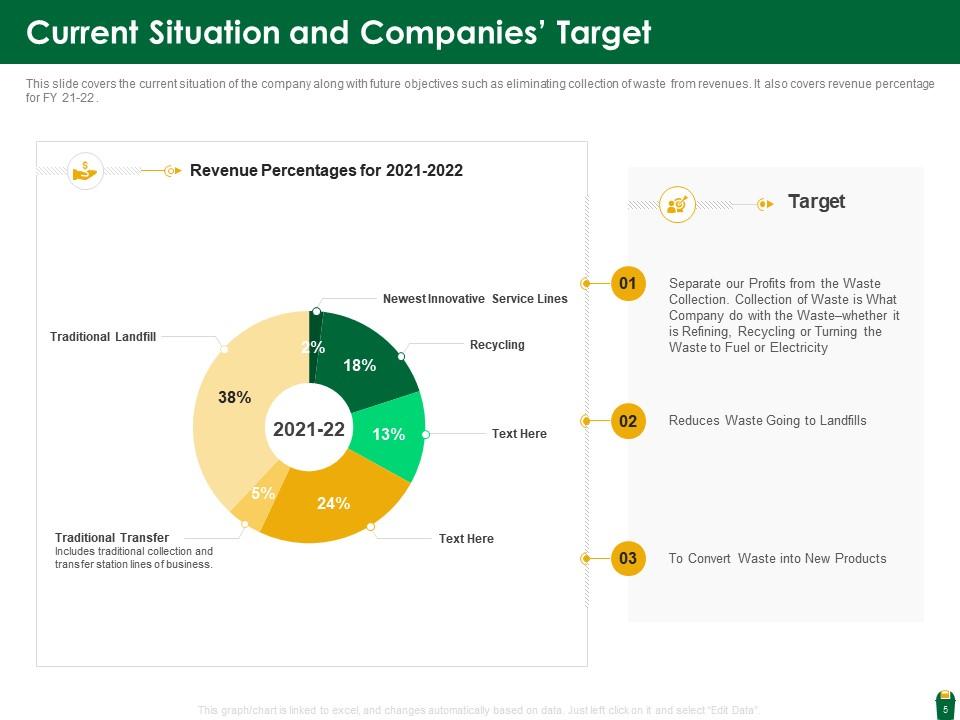
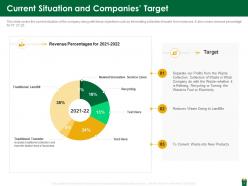
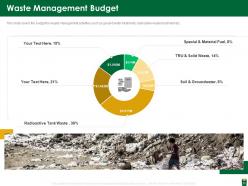
This slide provides you with very valuable information that will help your firm with its hazardous waste management strategy. Your team is able to get a clear understanding of where resources are currently allocated in waste management and disposal from the pie chart.
By comparing the revenue distribution over the years, your company would be able to trace the improvement and the ongoing trends that enable it to make rational decisions and adjust strategies accordingly. The timeline feature helps set and attain targets, enabling your team to make tangible steps toward sustainability goals.
Template 2: Waste Classification For Hazardous Waste Management Powerpoint Presentation Slides
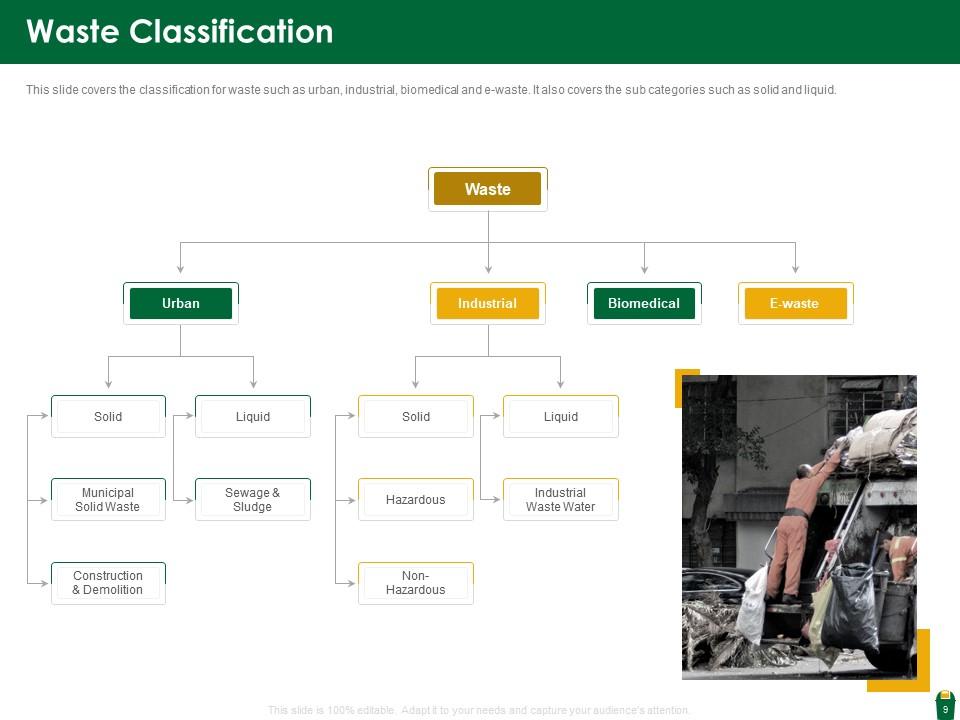
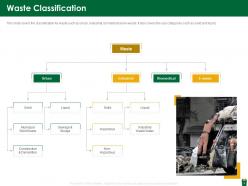
Our Waste Classification Flow Chart is your go-to for understanding how you can classify different types of waste in accordance with your industry-specific needs. It has a flow chart that provides a solid foundation for developing hazardous waste management strategies. The simple slide divides waste into four broad categories: urban, industrial, biomedical, and e-waste. You can take this slide as a starting place to further learn or develop the strategies for hazardous waste management through this hazardous waste management PPT slide.
This classification will help your firm to identify the type of waste it generates. Once that is sorted, you can think about specific strategies for managing each category of waste effectively. Take this as a basis for your organization’s targeted initiative planning to reduce the amount of waste generated by them. If you are looking for comprehensive hazardous waste management powerpoint presentation slides, you can check out out Waste Management Powerpoint Ppt Template Bundles.
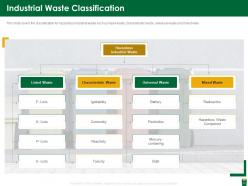
Template 3: Industrial Waste Classification Hazardous Waste Management PPT Slide
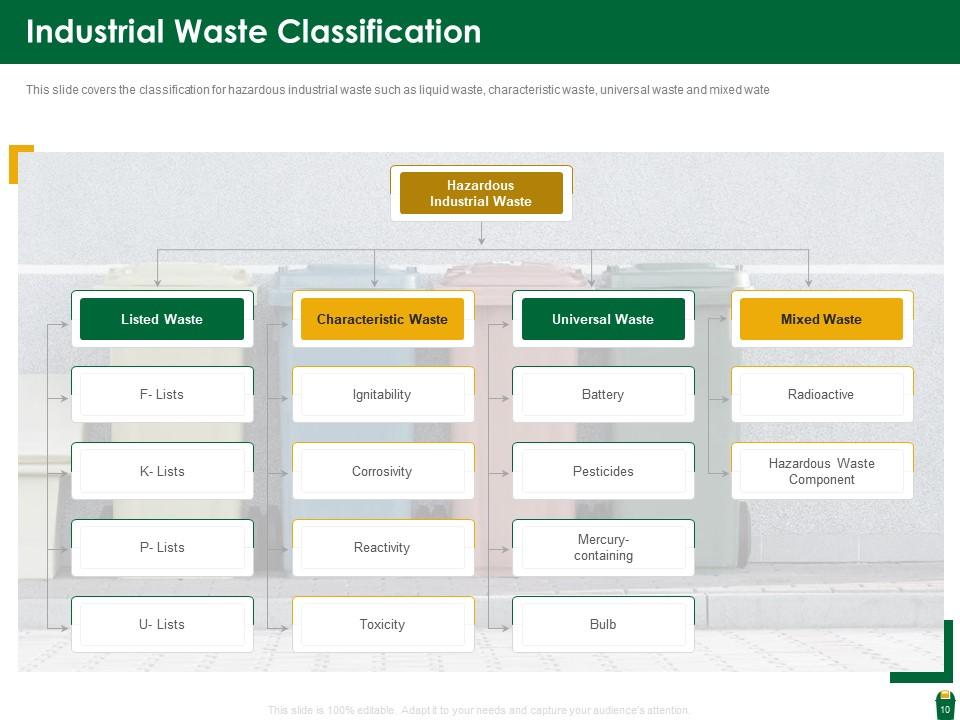
This slide presents a flowchart that details the category of industrial dangerous wastes. Industrial surface unsafe wastes are divided into four important categories: indexed wastes, widespread wastes, accepted wastes, and blended wastes types.
The indexed waste has specific classes together with F List, K List, P List, and U List to help your crew perceive and classify risky materials according to regulatory guidelines. Specialty Waste is classified on its traits, such as flammability, corrosion, reactivity, and toxicity Waste characteristics are simple.
By following this manner, your business can more correctly classify industrial unsafe waste, enabling higher storage, transportation, remedy, and disposal choices. You can use this chart as a tool in your agency’s hazardous waste control procedure to encourage sustainable practices.
Template 4: Automated Segregation Technology Slide For Your Hazardous Waste Management PPT
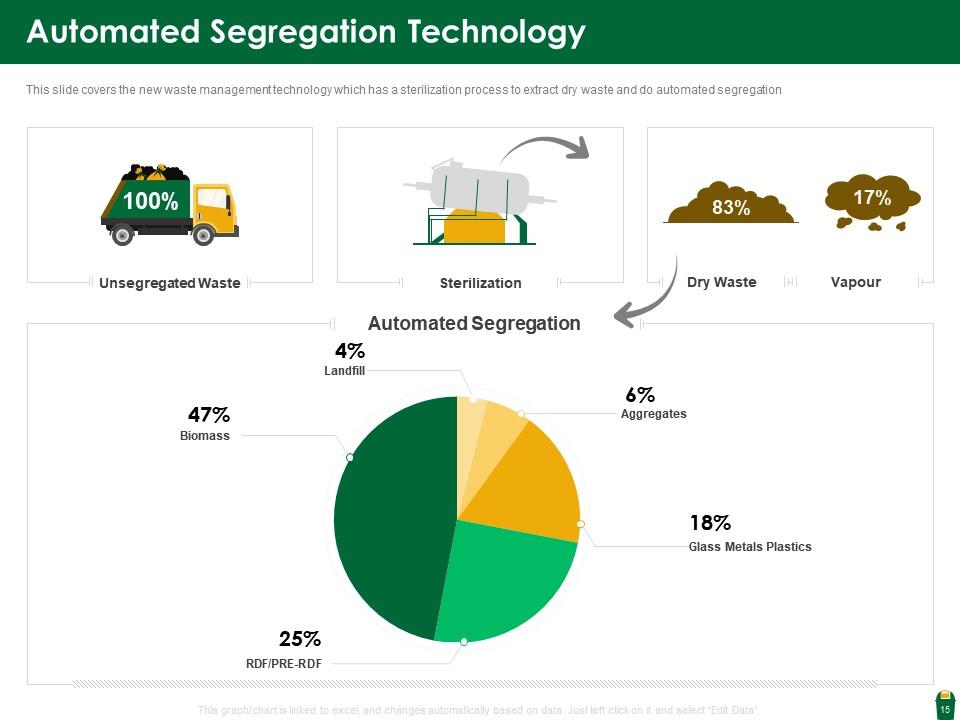
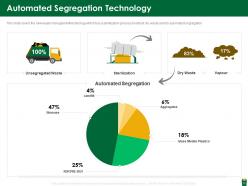
This slide introduces automated segregation technology, elucidating its system of waste segregation for risky waste management. It features a pie chart illustrating probabilities of segregation across diverse waste classes, together with biomass, landfill, aggregates, glass, metal, plastics, and Refuse-Derived Fuel (RDF), among others.
Additionally, the slide gives an in-intensity exploration of the levels of computerized sterilization for dangerous waste control. Using this slide, derive insights into the skills of automated segregation technology and its capacity effect on waste control practices. Each level is visually represented through slides.
Template 5: Construction and Demolition Waste Management Technology Slide
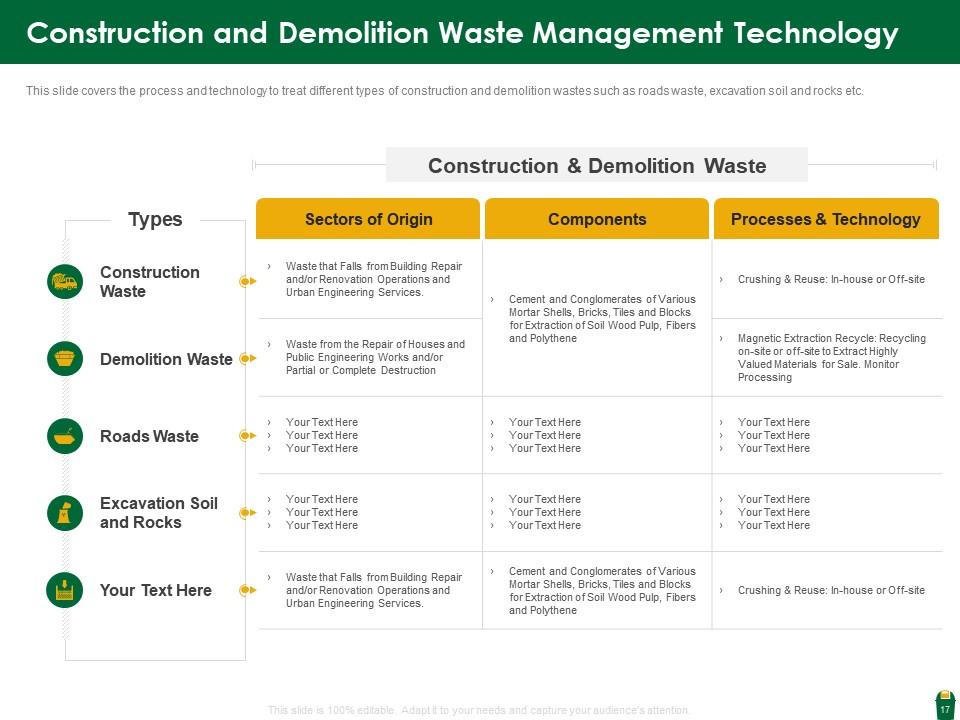
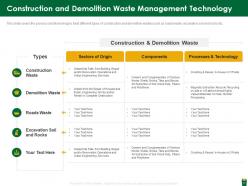
Our Construction and Demolition Waste Management Technology slide provides insights into treating numerous sorts of creation and demolition waste. At the top, it categorizes waste into types along with creation waste, demolition waste, road waste, and excavation soils and rocks.
The slide also breaks down the management manner into 3 key sectors: Foundation, components, and procedures & technology. From figuring out waste sources to deciding on suitable treatment methods, the slide does it all.
These sectors are presented via tables detailing the resources of waste generation, the additives of every kind of waste, and the corresponding procedures and technology used for effective management.
The slide equips agencies with the understanding and gear to implement efficient waste management techniques in construction and demolition tasks. From figuring out waste sources to deciding on suitable treatment methods, the slide does it all.
Template 6: Decomposition of Organic Material Planning For Your Company
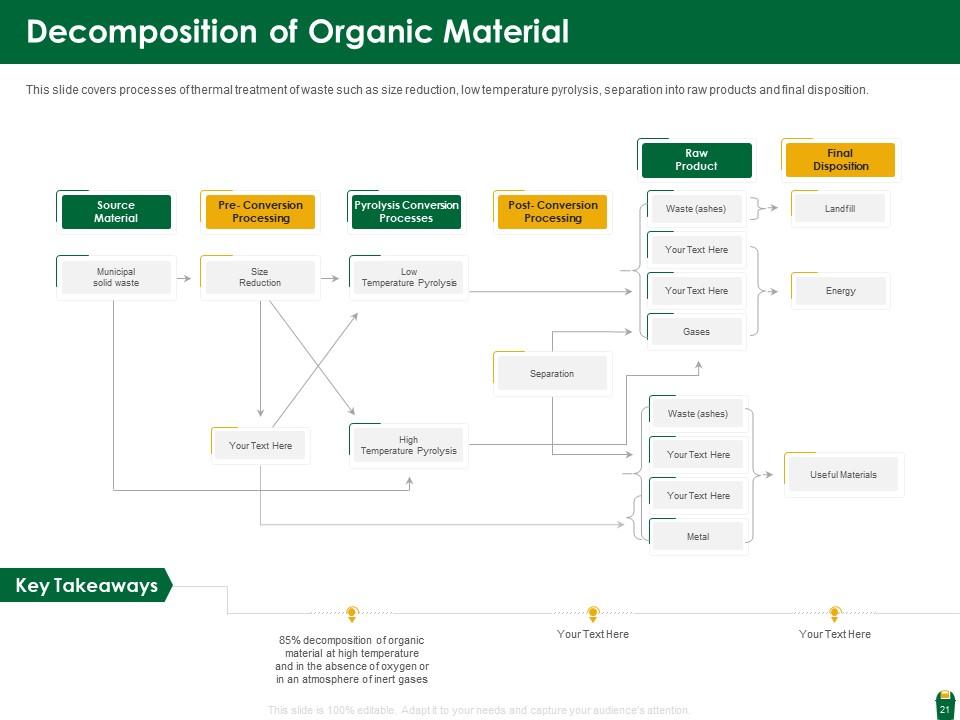
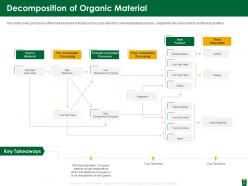
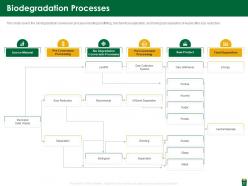
This slide has the decomposition of organic material. It outlines the process of thermal treatment of waste through a flowchart-based approach. It starts from the source of the material to its final deposition. The flowchart has sequence wise steps involved in the thermal treatment process, including collection, transportation, sorting, and treatment, to the final deposition of the decomposed organic material. Additionally, the slide includes a key takeaways section at the end. It will help you in summarizing the main points. If you are a company looking for Lean waste management powerpoint presentation slides, we can help!
Template 7: Disposal Of Hazardous Waste and Water PPT Template
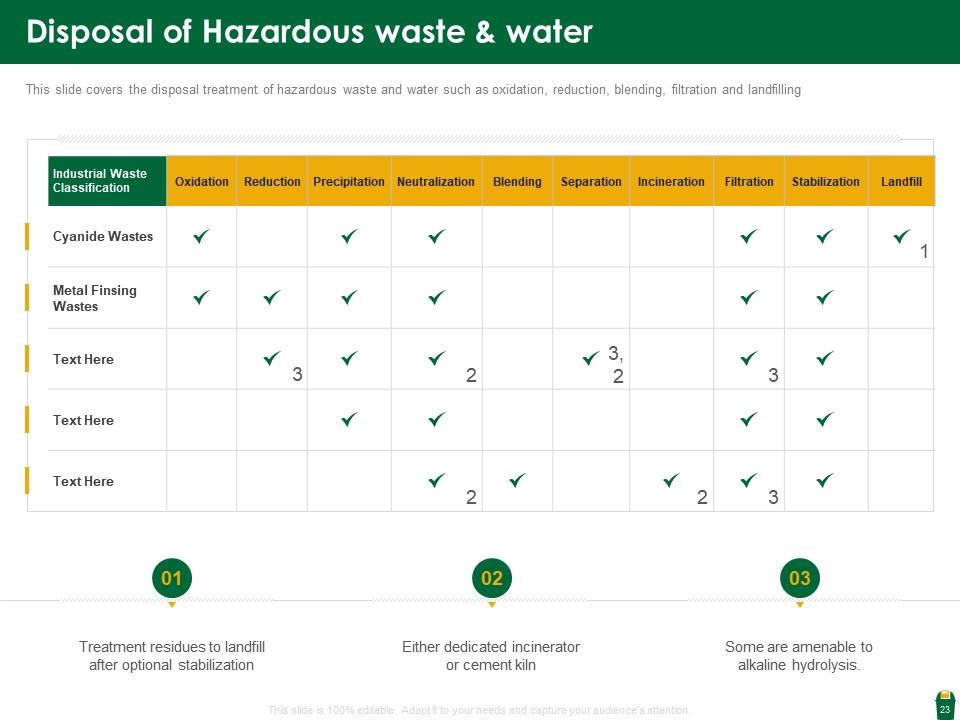
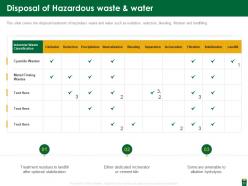
This slide has an overview of the disposal of hazardous waste and water management strategies. It has sections featuring industrial waste classification-based columns for various waste types. The major ones focused here are cyanide waste, metal finding waste, and more, with additional editable columns to accommodate specific waste characteristics and disposal methods.
The parameters cover a range of disposal techniques. From oxidation and reduction processes to precipitation, neutralization, and separation methods, it covers all. There is an editable timeline section at the bottom.
Template 8: Waste Management Manpower Budget Slide For Your Company
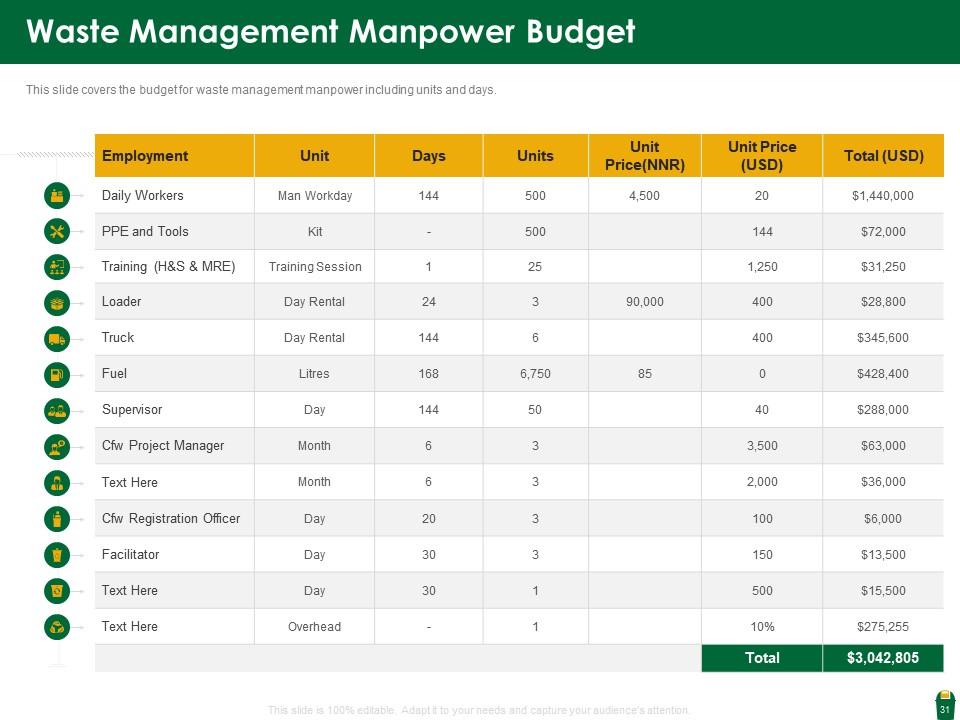
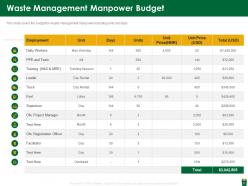
This slide offers a comprehensive overview of your firm's waste management manpower budget. It is structured to include options such as record-keeping or daily workers, personal protective equipment and tools, training expenses, loader and truck operations, fuel costs, registrations, and personnel officers, with the flexibility to insert additional text options as needed.
You can also check out our Waste Management Service Proposal Powerpoint Presentation Slides for a deeper understanding.
Template 9: Sustainability Management Key Performance Indicators Slide
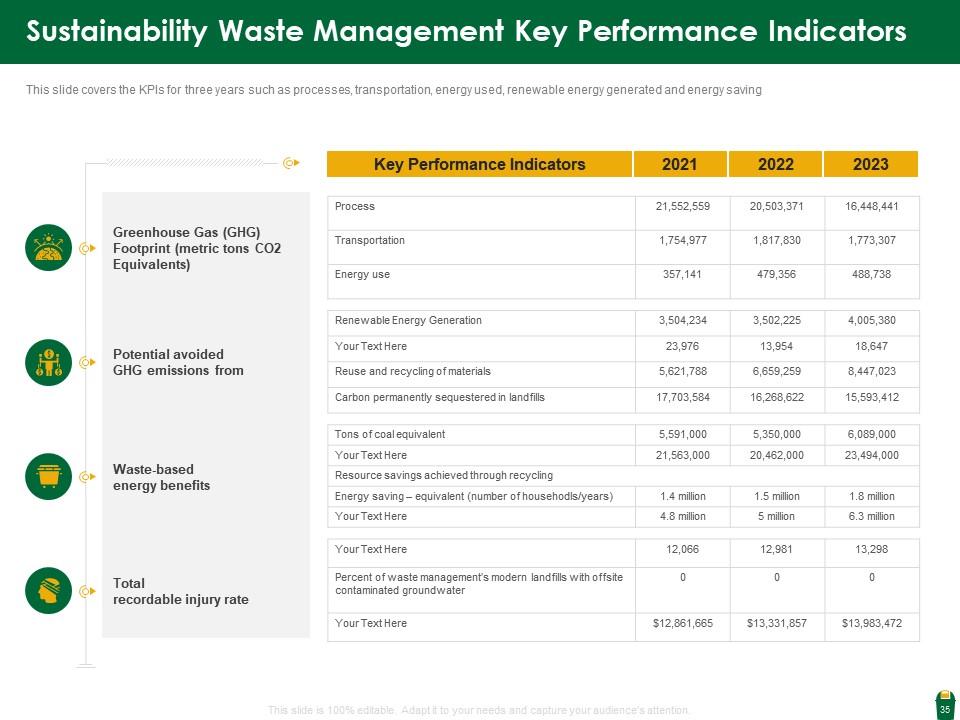
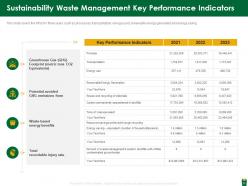
Use the key performance indicators (KPIs) showcased in this slide for sustainability in waste management. It highlights four critical parameters: Total recordable injury rate, waste-based energy benefits, potential avoided greenhouse gas (GHG) emissions, and greenhouse gas footprint. Each parameter has numerous sub-sections representing specific KPIs, with data columns which can be organized across financial years. The recordable overall performance of waste management operations are needed for tracking metrics inclusive of accidents, incidents, and protection training initiatives and the slide covers that. By systematically tracking those KPIs and analyzing tendencies over the years, evaluate the effectiveness in their sustainability initiatives. This slide serves as a treasured tool for tracking development, demonstrating responsibility, and fostering a culture of sustainability in the organization.
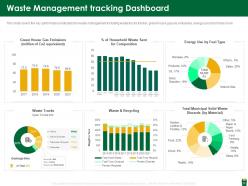
Template 10: Waste Management Tracking Dashboard
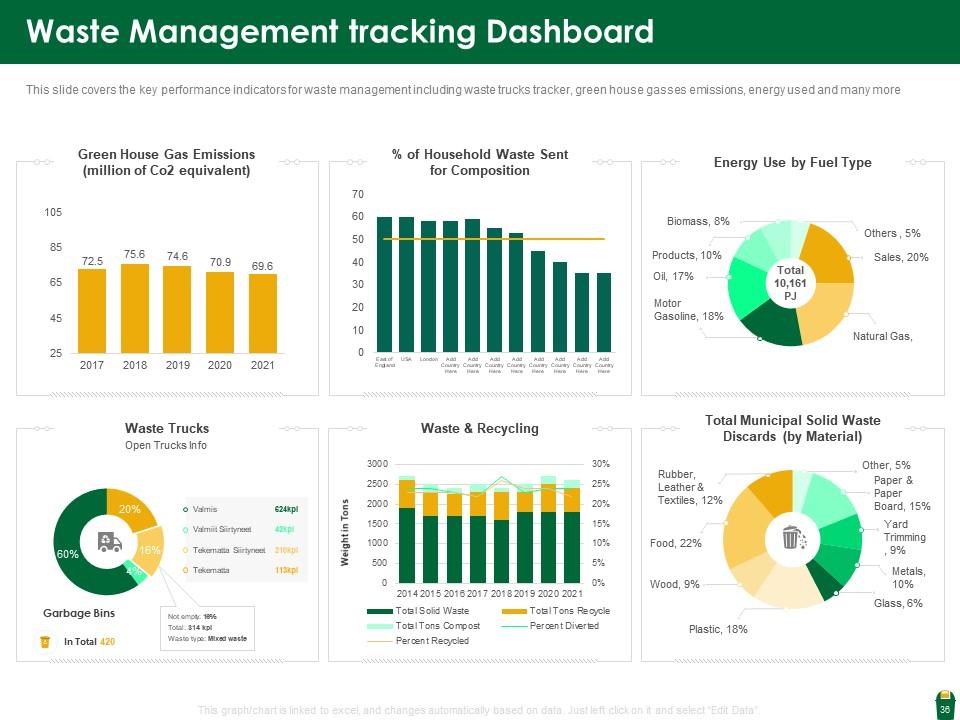
This is one of the most useful slides of the template. Our Waste Management Tracking Dashboard is your tool for monitoring waste management related practices for your organization. You can also keep tabs on the movement of trucks for waste collection with the Truck Tracker feature. In this slide, you also get to visualize the environmental impact of waste management activities. The Greenhouse Gas Emissions Bar Graph helps you with the same. There is also a Percentage of Household Waste Sent for Composition chart that will help you strategize the distribution and disposal strategies that fit your business needs.
The Energy Used by Fuel Type Pie Chart gives you an overview to help you analyze the proportion of energy derived from fuel sources. This slide features a Waste and Recycling Percentages Graph Monitor to help you monitor your company’s progress towards waste and recycling targets.
Finally, the Total Solid Waste Disposals by Material Pie Chart helps to Identify materials contributing the most to landfill waste and explore opportunities.
**************
EMBRACE BEST PRACTICES
The time to act is now. By using the power of data as an input into this hazardous waste management PowerPoint Slide and embracing best practices in hazardous waste management, you can position your organization as a leader in sustainability. And this not only helps the environment but helps the company’s brand positioning. From the first slide on current situation and targets to the next detailed slides of flowcharts and process and diagrams illustrating waste classification, decomposition of organic material, and automated segregation technology, we have got all covered. Other slides includine waste classification, industrial waste management, construction and demolition waste management, and the use of technology for waste segregation and disposal. Get the slide today.
Hazardous waste management powerpoint presentation slides with all 46 slides:
Use our Hazardous Waste Management Powerpoint Presentation Slides to effectively help you save your valuable time. They are readymade to fit into any presentation structure.


FAQs for Hazardous waste management
So the main ones are RCRA in the US - that's your cradle-to-grave tracking system. EU has the Waste Framework Directive for European countries. EPA runs federal stuff here but states can get way stricter (California's always extra about everything). Canada uses CEPA, Australia's got their National Environment Protection Act. Honestly, each country does their own classification thing and disposal rules, which is kind of a pain. If you're dealing with multiple countries, you'll have to dig into local regs for each spot. First step though - figure out what category your waste fits in each place. That determines everything else.
Look, just start with a full inventory of everything - chemicals, materials, waste, the works. Check all your safety data sheets since they'll tell you what's actually hazardous. Honestly, people always miss the obvious stuff like batteries and cleaning supplies, so don't skip those. Walk through every department and track what comes in, gets used, and goes out. Your environmental team should help with the regulatory side of things. Make a master list and actually keep it updated when you add new materials. Oh, and fluorescent bulbs - those get people every time.
You'll mostly deal with solvents, heavy metals, acids/bases, and paint waste. Solvents are literally everywhere in manufacturing - spent cleaning stuff, metal plating solutions with chromium or lead. Surface treatments create corrosive chemicals too. Paint booth waste is obvious, but machinery oil and grease count as hazardous which catches people off guard sometimes. Electronics adds circuit board etchants and soldering waste to your headaches. Honestly, just do a waste audit first. Walk through your processes and you'll probably find way more hazardous stuff than you realized that needs proper disposal.
Honestly, start with an audit to see where most of your waste comes from - that'll show you the biggest bang for your buck. Source reduction is huge - swap out nasty chemicals for safer ones when you can, or just use less of the bad stuff. Don't over-order inventory either, because expired chemicals are such a pain to deal with. Better training helps too since people waste less when they actually know what they're doing. Sometimes you can tweak your equipment or processes and boom - way less waste. I'd definitely hit the worst offenders first rather than trying to fix everything at once.
Honestly, you can't mess around with hazardous waste without the right tech. High-temp incinerators destroy toxins completely, while bioremediation uses bacteria to eat contaminants (which is pretty cool actually). Plasma arc systems handle the worst stuff - still feels futuristic to me. Real-time monitors track air quality and groundwater 24/7. Here's the thing though: match your waste type to the technology. Don't cheap out when people's health is on the line. Some facilities try to cut corners but that's just asking for trouble down the road.
Dude, you really don't want to mess this up. Your workers could get seriously sick from toxic exposure - skin problems, breathing issues, worse stuff down the line. Environmental contamination is another nightmare - if that crap leaks into groundwater, you're looking at massive cleanup bills and lawsuits. Regulatory fines are brutal too. I know a guy whose company got hit with like $200K for bad disposal practices. Honestly, the EPA doesn't play games. Get your team trained properly and only use certified disposal companies. Worth every penny to avoid that headache.
So hazardous waste landfills are basically Fort Knox compared to regular ones. Multiple liner systems, leachate collection, groundwater monitoring - the whole nine yards. Regular landfills just handle your typical trash with basic protections. But hazardous sites? They've got double or triple composite liners instead of simple clay ones, plus gas collection systems for all the nasty vapors that can build up. Permits take forever and cost a fortune too - honestly such a pain. If you're dealing with hazardous stuff, definitely use a certified facility and keep those manifests detailed for compliance purposes.
Start with HAZWOPER training - that's your baseline for handling hazardous materials and emergency response. Site-specific training comes next so people know your facility's unique risks. PPE training is crucial too because the wrong gear can be deadly. Annual refreshers aren't optional, they're required by law. I'd throw in waste minimization and labeling courses since those seem to confuse everyone (honestly, the number of mislabeled containers I've seen is ridiculous). Document everything religiously - OSHA inspectors will dig through your records and you don't want gaps.
Oh man, there's some really cool stuff happening! Plasma gasification basically turns toxic waste into useful gas and this glass-like material. AI sorting systems are crazy good now - way better than people at picking out hazardous stuff. Then you've got these engineered bacteria that literally eat toxins, which honestly sounds like sci-fi but it works. Chemical recycling lets you pull valuable metals from old phones and batteries instead of just tossing them. Some facilities don't even need external power anymore. Definitely check what's available near you though - regulations are all over the place depending where you live.
First thing - figure out what hazardous stuff you're actually dealing with and how EPA classifies it. Storage and labeling has to be done right, plus you'll need licensed haulers for disposal. The paperwork is honestly such a pain but you can't skip it. Track everything with manifests and keep records for three years minimum. Your staff needs training on handling procedures too - that's where accidents happen. Oh, and do yearly compliance checks yourself. Way better to find problems before the regulators show up at your door.
Honestly, community involvement is huge for hazardous waste stuff. People need to know what counts as hazardous - otherwise you get folks throwing old paint and batteries in regular trash (seriously happens all the time). When communities actually care, they show up to collection events and follow the rules. Informed residents push for better local policies too. Education programs work really well, but you've got to make disposal convenient or people won't bother. I've seen towns where they made it super accessible and compliance rates shot up. It's one of those things where a little upfront investment really pays off.
Okay so first things first - don't even think about moving that stuff yourself unless you've got the right licenses. Find a certified hazmat transporter with proper DOT credentials (definitely verify those). Your waste needs to be classified and labeled correctly before pickup. The manifest paperwork is honestly kind of a pain but super important - it tracks everything from start to finish. There are tons of different waste codes and shipping rules that can get confusing fast. Just make sure you keep copies of all the documentation. Trust me, it's way better to pay someone who knows what they're doing than deal with regulatory headaches later.
Dude, this stuff is no joke - hazardous waste can contaminate soil, water, and air for literally decades. Groundwater gets poisoned, plants die from toxic soil, and the air becomes dangerous for people and animals. What really sucks is how contaminants spread way beyond where they started through water and wind currents. Once an ecosystem gets messed up like that, it destroys entire food chains. Trust me, just follow proper disposal rules from day one. I've seen cleanup bills that'll make you cry compared to handling it correctly upfront.
So it really comes down to three main things: containing it, treating it, then getting rid of it. But honestly? What you do depends totally on what kind of contamination you're dealing with. Physical methods work - like digging it up or soil washing. Chemical treatments are another route, think oxidation or neutralization. Biological is pretty cool too, basically microorganisms eat the bad stuff. Thermal treatment's solid for organic compounds. Here's the thing though - you absolutely need a proper site assessment first. Don't skip that step! Get an environmental consultant to evaluate everything. Trust me, it'll save you so much trouble down the road.
Track your waste reduction and disposal costs - that's where you'll see real progress. Staff surveys are honestly pretty valuable since they're dealing with this stuff every day and catch things you won't. Run internal audits plus get third-party ones too. Don't forget about permit violations and near-misses, those add up quick. Training completion rates matter as well. The bottom line? You want waste and costs dropping year over year. If you haven't already, set your baseline measurements now or you'll have nothing to compare against later.
-
Unique design & color.
-
Content of slide is easy to understand and edit.
-
Use of icon with content is very relateable, informative and appealing.
-
Great experience, I would definitely use your services further.
-
Wonderful templates design to use in business meetings.