


Overview Of Sales Prospecting Process Training Ppt




Try Before you Buy Download Free Sample Product
 Impress Your
 Audience
 100%
100% Editable
 Save Hours
 of Time


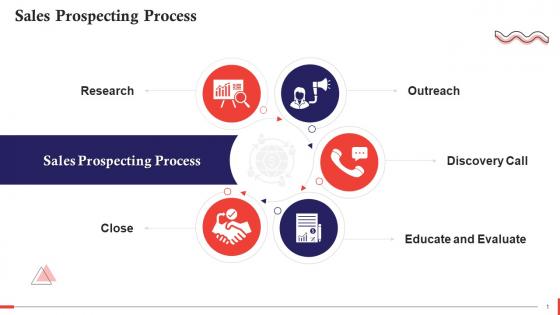
These slides showcase the sales prospecting process. The steps of the process are Research, outreach, discovery call, educate and evaluate, and close.
People who downloaded this PowerPoint presentation also viewed the following :
Content of this Powerpoint Presentation
Slide 1
This slide showcases the sales prospecting process. The steps of the process are: Research, outreach, discovery call, educate & evaluate, and close.
Slide 2
This slide explains the first step in the sales prospecting process, which is research. It highlights the importance of conducting additional research on prospects who are a good fit. It also states that during this phase, businesses seek to determine the prospect's quality and whether they will make a purchase based on their budget and needs.
Slide 3
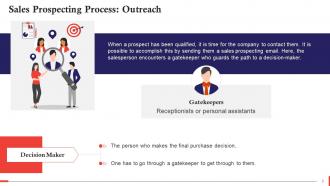
This slide explains the second step in the sales prospecting process, which is outreach. It highlights that once a prospect has been qualified, the company should contact them, which could be done by sending them a sales prospecting email. It also mentions that the salesperson will come across a gatekeeper who will control access to a decision-maker during this step.
Slide 4
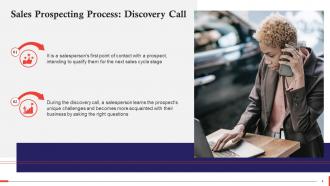
This slide explains the discovery call, the third step in the sales prospecting process. It highlights that Discovery Call is a salesperson's first point of contact with a prospect, with the goal of qualifying them for the next stage of the sales cycle. It also states that by asking the right questions during the discovery call, a salesperson learns the prospect's unique challenges and becomes more acquainted with their business.
Slide 5
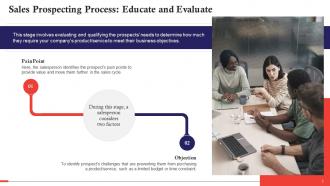
This slide describes the fourth step in the sales prospecting process, i.e., educating and evaluating prospects. It highlights that this stage entails evaluating and qualifying the prospects' needs to determine how much they require your company's product/service to meet their business objectives. It also states that during this stage, a salesperson addresses prospects' pain points and the reasons for their objection.
Slide 6
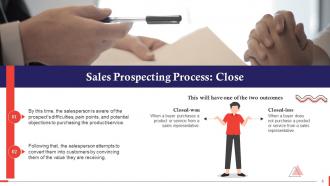
This slide explains the fifth step in the sales prospecting process i.e., closing. It highlights that the salesperson is aware of the prospect's pain points, potential objections, and other reasons for purchasing the product/service by this time. The salesperson then attempts to convert them into customers by persuading them of the value they are receiving. It has one of the two outcomes: closed-won or closed-loss.
Overview Of Sales Prospecting Process Training Ppt with all 22 slides:
Use our Overview Of Sales Prospecting Process Training Ppt to effectively help you save your valuable time. They are readymade to fit into any presentation structure.








FAQs for Overview Of Sales Prospecting
Honestly, LinkedIn's still your best shot for B2B stuff. You can actually research people before reaching out instead of going in blind. Email sequences work great too - way easier to scale than manually typing everything. Cold calling? Yeah, it converts but good luck getting past voicemail these days lol. What I'd do is hit them on LinkedIn first, maybe engage with their posts or whatever. Then follow up with email. Save the phone call for when you're ready to close. Using all three together beats just spamming one channel.
Do your homework first - check out their company news or recent challenges so you can actually personalize your opener. Those first 10 seconds? Absolutely crucial. Don't just dive into your pitch right away. Ask questions and really listen to what they're saying back. I always practice my responses to "we're not interested" beforehand because stumbling there kills your momentum. Focus on solving their actual problems, not rattling off product features they don't care about yet. Oh, and record yourself practicing - you'll catch all those "ums" and weird pauses you didn't know you were doing.
Dude, social media is seriously a game-changer for sales now. LinkedIn's obviously the king for B2B stuff, but Twitter's actually pretty solid for catching industry buzz and company updates. Here's what works - spend like 10 minutes a day stalking your prospects (in a professional way lol). Check out their interests, recent company drama, mutual connections. Then engage for real before you pitch anything. Comment on their posts, share their stuff, build some actual rapport first. I mean, you can even see what they had for lunch these days, though maybe don't lead with that conversation starter.
Honestly, data analytics just takes all the guesswork out of prospecting. Instead of randomly reaching out to people, you can look at your past customers and figure out what actually works - like which company sizes or industries convert the best. Then score your leads based on that stuff. Track who's opening your emails too, because there's no point chasing people who aren't even looking. I'd start super simple though, maybe just tracking where your best leads come from first. Once you get used to it, you'll wonder how you ever did prospecting without it.
Honestly, just focus on four things: response rates, how many prospects turn into actual qualified leads, time spent vs meetings you actually book, and pipeline value. I used to get obsessed with email opens - total waste of time lol. What really matters is tracking conversions at each step. Like prospect to conversation, conversation to meeting, meeting to opportunity. That's where you'll spot the weak links in your process. Oh and don't try tracking everything at once. Pick two metrics this month or you'll drown in spreadsheets.
Dude, you HAVE to personalize these emails or you're toast. Those generic "Dear [First Name]" blasts? Everyone deletes them instantly. I swear, prospects can spot mass emails from space. Here's what actually works - mention their recent funding round, drop a mutual connection's name, or reference something from their LinkedIn. Takes like 2-3 minutes of research but it's night and day difference. Shows you're not just blasting everyone with the same tired pitch. When you do your homework first, people actually respond. Trust me on this one.
Honestly, most people just spray and pray - they blast the same boring email to everyone and wonder why nobody responds. The other thing? They give up way too fast. Here's what actually works: spend like 2-3 minutes stalking each prospect first. Check their LinkedIn, company news, whatever. Then mention something specific in your opening line - not some generic "I hope this finds you well" garbage. And for the love of god, don't quit after one email. Most sales happen after multiple touchpoints, so set up a proper follow-up sequence. People are busy, they're not ignoring you on purpose.
B2C is all about volume - blast out those emails and social ads to tons of people since each deal is smaller. B2B? Totally different game. You're basically becoming a detective, digging into LinkedIn profiles and hunting down mutual connections. The deals are way bigger but take forever because you've got like 5 different people who need to sign off. I swear, sometimes I spend more time researching one B2B prospect than I do on 50 B2C leads. Figure out which type you're dealing with first. Then you'll know if you should spend 2 minutes or 2 hours per person.
Honestly, LinkedIn is your best friend here - dig into their company page and recent posts. Their "About Us" sections are goldmines (people sleep on those). Check news articles and press releases too. I use the BANT thing - budget, authority, need, timeline - to figure out if they're actually worth pursuing. Tools like ZoomInfo or Apollo help, but even Google alerts work. Don't spend forever on this though. Like 5-10 minutes per lead max, just enough to write something that doesn't sound copy-pasted. Generic outreach is basically throwing money away at this point.
Okay so here's what works for me - always lead with a quick story about another client who had the exact same problem. Use that "before, during, after" thing because honestly it's basic but it just works. Make them the hero though, not you. You're just the person who helped them figure it out. Get specific with real numbers and timelines instead of those boring generic case studies everyone uses. Like, actual emotions too - people remember how things felt. Then at the end, tie it directly back to what they're dealing with. The whole point is they should be thinking "oh shit, that could be us" by the time you're done talking.
Definitely hit them up within 24-48 hours - you want to stay top of mind. After that, I'd do day 3, then maybe week 2, and again at the one month mark. Don't just send those generic "checking in" messages though, they're the worst. Always bring something useful - an article, insight, whatever makes sense for them. Switch it up between email, LinkedIn, calls. I always try to mention something we actually talked about so they know I wasn't just going through the motions. Just don't be that pushy salesperson nobody wants to deal with. Set up reminders so you don't forget people.
Dude, testimonials are gold for cold outreach. Drop them right in your emails, especially from companies that look like your prospect's. People trust other customers way more than they trust us salespeople - it's just human nature. Start discovery calls with a quick story about how you helped someone in their exact situation. Video ones hit different too, they feel way more real than text. Oh and don't just spam random testimonials everywhere. Match them to whatever specific problem your prospect's dealing with. Makes all the difference.
So for CRM stuff, HubSpot and Salesforce are solid choices to track your pipeline. LinkedIn Sales Navigator is honestly where it's at - I'm on that thing constantly and it's worth every penny. ZoomInfo and Apollo work great for digging up contact info. Email sequences? Outreach or SalesLoft will automate that without making you sound like a robot. Oh, and Bombora's pretty cool - shows you when companies are actually looking into solutions like yours, which is clutch timing-wise. Just don't go crazy buying everything at once. Pick two tools, get good with them first, then figure out what else you need.
Dude, sales training is a game changer for prospecting - basically stops you from just randomly hitting up people and hoping for the best. You'll actually learn how to research prospects properly and write messages that don't suck. Plus they teach you timing for follow-ups so you're persistent but not creepy (there's definitely a fine line there). Honestly, the rejection handling part alone is worth it since that's like 90% of prospecting anyway. Best part? You get actual frameworks to track what works instead of just guessing.
Dude, emotional intelligence is everything in prospecting. You've gotta read what prospects are actually feeling, not just their words. Like when someone sounds rushed? Your EQ kicks in and you pivot - maybe cut the pitch short or tackle their concerns head-on. That's what separates pushy salespeople from people prospects actually trust. Every conversation is basically building a mini-relationship, which means understanding their emotions AND keeping your own reactions in check. Honestly, half the battle is just responding authentically instead of going into robot mode. Try really listening on your next calls and watch for tone shifts.
-
I never had to worry about creating a business presentation from scratch. SlideTeam offered me professional, ready-made, and editable presentations that would have taken ages to design.
-
My team has been relying on SlideTeam’s professional PPT designs for a while now. It has greatly sped up quality work at my organization. So thanks!