


Performance review process presentation ideas





Try Before you Buy Download Free Sample Product
 Impress Your
 Audience
 100%
100% Editable
 Save Hours
 of Time


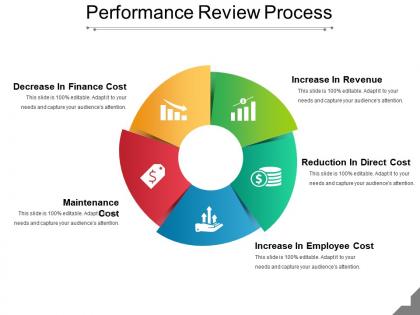
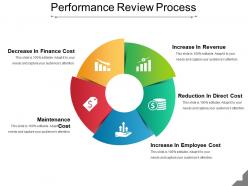
The performance review process PowerPoint presentation slide acts as an assessment tool for evaluating the performance of staff of an organization or a company. The performance review PPT template is ideal to assess the performance of the employee as well as the overall performance of an organization. Our professionally designed performance review process cycle PowerPoint template is perfect to give presentations related to financial reviews, sales reviews, marketing reviews as well as other performance reviews. The annual performance review presentation slideshow describes key elements of employee development i.e. review of employee's annual performance. The readily available performance review PPT template diagram is suitable for discussing job performance which incorporates goal setting of professional development.The performance review process cycle template for PowerPoint is a modern sophisticated design template which helps to display the performance of an organization sales and revenue. The annual performance review slide highlights the current status of sales and revenues of an organization. Assess your choices with our Performance Review Process Presentation Ideas. Give close attention to each alternative.
People who downloaded this PowerPoint presentation also viewed the following :
Performance review process presentation ideas with all 5 slides:
Expose flaws in the conclusions arrived at with our Performance Review Process Presentation Ideas. It helps dismantle arguments.


FAQs for Performance review
The key objectives of a performance review process include evaluating employee achievements, identifying skill development opportunities, aligning individual goals with organizational strategy, providing constructive feedback, and determining compensation adjustments. These objectives enhance workforce productivity by strengthening manager-employee relationships, clarifying expectations, and creating development pathways, ultimately delivering improved retention rates and organizational performance across industries.
Organizations ensure constructive, actionable feedback by training managers in specific communication techniques, establishing clear performance criteria with measurable outcomes, and implementing structured review formats that focus on behavioral examples rather than generalities. Through regular feedback cycles and follow-up mechanisms, companies create development-focused conversations that enhance employee growth, improve performance clarity, and ultimately strengthen retention while building more engaged, high-performing teams.
Self-assessment enables employees to reflect on their achievements, identify growth areas, and set future goals before formal evaluations. This process enhances dialogue between managers and staff, promotes ownership of professional development, and often reveals accomplishments managers might overlook, ultimately creating more comprehensive, collaborative reviews that drive engagement and strategic career planning.
Performance reviews should be conducted quarterly or bi-annually to maximize effectiveness, balancing comprehensive feedback with manageable administrative overhead. This frequency enables managers to address performance issues promptly, recognize achievements consistently, and align employee development with evolving business objectives, while many organizations find that quarterly cycles enhance employee engagement and ultimately deliver improved retention rates.
Employee performance metrics should include goal achievement, quality of work, productivity levels, collaboration skills, problem-solving abilities, and professional development progress. These comprehensive measurements enable organizations to assess both quantitative results and qualitative contributions, with many companies finding that balanced scorecards combining hard metrics with behavioral assessments deliver more accurate evaluations and strategic talent insights.
Technology streamlines performance reviews by automating data collection, enabling real-time feedback tracking, and providing analytics-driven insights for managers. Through digital platforms, organizations can minimize administrative burden, enhance transparency, and deliver more objective evaluations, with many companies finding that automated systems reduce review cycle times while improving employee engagement and developmental outcomes.
Managers can prepare for successful performance review discussions by gathering specific performance data, reviewing previous goals and achievements, preparing constructive feedback with examples, and setting clear agenda items for the meeting. This preparation enables more productive conversations, helps address both strengths and development areas effectively, and ultimately delivers better employee engagement and clearer performance expectations moving forward.
Organizations create continuous feedback cultures by implementing regular one-on-ones, peer feedback systems, real-time recognition platforms, open-door policies, and cross-functional collaboration sessions. These approaches streamline communication and enhance transparency by encouraging informal check-ins, celebrating achievements immediately, and normalizing constructive conversations, with many companies finding that consistent feedback ultimately delivers improved performance and stronger employee engagement.
Common biases affecting performance reviews include recency bias, halo effect, confirmation bias, similarity bias, and attribution bias. These cognitive patterns can skew evaluations by overemphasizing recent events, allowing one trait to influence overall ratings, or favoring employees with similar backgrounds, ultimately compromising fairness and accuracy in talent decisions across organizations.
Performance reviews can be tailored through flexible frameworks that accommodate cultural values, role-specific competencies, communication preferences, and organizational hierarchies. While tech companies might emphasize innovation metrics and peer feedback, traditional corporations often prefer structured evaluations with clear advancement pathways, ultimately enabling organizations to maintain consistency while respecting diverse work styles and strategic priorities.
Managers should receive training in goal-setting frameworks, constructive feedback techniques, active listening skills, documentation practices, and bias recognition to conduct effective performance reviews. This comprehensive preparation enables leaders to facilitate meaningful conversations, provide actionable development guidance, and ensure fair evaluations, with many organizations finding that well-trained managers significantly improve employee engagement and retention rates.
Performance reviews impact employee motivation and engagement by providing clear feedback, recognizing achievements, identifying development opportunities, setting meaningful goals, and creating career advancement pathways. When conducted effectively, these structured conversations enable managers to address concerns, celebrate successes, and align individual aspirations with organizational objectives, ultimately delivering higher retention rates and improved productivity across teams.
When employees disagree with performance evaluations, organizations should provide clear appeal processes including formal review meetings, documentation requirements, and third-party mediation options. These structured approaches enable transparent dialogue between managers and employees, facilitate objective reassessment of performance metrics, and ultimately deliver fair resolutions while maintaining workplace trust and accountability.
Organizations can measure performance review success through employee satisfaction surveys, retention rates, goal achievement metrics, 360-degree feedback scores, and productivity improvements following reviews. These measurements help identify process effectiveness by tracking engagement levels, career development progress, and manager-employee relationship quality, with many companies finding that regular assessment of their review systems ultimately delivers higher employee performance and reduced turnover rates.
Emerging performance management innovations include continuous feedback platforms, AI-driven analytics, peer review systems, goal-tracking software, and real-time coaching tools. These technologies streamline evaluation processes by automating data collection, enhancing transparency, and enabling more frequent touchpoints, with many organizations finding that employees receive timelier guidance, ultimately delivering improved engagement and accelerated professional development.
-
The Designed Graphic are very professional and classic.
-
Great product with highly impressive and engaging designs.