

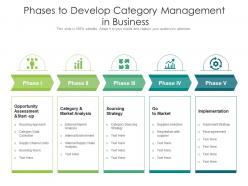
Phases to develop category management in business





Try Before you Buy Download Free Sample Product
 Impress Your
 Audience
 100%
100% Editable
 Save Hours
 of Time


Our Phases To Develop Category Management In Business are topically designed to provide an attractive backdrop to any subject. Use them to look like a presentation pro.
People who downloaded this PowerPoint presentation also viewed the following :
Phases to develop category management in business with all 2 slides:
Use our Phases To Develop Category Management In Business to effectively help you save your valuable time. They are readymade to fit into any presentation structure.
FAQs for Phases to develop category
Category management encompasses six primary phases: category definition, role determination, assessment, scorecard development, strategies formulation, and tactics implementation. These phases interrelate sequentially, with each building upon insights from the previous stage, while assessment and scorecard phases provide ongoing feedback loops that inform strategy refinements, ultimately enabling retailers to optimize product mix, enhance supplier relationships, and deliver improved customer experiences across all merchandise categories.
Organizations effectively gather category data through comprehensive spend analysis, supplier performance evaluations, market research, stakeholder interviews, and competitive benchmarking studies. These assessment methods enable procurement teams to identify cost-saving opportunities, evaluate supplier capabilities, and understand market dynamics, with many finding that systematic data collection streamlines decision-making and ultimately delivers enhanced strategic sourcing outcomes.
Market research serves as the foundation for category opportunity identification by analyzing consumer behavior, competitive landscapes, pricing trends, market gaps, and emerging demand patterns. Through comprehensive data analysis, retailers and suppliers uncover untapped segments, optimize product assortments, and identify strategic positioning opportunities, ultimately enabling more informed category decisions that drive revenue growth and competitive advantage.
Businesses align category management strategies with corporate objectives by integrating procurement goals with broader business targets, establishing cross-functional teams that include finance and operations, and implementing performance metrics that measure both cost savings and strategic value creation. This alignment enables organizations to optimize supplier relationships, enhance operational efficiency, and drive competitive advantage while supporting long-term growth initiatives across multiple business units.
Effective category strategy development involves market analysis, supplier assessment, spend analysis, stakeholder engagement, and competitive benchmarking. These techniques enable organizations to identify cost reduction opportunities, optimize supplier relationships, and align procurement with business objectives, with many companies finding that strategic category planning delivers enhanced operational efficiency and competitive advantage.
Key performance indicators for category plan implementation include cost savings percentages, supplier performance ratings, contract compliance rates, procurement cycle times, and spend under management metrics. These KPIs enable organizations to track financial efficiency, vendor relationships, and operational effectiveness, with many procurement teams finding that monitoring these metrics delivers enhanced visibility, reduced maverick spending, and ultimately stronger negotiating positions across their category portfolios.
Cross-functional collaboration enhances category management by integrating diverse expertise from procurement, marketing, finance, and operations teams, enabling comprehensive market analysis, strategic sourcing decisions, and aligned implementation strategies. Through shared insights and coordinated efforts, organizations streamline supplier relationships, optimize cost structures, and accelerate time-to-market, with many companies finding that collaborative approaches deliver superior category performance and sustained competitive advantage.
Technology and data analytics revolutionize category management decision-making by providing real-time market insights, predictive demand forecasting, automated pricing optimization, and comprehensive supplier performance tracking. Through advanced analytics platforms, retail organizations streamline assortment planning, enhance inventory management, and accelerate strategic sourcing decisions, ultimately delivering improved margins and customer satisfaction while reducing operational costs.
Common challenges during category management implementation include resistance to change, data integration complexities, supplier relationship management, cross-functional coordination issues, and inadequate technology infrastructure. Organizations often struggle with aligning stakeholder expectations, establishing consistent processes across departments, and measuring performance effectively, while many companies find that investing in comprehensive training and robust communication strategies ultimately delivers smoother transitions and sustainable competitive advantages.
Organizations ensure continuous improvement in category management by implementing regular performance reviews, stakeholder feedback loops, market trend analysis, and benchmarking against industry best practices. Through data-driven insights and cross-functional collaboration, companies streamline procurement processes, enhance supplier relationships, and optimize cost structures, with many finding that systematic evaluation cycles ultimately deliver sustained competitive advantage and operational efficiency.
Effective supplier relationship management strategies include performance scorecards, collaborative planning sessions, regular business reviews, joint innovation initiatives, and strategic partnership agreements. These approaches enhance transparency and communication while enabling organizations to leverage supplier expertise, reduce costs, and accelerate product development, with many companies finding that strong supplier relationships deliver competitive advantages and improved market responsiveness.
External market trends significantly influence category management phases by reshaping demand forecasting, supplier selection, pricing strategies, and product portfolio decisions throughout planning and execution stages. These trends, from sustainability demands to digital transformation requirements, compel category managers to continuously reassess market positioning, adjust procurement strategies, and realign stakeholder expectations, ultimately delivering more agile and responsive category outcomes.
Ethical considerations in category analyses include data privacy protection, supplier diversity promotion, fair competition practices, transparent evaluation criteria, and conflict of interest avoidance. These principles enhance procurement integrity by ensuring unbiased supplier assessments, supporting minority-owned businesses, and maintaining stakeholder trust, with many organizations finding that ethical category management ultimately delivers sustainable partnerships and reduced reputational risks.
Feedback loops from each phase enhance future category management efforts by capturing performance metrics, supplier relationship insights, market trend analysis, and cost optimization data throughout the strategic sourcing cycle. These comprehensive feedback mechanisms enable organizations to refine procurement strategies, strengthen vendor partnerships, and anticipate market shifts, with many companies finding that systematic feedback integration delivers improved contract negotiations and enhanced supply chain resilience.
Essential category management competencies include strategic sourcing expertise, data analysis skills, supplier relationship management, contract negotiation abilities, and market intelligence gathering. These capabilities enable professionals to optimize procurement processes, reduce costs, and enhance supplier partnerships, with many organizations finding that strong analytical and communication skills ultimately deliver competitive advantage and operational efficiency.
-
Wonderful templates design to use in business meetings.
-
Designs have enough space to add content.
-
Editable templates with innovative design and color combination.
-
Nice and innovative design.
-
Excellent work done on template design and graphics.
-
Easy to edit slides with easy to understand instructions.