


Phases of business cycle




Try Before you Buy Download Free Sample Product
 Impress Your
 Audience
 100%
100% Editable
 Save Hours
 of Time


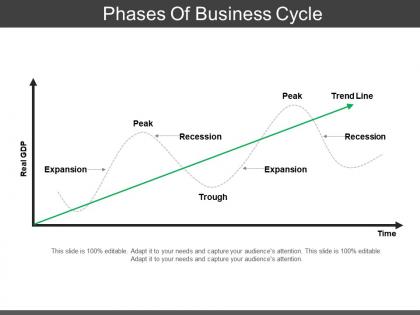
Utilize Phases Of Business Cycle PowerPoint presentation to discuss the economic activity of your business. Using this business cycle PPT layout, you can illustrate the movement of gross development around its long term growth. The rise and fall in the production output of goods and services can be depicted using this trade cycle PowerPoint theme. Using this economic cycle PPT layout, the fluctuations in which the expansion is rapid and the contraction severe can be tracked and discussed with your employees. The stages in the business cycle including expansion, peak, recession or contraction, depression, trough, and recovery can be showcased using this Powerpoint template. The effects of rapid economic boom and the market recession can be discussed using this business phase PowerPoint layout. By employing this economic cycle PPT layout, you can examine how your company responds to the trade cycle to predict future sales. Economists and investors can download this business steps PPT theme to study the effects of business operations.
People who downloaded this PowerPoint presentation also viewed the following :
Phases of business cycle with all 5 slides:
Enjoy fighting for a good cause with our Phases Of Business Cycle. Contribute and have fun also.


FAQs for Phases
The primary phases of the business cycle include expansion, peak, contraction, trough, and recovery, each characterized by distinct economic indicators like GDP growth, employment levels, and consumer spending patterns. These phases interact cyclically, with expansion leading to peak conditions that trigger contraction, ultimately reaching trough levels before recovery begins, enabling organizations to anticipate market conditions and adjust strategic planning accordingly.
Economic indicators identify business cycle phases by tracking patterns in employment rates, GDP growth, inflation levels, consumer spending, and manufacturing output. Through leading indicators like stock market performance and consumer confidence, economists recognize expansion periods with rising employment and GDP, while lagging indicators such as unemployment rates confirm recession phases, ultimately enabling businesses to anticipate market shifts and adjust strategic planning accordingly.
Consumer confidence and business investment serve as primary drivers of business cycle fluctuations, with confident consumers increasing spending on goods and services while optimistic businesses expand operations, hire workers, and invest in new technologies. These interconnected forces create self-reinforcing cycles, where rising confidence stimulates economic growth during expansions, while declining sentiment accelerates contractions, ultimately determining the timing and intensity of economic transitions.
Businesses can effectively prepare by diversifying revenue streams, maintaining flexible cost structures, building cash reserves, and investing in adaptable technologies during expansion phases. During contractions, companies should focus on operational efficiency, strategic partnerships, and customer retention, while positioning for recovery through innovation and market research, ultimately enabling sustainable growth regardless of economic conditions.
Companies can mitigate recession risks through cost optimization, cash flow management, strategic diversification, customer retention programs, and operational efficiency improvements. While challenging, these periods present opportunities for market consolidation and competitive positioning, with many organizations finding that maintaining selective investments in technology and talent development ultimately delivers stronger post-recession performance and market advantage.
Government policies influence business cycle fluctuations through fiscal measures like spending adjustments and tax changes, monetary policies controlling interest rates and money supply, and regulatory frameworks affecting market conditions. These interventions help stabilize economic volatility by stimulating growth during recessions and cooling overheated markets during expansions, ultimately enabling businesses to navigate cyclical changes more predictably.
Globalization extends business cycle phases and amplifies their intensity by creating deeper economic interconnections, faster contagion effects, and synchronized global demand patterns. Through integrated supply chains and financial markets, economic shocks now spread rapidly across borders, with many economies finding that recessions become more severe while recoveries benefit from broader market access, ultimately delivering both increased volatility and enhanced growth opportunities.
Businesses can leverage automation, data analytics, cloud computing, and AI-driven forecasting to optimize operations across economic fluctuations, enabling dynamic resource allocation and strategic pivoting. During expansions, technology accelerates scaling and market penetration, while in downturns, automation reduces costs and enhances efficiency, with many organizations finding that digital transformation delivers competitive resilience.
Historical business cycle fluctuations include the Great Depression (1929-1939), the 2008 Financial Crisis, the 1970s stagflation period, and the dot-com bubble burst (2000-2001). These cycles significantly impacted employment rates, consumer spending patterns, and corporate investment strategies, with many organizations finding that diversification and adaptive planning enable greater resilience during economic transitions, ultimately delivering competitive advantages.
The business cycle significantly affects employment through expansion phases creating job growth, hiring increases, and wage pressure, while contraction phases bring layoffs, reduced hiring, and higher unemployment rates. During expansions, companies in sectors like manufacturing, retail, and construction compete for talent, ultimately delivering tighter labor markets and improved worker bargaining power across industries.
Startups can learn strategic cash flow management, diversified revenue streams, and flexible operational models from established companies navigating business cycles. Through studying how mature organizations like banks adjust lending practices during downturns and retailers modify inventory strategies, emerging businesses can develop resilience frameworks, enabling them to scale sustainably while maintaining competitive advantage across economic fluctuations.
Industries respond differently to business cycle phases, with consumer staples and utilities remaining relatively stable during downturns, while luxury goods, construction, and technology sectors experience greater volatility. Financial services, manufacturing, and retail face significant challenges during recessions but benefit substantially during expansion phases, with many companies strategically adjusting inventory, workforce, and investment levels to optimize performance across cycles.
Business cycle phases create distinct psychological patterns that significantly influence consumer spending, including increased confidence and discretionary purchases during expansions, heightened anxiety and conservative spending during recessions, uncertainty-driven savings behaviors, and delayed major purchases during transitions. These psychological shifts ultimately drive demand fluctuations across sectors like retail, automotive, and luxury goods, with many businesses finding that understanding consumer sentiment cycles enables more strategic inventory management and marketing timing.
Data analytics and forecasting enhance business cycle responsiveness by providing predictive insights, identifying market patterns, and enabling proactive resource allocation adjustments. Through advanced analytics, companies streamline inventory management, optimize staffing levels, and adjust marketing strategies ahead of economic shifts, with many organizations finding that data-driven cycle preparation delivers significant competitive advantages and operational resilience.
Fiscal and monetary policies significantly influence business cycle dynamics by adjusting government spending, taxation, and interest rates to stabilize economic fluctuations. Through strategic fiscal stimulus during downturns and monetary easing by central banks, governments and financial institutions can accelerate recovery phases, moderate expansion periods, and minimize recession impacts, ultimately delivering more predictable economic growth patterns for businesses across all sectors.
-
Much better than the original! Thanks for the quick turnaround.
-
Great designs, really helpful.