


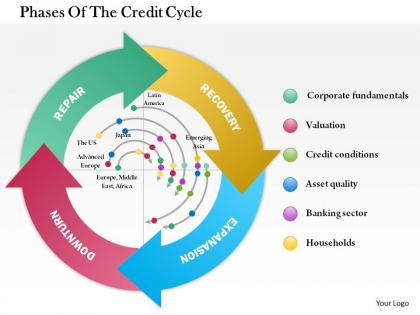
1114 phases of the credit cycle powerpoint presentation




Try Before you Buy Download Free Sample Product
 Impress Your
 Audience
 100%
100% Editable
 Save Hours
 of Time


To better understand the market needs and take the business decisions accordingly, it will not only boost your performance is a good way but also add flexibility to your thinking as all the data will be in easy reach if compiled in PPT design. In order to track the progress of business across various stages like growth to maturity, the whole journey can be mapped in business lifecycle designed and integrated creatively into a presentation visual. To allow access to credit for the borrowers a period characterized by easy borrowing or lending of credit can be marked with the effective use of PowerPoint presentation with phases of credit cycle. An all in all good PowerPoint presentation not only gives a unique look but also helps to focus and factor in internal and external stimulus. To thrive for excellence and factor in various aspects of business cycle namely- repair, recovery, expansion and downturn, a cyclic diagram forming arrows in a loop help to put the facts across the table via a PPT design in a meaningful manner. Acquire the best assistance with our 1114 Phases Of The Credit Cycle Powerpoint Presentation. They put their excellence at your disposal.
People who downloaded this PowerPoint presentation also viewed the following :
1114 phases of the credit cycle powerpoint presentation with all 5 slides:
Make up lost time with our 1114 Phases Of The Credit Cycle Powerpoint Presentation. Trigger your thoughts and get ahead in the game.




FAQs for 1114 phases of the credit
So there are four stages to watch for: expansion, peak, contraction, and trough. Expansion means easy money - banks are lending like crazy and businesses grow. Then you hit the peak where credit gets tighter. Contraction is honestly the worst part - banks freak out, stop lending, defaults spike everywhere. The trough comes last with barely any lending happening. Here's the thing though - you've got to adjust your cash flow and financing plans based on where we're sitting in this cycle. Otherwise you'll get caught with your pants down when things shift. Makes a huge difference for timing major decisions.
When credit gets tight, people freak out and stop spending. They focus on paying off debt instead of taking on more. But when credit's easy to get? Total opposite - bigger mortgages, car loans, credit card splurges. People get way more optimistic about money. Honestly, it's like watching a mood swing happen across entire populations. Here's what's actually useful though: these shifts happen before the official economic numbers come out. So if you're tracking consumer sentiment surveys, you can spot trends early. Way better than waiting for government data that's already old news.
Think of central banks like a thermostat for the whole credit system. They bump up interest rates when lending gets too crazy, then slash them during rough patches to get people borrowing again. Reserve requirements and capital ratios are their other big tools - basically controls on how much banks can actually lend out. Honestly, it's wild how much they can move entire economies with just these few levers. When they tighten things up, credit gets pricier and harder to snag. That's your signal the cycle might be shifting. Pro tip: their policy announcements usually hint at what's coming next.
Interest rates are basically the puppet master of credit cycles. Low rates? Everyone's borrowing money like crazy, credit flows everywhere, and asset prices go nuts. Central banks freak out about inflation and jack up rates. Suddenly debt payments suck and nobody wants to lend. People scramble to pay down what they owe, everything contracts. Rinse and repeat when they cut rates again to juice the economy. Honestly, I think most people ignore rate trends but they're your best indicator for timing credit moves. Short bursts, long squeezes - that's the pattern.
Check credit spreads first - they get tight when things are good, blow out when markets panic. Default rates and loan growth tell the story too. Banks loosen up lending standards during good times, then suddenly get super picky. The yield curve inverting is a classic warning sign. Covenant-lite loans are my personal favorite indicator though - when that garbage starts flying off the shelves, you know we're probably near a top. Pull this data monthly so you'll catch shifts before everyone else does.
Yeah, small businesses get absolutely crushed during credit crunches. Banks will drop them first since they're "higher risk" - total BS if you ask me, but whatever. Big companies? They've got backup plans and can tap into capital markets when banks get stingy. Credit expansions flip this around completely. Suddenly loan approvals get way easier and small biz owners can actually function again. Oh, and if you're dealing with smaller clients, their cash flow problems get like 10x worse when credit's tight. Just something to factor in.
Dude, tech basically puts credit cycles on steroids. AI and better data make lenders way too cocky during good times - they think they've cracked the code on risk and start throwing money around. But then everything flips fast when stuff goes sideways. Same algorithms that opened the floodgates suddenly slam them shut. Digital lending happens so quick now, like instant approvals and all that. Creates way more volatility than the old days when everything moved slower. Plus fintech keeps inventing weird new credit products that regulators don't even understand yet. Just watch how fast things are changing in your space compared to before.
Look, governments basically turn credit markets like a faucet. Stimulus spending or tax cuts? Banks suddenly get looser with money since there's more cash floating around. Austerity does the reverse - credit dries up fast. I've noticed policy announcements are usually your best early warning system, honestly better than waiting for the actual changes to hit. Short sentences, long ones that flow naturally. Watch for those government moves because they'll tell you where lending's headed way before you feel it in the real world.
Dude, credit and housing are basically glued together. Easy credit means people borrow more for houses, prices go up. Credit gets tight? Housing tanks hard. What's crazy is how you can almost set your watch to it. Expansion periods bring loose lending and speculation - hello housing bubbles. Then rates climb, banks get picky, and everything just stops. I swear it happens every single time. If you're looking at real estate stuff, just watch what credit's doing and where rates are going. Those two things will tell you way more about housing's direction than anything else.
Build up that safety net now while you've got steady income coming in. Pay down debt, stack some cash, don't go crazy with borrowing. If you've got a business, keep those debt ratios reasonable and lock in credit lines while banks are still happy to lend. Yeah it's not exciting when everything's going well, but that's literally the perfect time to prep. Multiple income streams are your friend - different revenue sources or just building up other skills. My dad always said the smart money moves opposite to everyone else. So when people are being reckless, you stay careful.
Look, the big stuff you need to worry about is asset bubbles and banks getting way too loose with lending. Cheap credit makes everyone sloppy - suddenly they're handing out loans to people who have no business getting them. Prices get completely detached from reality. It's like musical chairs, honestly. When things go south, you get hit with defaults, fire sales, and credit drying up all at the same time. Pretty brutal combo. Watch your loan-to-value ratios and debt service coverage - those metrics usually show problems before they blow up.
Think of it like this - when the global economy's doing well, money flows everywhere and banks get pretty loose with lending. But the second things get shaky? Capital runs straight to safe places and credit dries up fast. The Fed's probably the biggest player here - whatever they do with rates hits everyone else. Commodity prices can really mess with resource-heavy countries too. Honestly, it's wild how connected everything is now. Your country's credit cycle isn't just about domestic stuff anymore - you've got to keep an eye on what's happening globally or you'll miss the bigger picture.
Look, credit cycles always happen - no way around it. When times are good, that's exactly when you should prep for the crash. Remember 2008? Dot-com bubble? Same story every time, but people convince themselves it's different now (spoiler: it never is). Watch for red flags like crazy asset prices or sketchy loan standards. Keep extra cash on hand when credit's flowing like water. Honestly, most people do the opposite - they get greedy right before everything falls apart. Test your portfolio regularly and don't get caught up in the hype. Build your safety net during the good times.
Think of consumer debt as the gas pedal for the whole credit cycle. People borrow more when they're feeling confident - houses, cars, credit cards, you name it. All that spending keeps the economy humming along nicely. Problem is, debt piles up and eventually hits a wall. Once folks start defaulting or just stop borrowing altogether (which always happens), that's when things flip and the cycle heads south. I always keep an eye on debt-to-income ratios - they're pretty solid at predicting which way the market's gonna move next.
Understanding credit cycles is honestly a game-changer for your finances. You'll know when banks are loosening up and credit's cheap - perfect time for that refi or big purchase. But financial literacy also helps you spot when things are getting bubbly so you don't overdo it. My uncle learned this the hard way in 2008. When credit tightens up, you'll already be prepared instead of scrambling. Start following interest rate news and lending trends now. That way you're positioning yourself ahead of time rather than just reacting to whatever's happening.
-
Unique design & color.
-
Graphics are very appealing to eyes.