


Credit creation process powerpoint guide





Try Before you Buy Download Free Sample Product
 Impress Your
 Audience
 100%
100% Editable
 Save Hours
 of Time


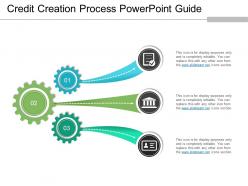
Are you looking for ways to explain your credit creation process to the audience? Here is a perfect credit creation process PPT visual slide to meet your daily business needs. Credit creation vitally affects the level of economic activity in any country which in turn affects your business. It ensures the availability of currency for meeting the transaction needs of an economy and facilitating various economic activities, such as production, distribution, and consumption. Our credit creation process Presentation template consists of a beautifully designed three steps gears process with elegant and professional colors. Each gear can be highlighted with related text as the slide is wholly modifiable. Our credit creation PowerPoint slideshow will be perfect for you to highlight all the necessary tasks which are essential for business growth and profitability. Just download the presentation template design and then share it with who so ever you are looking to share with. Assess the applicability of the concept with our Credit Creation Process Powerpoint Guide. It helps analyze the interpretation.
People who downloaded this PowerPoint presentation also viewed the following :
Credit creation process powerpoint guide with all 5 slides:
Bring an end to intolerant attitudes with our Credit Creation Process Powerpoint Guide. Be able to convert bigots.




FAQs for Credit creation
Credit creation is the process by which banks generate new money through lending, using fractional reserves to multiply deposits beyond their actual cash holdings. This fundamental banking mechanism enables financial institutions to extend loans significantly exceeding their reserves, ultimately stimulating economic growth and liquidity while managing risk through regulatory capital requirements and reserve ratios.
Banks utilize fractional reserve banking by keeping only a fraction of deposits as reserves while lending the remainder, creating new money through loans. When banks issue loans, these funds are deposited elsewhere, enabling additional lending cycles, with each cycle multiplying the money supply and ultimately expanding credit availability throughout the economy.
Central banks influence credit creation through monetary policy tools including interest rate adjustments, reserve requirements, quantitative easing, and open market operations. These mechanisms enable central banks to control money supply, liquidity levels, and lending capacity across financial institutions, ultimately delivering enhanced economic stability and strategic control over inflation, with many economies finding that coordinated monetary policies streamline credit flows.
Reserve requirements directly limit banks' credit creation by mandating specific percentages of deposits be held as reserves, reducing available funds for lending. Higher reserve requirements constrain lending capacity and slow credit expansion, while lower requirements enhance banks' ability to create loans, with many financial institutions finding that strategic reserve management ultimately determines their competitive position in credit markets.
Excessive credit creation risks include asset bubbles, inflation, financial instability, unsustainable debt levels, and economic volatility. While credit expansion fuels growth, it can lead to speculative investments in real estate or stocks, with many economies finding that overheating markets ultimately require correction, creating potential downturns that affect businesses across banking, retail, and manufacturing sectors.
Bank loans and deposits interact through a multiplier effect, where initial deposits enable banks to create new loans, which become deposits at other banks, continuing the cycle. Through fractional reserve banking, financial institutions leverage deposited funds to extend credit while maintaining required reserves, ultimately expanding the money supply and enabling economic growth, with many commercial banks finding that this process enhances liquidity circulation throughout the financial system.
Higher interest rates typically reduce credit demand by increasing borrowing costs, making loans less attractive to consumers and businesses, while lower rates stimulate demand by making credit more affordable. This inverse relationship significantly impacts economic activity, with many financial institutions finding that rate changes directly influence loan application volumes, investment decisions, and consumer spending patterns, ultimately affecting overall economic growth and monetary policy effectiveness.
Credit creation fuels economic growth by enabling businesses to expand operations, invest in new technologies, and hire additional workforce, while allowing consumers to make significant purchases that stimulate demand. Through strategic lending, banks facilitate capital formation, entrepreneurship, and infrastructure development, ultimately delivering increased productivity, job creation, and higher living standards across developing and established economies.
Credit creation in commercial banks and cooperative banks differs in scale, purpose, funding sources, regulatory oversight, and geographic focus. Commercial banks leverage larger deposit bases and capital reserves to create substantial credit for diverse sectors including corporations, retail, and international markets, while cooperative banks typically focus on localized lending to members and communities with smaller credit multipliers, ultimately serving regional economic development rather than profit maximization.
Digital banking technology streamlines the credit creation process by automating loan origination, enhancing risk assessment through AI-powered analytics, and accelerating approval workflows. Through machine learning algorithms and real-time data processing, banks can evaluate creditworthiness more accurately, reduce processing times from weeks to hours, and scale lending operations efficiently, ultimately delivering faster credit decisions and improved customer experiences.
Credit ratings significantly impact banks' credit creation capacity by influencing funding costs, regulatory capital requirements, and market confidence levels. Banks with higher ratings access cheaper funding sources, face lower regulatory scrutiny, and attract more deposits, while those with lower ratings experience constrained lending capacity, with many financial institutions finding that maintaining strong credit profiles ultimately enables expanded lending operations and competitive market positioning.
Regulatory frameworks shape credit creation by establishing capital requirements, lending standards, and risk management protocols that banks must follow when extending credit. These regulations, including Basel III guidelines and reserve requirements, directly influence how much credit institutions can create while ensuring financial stability, with many banks finding that compliance ultimately enhances their operational efficiency and competitive positioning.
Consumer behavior significantly influences credit creation through spending patterns, repayment histories, risk assessments, and loan demand fluctuations. When consumers demonstrate responsible financial habits, banks gain confidence to expand lending, while behavioral shifts like increased savings or delayed purchases can reduce credit demand, ultimately affecting how financial institutions structure their lending portfolios and risk management strategies.
Macroeconomic factors like inflation significantly alter credit creation by influencing central bank monetary policies, interest rate adjustments, and lending institution risk assessments. During inflationary periods, central banks typically raise interest rates to control money supply, making credit more expensive and reducing loan demand, while banks tighten lending standards, ultimately constraining credit expansion and economic growth.
Banks face challenges including regulatory compliance pressures, economic volatility affecting borrower creditworthiness, data quality issues in risk assessment, and balancing profitability with prudent lending standards. Through advanced analytics and automated risk scoring, financial institutions increasingly streamline loan evaluations, enhance portfolio diversification, and optimize capital allocation, ultimately delivering competitive advantage while maintaining regulatory compliance and minimizing default rates.
-
Wonderful templates design to use in business meetings.
-
Unique research projects to present in meeting.