Credit Analysis Process For Banking Institutions
Try Before you Buy Download Free Sample Product
Audience
Editable
of Time
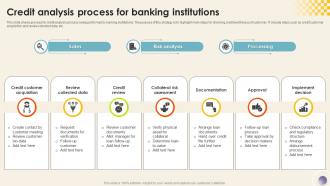
This slide shows process for credit analysis process being performed by banking institutions. The purpose of this strategy is to highlight main steps for checking credit worthiness of customer. IT include steps such as credit customer acquisition and review collected data, etc.
People who downloaded this PowerPoint presentation also viewed the following :
Credit Analysis Process For Banking Institutions with all 6 slides:
Use our Credit Analysis Process For Banking Institutions to effectively help you save your valuable time. They are readymade to fit into any presentation structure.
FAQs for Credit Analysis Process
Key components include financial statement analysis, cash flow assessment, credit history evaluation, industry risk analysis, and collateral valuation. These elements work together to provide lenders with comprehensive borrower insights, enabling banks and financial institutions to make informed lending decisions, minimize default risks, and optimize portfolio performance while delivering faster loan approval processes.
Credit scoring significantly impacts lending decisions by providing standardized risk assessment through mathematical models that evaluate payment history, credit utilization, length of credit history, types of accounts, and recent inquiries. These algorithms enable banks and financial institutions to streamline loan approvals, minimize default risks, and offer competitive rates, with many lenders finding that automated scoring delivers faster decisions while maintaining consistent risk management standards.
Financial statements provide comprehensive insights into a borrower's financial health through income statements, balance sheets, cash flow statements, and equity statements, revealing revenue patterns, debt obligations, and liquidity positions. These documents enable lenders to assess repayment capacity, evaluate debt-to-income ratios, and analyze operational stability, with many financial institutions finding that thorough statement analysis significantly reduces default risk while streamlining loan approval processes.
Macroeconomic factors significantly influence credit risk assessments by affecting borrowers' ability to repay through economic cycles, inflation rates, unemployment levels, and interest rate changes. Banks and financial institutions increasingly integrate GDP trends, sector-specific downturns, and regulatory shifts into their models, enabling more accurate risk pricing and portfolio management in volatile economic environments.
Corporate credit analysis evaluates business financial statements, cash flow patterns, industry risks, management quality, and debt capacity, while personal credit analysis focuses on individual income stability, credit history, debt-to-income ratios, and collateral assets. These approaches differ significantly in complexity and scope, with corporate analysis requiring deeper industry expertise and multiple financial metrics, while personal analysis streamlines around individual creditworthiness and repayment ability.
Default probabilities serve as fundamental risk metrics in credit analysis models, quantifying the likelihood of borrower payment failure within specific timeframes through statistical modeling, historical data analysis, and economic indicators. These probabilities enable banks and financial institutions to price loans accurately, set appropriate interest rates, and allocate capital strategically, with many lenders finding that incorporating dynamic default probability models significantly enhances portfolio performance and regulatory compliance.
Qualitative factors in credit analysis include management quality, industry outlook, competitive positioning, regulatory environment, and business model sustainability. These elements complement financial metrics by providing context for quantitative data, with banks and financial institutions finding that management experience, market conditions, and operational strategies often predict creditworthiness more accurately than numbers alone.
Industry trends significantly impact a company's credit profile by influencing revenue growth potential, competitive positioning, regulatory compliance costs, and market demand patterns. Companies in declining sectors like traditional retail face heightened credit risks, while those in expanding industries such as renewable energy or healthcare technology often demonstrate stronger creditworthiness, with lenders increasingly factoring these macro trends into their risk assessments.
Covenants in credit agreements serve as protective mechanisms for lenders, requiring borrowers to maintain specific financial ratios, operational standards, and reporting requirements throughout the loan term. These contractual obligations significantly enhance credit analysis by providing early warning indicators of financial distress, enabling proactive risk management, and establishing clear benchmarks for ongoing borrower performance monitoring, ultimately delivering stronger portfolio oversight.
Credit ratings from agencies like Moody's and S&P directly influence borrowing costs by signaling creditworthiness to investors, with higher ratings enabling lower interest rates and better access to capital markets. These ratings streamline investment decisions by providing standardized risk assessments, ultimately delivering significant cost advantages for highly-rated borrowers while helping financial institutions price loans more accurately across diverse market conditions.
Cash flow analysis reveals a borrower's actual liquidity and debt servicing capacity by examining income patterns, operational efficiency, and financial stability over time. This assessment enables lenders to evaluate repayment feasibility beyond static balance sheets, with banks and financial institutions finding that consistent cash flow trends significantly predict loan performance and minimize default risks.
Credit analysis benefits investors by identifying creditworthy borrowers, assessing default probabilities, and evaluating repayment capacity through financial statement analysis, cash flow evaluation, and risk assessment. Through comprehensive credit evaluation, investors can diversify across higher-quality securities, avoid potential defaults, and optimize risk-adjusted returns, ultimately delivering enhanced portfolio stability and improved long-term investment performance.
Credit analysis employs financial ratio analysis, cash flow evaluation, industry benchmarking, credit scoring models, and collateral assessment to evaluate borrower creditworthiness. These techniques work together by examining payment history, debt-to-income ratios, and market conditions, with banks and financial institutions finding that comprehensive analysis significantly reduces default risk while enabling faster, more accurate lending decisions.
Geopolitical risks and regulatory changes significantly impact credit assessments by altering borrower stability, market conditions, and compliance requirements, requiring analysts to evaluate sovereign risk, policy shifts, and cross-border exposures. These factors influence creditworthiness through currency volatility, trade disruptions, and changing capital requirements, with many financial institutions finding that dynamic risk models and scenario analysis ultimately deliver more accurate assessments in increasingly uncertain environments.
Credit enhancement reduces lending risk by providing additional security through guarantees, collateral, insurance, and third-party backing during credit analysis. These mechanisms enable banks and financial institutions to offer competitive rates while protecting against defaults, with many lenders finding that strategic credit enhancement ultimately delivers improved loan portfolio performance and expanded market opportunities.
-
Wow, never been this impressed with any online service provider. Really appreciate the customer support all along from the navigation to purchasing the right products.
-
Happy to incorporate such stunning templates in my presentation. Made my presentation look professional and engaging.Â