

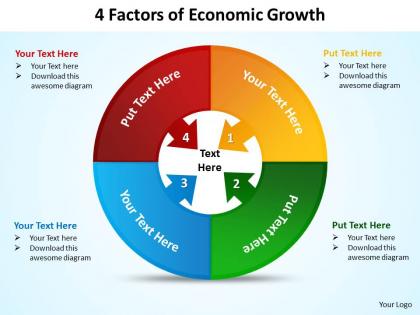
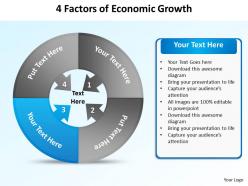
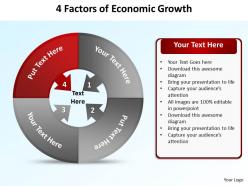
4 factors of economic growth powerpoint diagrams presentation slides graphics 0912




Try Before you Buy Download Free Sample Product
 Impress Your
 Audience
 100%
100% Editable
 Save Hours
 of Time


Make up lost time with our 4 factors of economic growth powerpoint diagrams presentation slides graphics 0912. Trigger your thoughts and get ahead in the game.
People who downloaded this PowerPoint presentation also viewed the following :
4 factors of economic growth powerpoint diagrams presentation slides graphics 0912 with all 8 slides:
Our beautiful designs make each slide count and that is why the major companies are making use of our 4 factors of economic growth powerpoint diagrams presentation slides graphics 0912. You just can't beat it.


FAQs for 4 factors of economic growth powerpoint diagrams presentation
So the big ones are infrastructure, education, and tech adoption - that's your foundation right there. Natural resources can be massive too, but honestly countries get screwed if they don't branch out from that. Foreign investment brings money and expertise. Good governance matters more than people think - businesses need stability to actually grow. Trade deals help connect to global markets. Oh, and which country are you looking at? That'd help narrow down what they're actually focusing on right now.
Honestly, government policies are what really drive local economic growth. Tax breaks and zoning laws determine where businesses actually want to set up shop. Infrastructure spending matters too - good roads and utilities attract investment while crappy ones don't. You've also got workforce training programs and regulations that either help or hurt your area's chances. Different government departments need to work together though, which doesn't always happen (bureaucracy, am I right?). If you're trying to make change locally, figure out which policies actually impact your goals instead of just assuming they all matter equally.
Honestly, tech is what's driving most economic growth right now. AI and automation are completely reshaping how businesses work - the speed is actually insane. Companies can produce way more stuff with less people and resources, which bumps up GDP and makes life better overall. Plus you're seeing entirely new industries pop up that didn't exist five years ago. Oh, and new business models too - like how everyone's got a side hustle now through apps. If you're thinking about money moves or career stuff, definitely watch the emerging tech spaces. That's usually where the real opportunities show up first.
So basically, when people get better training and education, they just work smarter and faster. Like, they can handle more complex stuff and use new tech without constantly asking for help. It's honestly pretty obvious when you think about it - countries that actually invest in schools and job training see way better economic growth. Even small companies notice productivity jumps within a few months of doing basic skills workshops. Your workers become more adaptable too, which is huge these days since everything changes so fast. It's kinda like the difference between someone who knows Excel shortcuts versus someone clicking through menus all day.
Honestly, it's super messy. Growth can make inequality worse OR better depending on who benefits. Like if only tech bros and investors get richer, obviously that widens the gap. But when growth creates decent jobs for everyone and wages go up across different sectors, it helps level things out. Here's what's weird though - you actually need some inequality to motivate people and fund new businesses. The real key is policies around education, taxes, and how labor markets work. Those determine whether regular people see the benefits or if wealth just keeps pooling at the top.
Regulations definitely create some tension with growth, but it's way more complicated than people realize. Short-term? Yeah, compliance costs hit hard, especially manufacturing and energy companies. But here's what's interesting - they actually spark innovation and whole new industries. Clean tech, renewables, all that efficiency stuff. Your economy shifts instead of just taking a hit. The trick is rolling them out gradually with business support, not shocking everyone overnight. I mean, look at whoever's crushing it in green tech right now. Those countries figured it out.
So globalization usually helps countries grow - more trade, investment money flowing in, bigger markets to sell to. Plus you get cool tech transfers and companies have to actually innovate to compete. But honestly, some industries just get crushed by cheap imports. Workers in those sectors? They're kinda screwed unless there's good retraining programs. It really depends on what your economy looks like to begin with. The smart move is having policies that help people pivot to new jobs while still grabbing all those international benefits. Mixed results for sure.
Honestly, access to finance is make-or-break for entrepreneurs. Your amazing business idea? Worthless without funding to actually build it. Loans and investment let people start companies and hire workers. More businesses = more jobs and innovation - pretty straightforward ripple effect. Countries with solid financial systems grow faster because money goes where it can actually do something productive. I've always thought it's crazy how overlooked this is. If you're thinking about economic development, fixing credit access should be priority number one. Can't build an economy on dreams alone.
So here's the deal with infrastructure spending - it's actually pretty smart economics. Building roads, bridges, broadband, all that stuff creates jobs right away during construction. But the real magic happens after. Companies can move their products around easier, which makes them more efficient and profitable. Better infrastructure also attracts new businesses to set up shop in your area. Honestly, I think politicians should talk about this more instead of just arguing about taxes all the time. It's like giving the whole economy better tools to work with. Makes everything flow better.
FDI is huge for emerging markets - they get the capital injection for infrastructure plus job creation. Technology transfer is probably the biggest win though, stuff domestic investment can't really provide. It connects them to global supply chains too (dependency risk aside). Countries see major productivity boosts and industrialization they wouldn't hit otherwise. Tax revenue from all this activity helps stabilize currencies. Export growth follows naturally. Honestly, I always check FDI flows when I'm researching which emerging markets might actually sustain growth long-term. It's like a cheat code for spotting the winners.
Honestly, small businesses are like the secret sauce for local economies. They hire tons of people - way more than big corps when you add them all up. Plus they're quick to try new stuff and fill weird market gaps that Amazon or whoever just ignores. Here's the cool part though: when a small bakery buys flour from the local supplier, who then pays their local accountant, it creates this whole chain reaction of money staying in your community. I always try to shop local when I can - even if it costs a bit more, you're literally investing in your neighborhood's future.
Innovation's basically how you grow an economy without just burning through more stuff. You're finding ways to create more value with less input - cleaner energy, better production methods, totally new markets. Smartphones are a perfect example - they replaced like 10 different gadgets while using way less materials overall. Instead of just scaling up the same old things (which eventually hits walls), you're actually doing things better. Honestly, most countries don't invest nearly enough in R&D. If you want long-term growth, prioritize research and create space where new ideas can actually take off.
So demographics basically control how fast an economy can grow - it's all about who's working and spending. More working-age people = more growth since they're both producing stuff and buying it. Japan's a perfect example of the opposite though - tons of retirees, fewer workers, and older people just don't buy as much (like who's 70 and shopping for a new house?). Birth rates are huge too since that's your future workforce right there. Honestly, demographic data is weirdly accurate for predicting economic trends. If you're looking at any market long-term, check those population projections first.
So basically trade deals knock down all those annoying barriers between countries - tariffs, red tape, the whole mess. Your local companies suddenly get access to huge new markets instead of being stuck selling domestically. Imports get cheaper too, which is great for keeping prices reasonable and giving people more stuff to choose from. Competition heats up so businesses have to actually get their act together and innovate. Some industries definitely get hurt in the short run, I won't lie about that. But overall? These deals usually boost economic growth pretty well.
Honestly, you don't have to pick one or the other - think of social programs as an investment that actually pays off. When you spend on education, healthcare, and unemployment benefits, you're building a stronger workforce and keeping people spending money. Nordic countries figured this out ages ago and they're crushing it economically. The wild part? Good welfare programs often generate more tax revenue down the line than they cost. I'd look at what social investments would give your region the biggest bang for your buck. It's counterintuitive but the data's pretty solid on this.
-
Informative presentations that are easily editable.
-
Use of different colors is good. It's simple and attractive.