

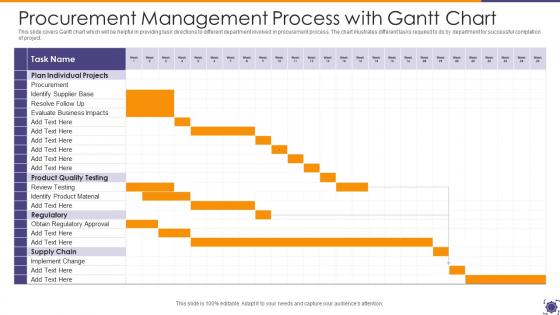
Procurement Management Process With Gantt Chart




Try Before you Buy Download Free Sample Product
 Impress Your
 Audience
 100%
100% Editable
 Save Hours
 of Time


This slide covers Gantt chart which will be helpful in providing task directions to different department involved in procurement process. The chart illustrates different tasks required to do by department for successful completion of project.
People who downloaded this PowerPoint presentation also viewed the following :
Procurement Management Process With Gantt Chart with all 6 slides:
Use our Procurement Management Process With Gantt Chart to effectively help you save your valuable time. They are readymade to fit into any presentation structure.





FAQs for Procurement Management Process
So there's basically five stages to procurement: planning (figuring out what you actually need), sourcing (hunting down suppliers), selection (picking the best one), contract management (dealing with all the negotiation stuff), and performance evaluation at the end. Honestly, sourcing is where I always get stuck - it's such a pain if you're not super organized about it. You really can't skip around between steps either, trust me on that one. I learned the hard way that rushing through planning just creates a mess later. Spend way more time upfront planning than you think you need to. Seriously saves so much headache.
Honestly, most supplier drama comes from crappy communication - I've seen it a million times. Talk upfront about what you both expect and how you'll measure success. Don't just check in when there's a problem either. Quarterly reviews work well for discussing performance and what's coming down the pipeline. Your best suppliers should feel more like teammates than random vendors you order from. Oh, and definitely don't put all your eggs in one basket - spread things around so you're not screwed if someone drops the ball. Maybe throw in some joint projects where you tackle cost cuts or new ideas together.
Tech has completely changed how procurement works - it handles everything from finding vendors to managing contracts automatically. E-procurement platforms make vendor selection way smoother, and AI can actually predict demand patterns and price changes (pretty wild stuff). Digital workflows killed most of that paperwork hell we used to deal with. Cloud systems give you instant visibility into spending and supply chain issues too. Honestly? Teams still doing everything manually are probably losing their minds. My advice: figure out what's driving you crazy first, then find specific tools for those problems. Don't go overboard trying to digitize everything at once.
Start with checking their finances and getting references from current clients - seriously, this saves so much drama down the road. Can they handle your order volume? What's their track record on delivery and quality certs? Site visits are clutch if you can swing it. Walking through their place tells you way more than any brochure ever will. Also check out their backup plans for when things go sideways. Oh, and make a scoring system that weights everything based on what actually matters to your business. That way you're not just picking whoever sounds the best on paper.
Hey! So basically you want to scope out supplier risks before signing anything. Check their financials first - trust me, I learned this the hard way once. Don't put all your eggs in one basket with suppliers either. Mix it up so you're not screwed if one fails. Contracts should have penalty clauses for late deliveries and stuff. Always have backup suppliers lined up before disasters hit. The trick is making risk checks part of how you pick vendors from day one, not scrambling later. Oh and definitely do regular check-ins to catch problems early!
Honestly, you'll want to track both cost stuff and how things actually run day-to-day. Cost savings percentage is obvious, but don't sleep on contract compliance rates and supplier delivery times - those bite you later if ignored. Purchase order cycle times matter too. Quality metrics like defect rates are huge because saving money on garbage suppliers is basically pointless. I'd throw in supplier scorecards and maybe some diversity/risk tracking so you're not totally screwed if one vendor flakes. Start with like 4-5 metrics that actually match what your company cares about, then add more once you've got decent data coming in.
So sustainable procurement totally flips how you think about buying stuff for your business. Instead of just going for whatever's cheapest, you're looking at the bigger picture - environmental impact, ethics, all that. Yeah, it's annoying to set up initially and finding suppliers who actually walk the walk is harder than you'd think. But honestly? It ends up driving innovation because you're pushing for better solutions. Plus you're not stuck with sketchy suppliers who might screw you over later. Customers love it too, which doesn't hurt. I'd start with your top 3 supplier categories and build from there.
Honestly, data analytics is a total game-changer for procurement. You'll finally see spend patterns and supplier performance stuff you'd never catch doing it by hand. Real-time dashboards showing your KPIs across everything? *Chef's kiss.* Plus you can actually predict when suppliers might screw up or when demand's about to spike. I'd start with something simple like supplier scorecards first - don't go crazy trying to analyze everything right away. The benchmarking against market rates alone will probably save you a ton. Oh, and spotting those cost-saving opportunities becomes way easier when you're not drowning in spreadsheets.
Ugh, where do I even start? Supply chains are still completely screwed from 2020 - costs keep going up and finding decent suppliers feels impossible sometimes. Then you've got all this compliance stuff to deal with, plus everyone's breathing down your neck about sustainability now. Oh, and don't get me started on how outdated most procurement systems are. You'll need to digitize everything eventually. Risk management is way more complicated with all the global tensions too. The talent shortage isn't helping either - good procurement people are hard to find. Honestly though, build diverse supplier networks first and get solid software ASAP. Trust me on that one.
Your procurement team can totally drive innovation - just don't make it all about cutting costs. Look for suppliers bringing fresh tech or processes to the table. When you write RFPs, throw in innovation criteria alongside the usual price stuff. Build relationships with vendors who actually invest in R&D. Honestly, innovation challenges work great - let suppliers pitch you wild solutions to your biggest headaches. Set aside some budget (even small amounts) to test new ideas. The trick is making innovation part of your sourcing strategy from day one, not something you think about later. I've watched teams completely flip their operations this way.
Look, fair competition is everything here - give all qualified vendors an actual chance to win. Document your whole process and don't play favorites with anyone. Anti-corruption stuff is serious business too. No gifts, kickbacks, or sketchy dinners (yeah, even those "innocent" vendor lunches can bite you). Contract terms need to be reasonable for everyone involved. Oh, and transparency matters big time - keep everything above board. Honestly, the legal team should be your best friend on this stuff. When you're unsure about something, just ask them first. Better safe than sorry with procurement issues.
Start with your approval workflows - map those out first and make them crystal clear. Half the mess I've seen happens because people literally don't know the rules exist. Get procurement software that flags weird stuff automatically. Makes life so much easier. Document everything as you go, not after the fact when you're scrambling. Oh, and actually train your team on the policies - I know it's boring but it saves headaches later. Regular audits help catch problems early. The whole trick is making the compliant way the obvious way to do things.
Honestly, most places end up doing a mix of both. Centralized gets you way better deals on bulk stuff and keeps everything consistent, but man, the approval process can drag forever. Decentralized is the opposite - departments can buy what they actually need quickly, but you're paying more since you lose that bulk pricing power. I'd probably start by figuring out what's driving you crazy right now. Like, are you bleeding money on random purchases, or is everyone stuck waiting weeks for basic supplies? High-volume standard stuff should definitely go through central purchasing, but let teams handle their specialized gear directly.
Dude, you can't just use the same playbook everywhere - learned that one the hard way! What sounds direct to us might come off super rude in Japan. Meanwhile, Germans want efficiency while Latin Americans need that relationship-building time (which honestly makes sense). Your whole approach needs tweaking per region. Negotiation style, contract stuff, even how you run meetings. Some places care way more about partnerships than rock-bottom prices too. My advice? Spend time upfront getting the cultural piece right. Otherwise you'll be fighting uphill battles with suppliers who think you don't get it.
Dude, procurement's changing fast. AI platforms are everywhere now, plus everyone's obsessed with sustainability and supply chain backup plans. Gone are the days of just buying whatever's cheapest - that strategy's toast. You've gotta think bigger picture with suppliers, build diverse networks, factor in ESG stuff when picking vendors. Oh and outcome-based contracts are replacing the old "buy this widget" approach. Teams that make it will be using predictive analytics to spot problems early. Seriously though, start learning data analysis ASAP or you'll get left behind.
-
“Love it! I was able to grab an exciting proposal because of SlideTeam.”
-
“Excellent information with easy access.”