


Product launch marketing plan strategy checklist sample of ppt




Try Before you Buy Download Free Sample Product
 Impress Your
 Audience
 100%
100% Editable
 Save Hours
 of Time


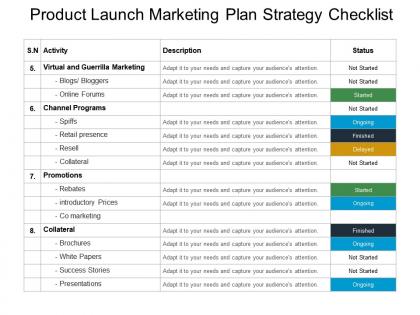
Reduce the risk of your new product launch with our product launch marketing plan strategy PPT design. The marketing plan PPT slide will helps in generating the sources of income with an effective marketing strategies for the new launch. It will help you to structuralize the factors which may affect the launch. Use this new product launch plan PPT slide design to define the procedure of launching a product from the stage of initially figuring out the right product till the stage of final launch and evaluating the performance of the product in the market. It will help in developing a strong marketing strategy like the deciding on the elements like the channel programs to be used, the promotions idea and more. You can also use this PPT design to explain your product launch structure to your potential investors too. Thus, simply tap on the download button given below to begin instating with this PPT slide for building a better business model now. Our Product Launch Marketing Plan Strategy Checklist Sample Of Ppt act as an effective circular. Get everybody immediately aware of the facts.
People who downloaded this PowerPoint presentation also viewed the following :
Product launch marketing plan strategy checklist sample of ppt with all 5 slides:
Acquire general acceptance with our Product Launch Marketing Plan Strategy Checklist Sample Of Ppt. Everyone will find them attractive.
FAQs for Product launch marketing plan strategy checklist
Okay so think of it in three chunks: pre-launch, launch day, and what happens after. Honestly, most people totally underestimate the pre-launch stuff - that's where you research your market, build some hype, nail down your messaging. It's kinda boring but it actually determines everything. Launch day is just executing your plan across all your channels at once. Then post-launch you're collecting feedback and tweaking based on real data. Don't get obsessed with just the launch event itself - each phase matters equally. Oh and start planning like 3-6 months out, trust me on that one.
Look, market research stops you from launching blind and hoping for the best. Survey people, run focus groups, whatever - just validate your ideas before you blow your budget. I can't tell you how many products I've watched crash because founders thought they knew what customers wanted without actually asking them. You'll figure out real pain points, what people will actually pay, and where to find your audience. Plus you can scope out competitors and find gaps they're missing. Oh and timing matters too - research helps you pick when to launch. Short version: ask the right questions early or risk building something nobody wants.
Think of audience segmentation as picking your target before you even aim. Without knowing who you're talking to, your messaging just becomes this generic mess that doesn't hit anyone. Each group has totally different problems and budgets - what works for startups won't work for enterprise clients, you know? I'd honestly start small with maybe 2-3 segments max. Then build separate value props for each one. It sounds like extra work but trust me, it's way better than the spray-and-pray approach most people try.
Pick 3-5 metrics that actually matter to your launch goals - don't go crazy tracking everything. Conversion rates from awareness to trial are huge, plus user acquisition costs and early adoption stuff like sign-ups. Retention rates and customer satisfaction scores come next. Revenue growth obviously. Market share is useful but honestly the data's always delayed and sketchy. I'd also watch support ticket volume - that'll spike if something's broken. Oh, and user feedback sentiment. Set up your dashboards beforehand though, trust me on this one. Last launch I waited and spent day one frantically building reports instead of celebrating.
Honestly, forget the boring feature lists - nobody remembers those anyway. People connect with stories, so build your launch around a real customer's problem. I've watched so many launches where everyone's literally falling asleep during the pitch (awkward). Start with the pain point first. Build up some tension around why it sucks. Then boom - your product swoops in to save the day. It's like you're creating this little movie arc that actually keeps people awake and invested. Way better than just rattling off specs that'll get forgotten in five minutes.
Honestly, it all comes down to where your people actually are. I'd go heavy on social first - but like, the platforms they're actually using, not just Instagram because everyone says so. Email's still huge for your current customers, and content stuff (blog, YouTube) builds trust over time. Influencers can be amazing if you find the right ones - skip the mega-famous ones and find people who actually fit your vibe. Oh, and PR's not dead! Still great for looking legit. Your employees talking you up works too, weirdly well actually. But seriously, pick maybe 3-4 things and crush those instead of trying everything at once. Test small, see what hits, then go all in.
Dude, you HAVE to build hype beforehand - seriously can't stress this enough. Apple's whole cryptic teaser thing works for a reason (though maybe don't go that overboard lol). When people are already buzzing about your product, you're not just shouting into the void on launch day. Plus it helps you figure out if there's actual demand. I'd say start dropping hints about features maybe 2-4 weeks out? That way you've got momentum building instead of crickets when you finally go live.
Dude, the worst thing you can do is rush it out there without testing properly first. Also make sure you actually know who you're selling to - sounds obvious but so many people skip this. Never overpromise stuff you can't deliver, I've watched that blow up in people's faces more times than I can count. Timing matters too - don't launch during Christmas or when some competitor is having their big moment. Oh and get your support team ready because if anything breaks, customers will lose their minds. Honestly? Do a small test launch first so you can fix the inevitable problems before everyone sees them.
So here's the thing - influencer partnerships actually work because people trust these creators way more than ads. Their followers genuinely listen to their recommendations. You're basically getting access to communities you'd never reach otherwise, which is pretty smart tbh. But don't just chase follower counts! That's where most people mess up. Look for micro-influencers in your space instead. They have smaller but way more engaged audiences. Make sure their followers actually match who you're trying to reach though - otherwise you're just throwing money away.
Honestly just pick Asana or Monday.com and stick with it - I've watched too many teams waste weeks debating tools instead of actually launching. Both handle timelines and team coordination really well. If you need something more visual, Gantt charts in Smartsheet are pretty solid for mapping out how marketing, dev, and sales stuff connects. Trello works too if your team likes the simple card thing. Oh and whatever you pick, make sure it plays nice with Slack since you're probably living in there anyway. Don't overthink it.
Honestly, the biggest thing is getting everyone aligned upfront with a solid launch plan - like who's doing what and when. I've watched so many launches implode because marketing, product, and sales were basically on different planets lol. Weekly cross-team check-ins are clutch for catching issues early. Your messaging has to be consistent too - customers get confused fast when they're hearing different things. Oh, and pick one person to own the whole thing. Someone who can make calls quickly when teams start stepping on each other's toes.
So a post-launch review is basically your sanity check after everything goes live. Look at your actual numbers vs what you expected, plus all the customer feedback and how your team handled things. I know it sounds boring as hell, but it's honestly worth doing. Figure out what bombed and what actually worked - that stuff becomes gold for your next launch. Your team stays honest about results too, which is nice. Oh, and do it within like 30-60 days while people still remember the chaos. Trust me on the timing thing.
Dude, you absolutely need to collect feedback during and after every launch - it's like finding money on the ground. Set up surveys, do user interviews, dig through support tickets, watch social media. Teams miss huge patterns when they only check one place (I've watched this happen way too many times, it's painful). Group everything into themes - usability problems, missing features, confusing messaging, whatever comes up. Then figure out what'll actually change your next launch. Oh, and make a "what we'd do differently" doc after each release. Sounds nerdy but it's a game-changer.
Dude, multimedia is a game changer for launches. Different people absorb info differently - some need visuals, others are all about audio. Video hits both which is clutch. Here's the cool part: make one solid product demo and suddenly you've got Instagram clips, podcast material, blog images, whatever. It's like magic content multiplication or something. Plus honestly? People engage way more with multimedia than boring text walls. My advice - start with one killer video piece then chop it up for different platforms. You'll get so much more mileage that way.
Honestly, your launch price is gonna shape how people see your product right off the bat. Set it high? They'll assume it's premium stuff. Go too low and suddenly everyone thinks you're selling garbage - which is kinda unfair but whatever. The whole thing is so psychological it's crazy. You can actually play with this though - use pricing to position yourself against competitors or show you're doing something different. Just make sure whatever price you pick actually matches the vibe you want. Like, don't price like Apple if you're going for the budget-friendly angle, you know?
-
Best Representation of topics, really appreciable.
-
Innovative and Colorful designs.