

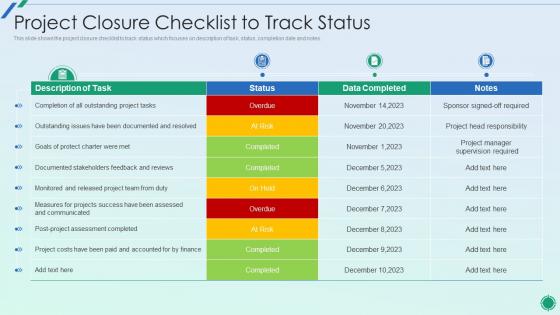
Project Closure Checklist To Track Status Establishing Plan For Successful Project




Try Before you Buy Download Free Sample Product
 Impress Your
 Audience
 100%
100% Editable
 Save Hours
 of Time


This slide shows the project closure checklist to track status which focuses on description of task, status, completion date and notes.
People who downloaded this PowerPoint presentation also viewed the following :
Project Closure Checklist To Track Status Establishing Plan For Successful Project with all 6 slides:
Use our Project Closure Checklist To Track Status Establishing Plan For Successful Project to effectively help you save your valuable time. They are readymade to fit into any presentation structure.





FAQs for Project Closure Checklist To Track Status Establishing Plan
So you'll want to nail down the obvious stuff first - make sure all deliverables are actually done and signed off on. Close out your budgets, pay final invoices, that whole financial mess. Release your team members (they're probably dying to get off your project anyway) and return any equipment. Documentation is huge - archive everything important because someone will definitely ask about it later. Keep stakeholders in the loop too since people get really annoyed when projects just... disappear without updates. Oh, and do lessons learned sessions while everything's still fresh in people's minds. Honestly, the hardest part is just staying organized when everyone wants to bolt to their next thing.
Don't just assume everyone's happy because nobody's complaining - people are weird about speaking up sometimes. Actually reach out and ask if they got what they needed. Maybe send a quick survey or grab coffee with key people to see how things went. Double-check you delivered everything you promised and didn't leave any loose ends hanging. Honestly, the "are we actually done here?" conversation is way more important than people think. Document what worked, what didn't, and any last-minute changes you made. Being upfront about closure beats just ghosting and hoping for the best.
Anonymous surveys are your best bet - people actually tell the truth when there's no names attached. I'd also do some one-on-ones if you're tight with your team members. Group retrospectives can be hit or miss though, since the chatty people usually take over (been there). Coffee chats work surprisingly well too. Way more relaxed than formal meetings. Honestly, I'd try mixing two or three approaches since everyone's different about how they like to give feedback. Just pick whatever doesn't feel super weird for your team's vibe.
Get your core team together ASAP while everything's still fresh. Use whatever works - spreadsheet, Google doc, doesn't matter. But here's the thing: don't just focus on wins. The failures are where you actually learn something useful. I always push for specific examples, not that vague "communication could've been better" nonsense. Write down actual next steps too. Then share it around! Send it to other PMs, stick it in your knowledge base, whatever. Honestly, most people skip this part and then wonder why they keep making the same mistakes.
Look, project documentation is basically your project's story - what worked, what bombed, all the messy lessons in between. I know it feels like total busy work when you're dead tired from finishing everything, but seriously, future you will be SO grateful. Gather your final reports, update those process docs, create a decent handover package. The trick is making it actually useful, not just some random pile of files. Oh and start collecting stuff early! Trust me, you don't want to be desperately trying to remember what went down six months ago.
Oh definitely do that final budget review - seriously, don't skip it. You'll want to compare what you actually spent vs what you planned, then figure out where things went sideways (or surprisingly well). Finance is gonna ask for those numbers anyway, so might as well get ahead of it. Document the weird stuff too - like why that software ended up costing double or whatever. Trust me, future you will thank present you when you're planning the next project and actually remember what happened. Plus any leftover money usually needs to go back somewhere. It's boring but super worth it.
Start with exit interviews - you'll want to know where your team wants to go next. Work with resource managers to match people with upcoming projects based on their skills. Update those resource planning tools too (such a pain but someone has to do it). Don't forget the boring stuff like returning equipment and redistributing leftover budget. Honestly, the timeline communication piece is huge - give stakeholders a heads up early so they know when your people will be free. Makes everyone's life easier.
Do one last risk check with your team before handing things over. Go through that risk register again - there's always something lurking that you didn't catch earlier. Flag the stuff that'll stick around after you're gone: vendor issues, knowledge gaps, technical debt, whatever. Make sure someone actually owns these problems going forward. Write up a simple handover doc explaining the context and how to deal with each risk. Don't just dump a list on them though - sit down and walk through what they're inheriting. Trust me, they'll thank you later when something inevitably goes sideways.
Dude, there's so many good options! Pizza for the office is always a hit, or do team lunches and happy hours. I'd definitely shoot recognition emails to leadership too. Public shoutouts work way better than private praise IMO - share those wins in team meetings or company Slack. Oh, and handwritten thank-you notes are clutch if you want to get personal about everyone's contributions. Just match whatever you do to your team's personality and how big the project actually was. Don't wait though - plan something while everyone's still hyped about it!
Honestly, project closure is like creating a cheat sheet for your future self. Document what went right and what was a total disaster - trust me, you'll forget otherwise. I've watched teams cut months off timelines just by digging up old wrap-up notes. Store everything somewhere you can actually find later (not buried in some random folder). The good stuff helps you dodge the same mistakes twice, nail your estimates better, and figure out which workflows don't suck. Sometimes I think closure docs are more valuable than the actual project deliverables.
So you need five main docs for your closure report: final project summary showing objectives vs what actually happened, lessons learned (seriously this one saves your butt on future projects), resource breakdown, stakeholder feedback, and deliverable acceptance records. Budget actuals versus what you planned is crucial too. The lessons learned part is honestly where the real value is - write down what worked, what bombed, what you'd change next time. Oh and start collecting this stuff now instead of panicking later. Create a template so next time it's not such a pain.
Just go through that contract line by line and check off what's actually done. I know it sounds boring but trust me - I've seen people get burned because they missed some tiny deliverable buried in section 12 or whatever. Create a simple checklist so nothing slips through. Get the client to formally sign off on each milestone, chase down any unpaid invoices, and double-check you've handed over everything in the right format. Oh, and don't forget about ongoing stuff like training or warranties that might still be active. Once everything's complete, get written confirmation from them that you're all good. Covers your ass later.
Definitely follow up with the main people in like 30-60 days to see how everything's working out. Write actual thank-you notes mentioning what they specifically did - trust me, nobody does this anymore so it really stands out. Post LinkedIn updates about how the project turned out or share stuff they'd find useful. Quarterly check-ins are clutch so these connections don't just disappear. Oh, and send them the lessons learned doc afterward. Shows you actually care about their feedback for next time. Just don't make it feel like you're only hitting them up when you need something.
So basically, compare what you actually delivered to what you promised at the start. Did you hit your deadlines? Stay on budget? Meet quality standards? Stakeholder happiness is honestly the make-or-break thing here - I can't stress that enough. Also check if your deliverables actually fixed the problem they were supposed to solve (sounds obvious but you'd be surprised). Write down what went right and what was a disaster, because trust me, you'll forget otherwise and make the same mistakes again. Oh, and get that formal sign-off from your sponsor before celebrating.
Honestly, send your agenda and docs 1-2 days early or people show up clueless. Focus on three things: sign-offs, lessons learned, and who's taking over what resources. Time-box everything because these meetings turn into therapy sessions real quick. Don't let anyone drag up old scope drama – I learned this the hard way on my last project. Get someone else taking notes while you run it. Here's the key thing though: draft your action items beforehand. You don't want to sit there figuring out next steps when everyone's already mentally checked out. Make decisions, not endless chatter.
-
Editable templates with innovative design and color combination.
-
Great experience, I would definitely use your services further.