


Project governance structure powerpoint topics





Try Before you Buy Download Free Sample Product
 Impress Your
 Audience
 100%
100% Editable
 Save Hours
 of Time


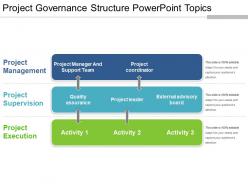
Check out our project governance structure PowerPoint topics design. In the corporate sector, governance refers to the set of regulations, processes, functions, procedures, responsibilities and policies that define the corporate, management of project and programme. This presentation template helps to present details about how project should be managed in an effective manner to get the best results. Project governance is a vital aspect of any project as it is important for every business to deliver the quality work in the stipulated time frame. Our PPT slide can be used to convey messages about three pillars of project governance which are structure, people and information. This presentation layout has been designed with some purpose which is to give best value to the project managers and project executives. Project management, project supervision and project execution are key aspects that are highlighted in this design which can share with your audience as shown or can deliver it in your own way as it is easy to edit and make changes as required. Download project governance structure PPT diagram now. Our Project Governance Structure Powerpoint Topics team always have their eyes and ears open. They are alert to changing demands.
People who downloaded this PowerPoint presentation also viewed the following :
Project governance structure powerpoint topics with all 5 slides:
Our Project Governance Structure Powerpoint Topics will astound you with their coverage. They contain every conceivable design.




FAQs for Project governance
Key components include a governance board, clear decision-making frameworks, defined roles and responsibilities, risk management protocols, and regular reporting mechanisms. These elements work together by establishing accountability, streamlining communication, and ensuring strategic alignment, with many organizations finding that robust governance structures ultimately deliver improved project success rates and enhanced resource allocation efficiency.
Project governance significantly influences project success rates by establishing clear decision-making frameworks, defining accountability structures, and ensuring consistent oversight throughout project lifecycles. Through robust governance models, organizations streamline resource allocation, minimize scope creep, and enhance stakeholder communication, with many companies finding that structured governance delivers faster project completion, reduced costs, and improved quality outcomes, ultimately providing competitive advantage in increasingly complex business environments.
**INPUT**: What roles and responsibilities should be defined in a project governance framework? **OUTPUT**: A project governance framework should define roles including project sponsor, steering committee, project manager, business analysts, and stakeholder representatives, each with clear decision-making authority and accountability measures. These roles streamline project oversight by establishing escalation paths, resource allocation responsibilities, and quality assurance protocols, with many organizations finding that well-defined governance structures significantly reduce project delays and enhance strategic alignment across departments. [Word count: 60 words]
Organizations tailor project governance structures by adjusting oversight levels, stakeholder involvement, compliance requirements, decision-making processes, and risk management protocols based on project complexity and industry regulations. Financial services projects require stricter audit controls, healthcare initiatives need regulatory compliance frameworks, and IT developments benefit from agile governance models, ultimately delivering more effective project outcomes and strategic alignment.
Tools enhancing project governance include project management software, risk assessment frameworks, stakeholder mapping platforms, performance dashboards, and automated reporting systems. These methodologies streamline oversight by centralizing communication, tracking milestones, and ensuring compliance standards, with many organizations finding that integrated governance platforms ultimately deliver improved project visibility, reduced operational risks, and enhanced strategic alignment.
Stakeholder engagement ensures project alignment with business objectives by facilitating clear communication, managing expectations, and securing necessary resources and approvals throughout the project lifecycle. Through regular stakeholder meetings and feedback loops, organizations streamline decision-making processes, minimize project risks, and enhance buy-in, with many finding that engaged stakeholders ultimately deliver faster approvals and improved project outcomes.
Common pitfalls include unclear roles and responsibilities, inadequate stakeholder communication, inconsistent decision-making processes, insufficient risk monitoring, and lack of standardized frameworks across projects. These governance gaps often result in project delays, budget overruns, and scope creep, with many organizations finding that poor governance structures ultimately undermine strategic objectives and competitive positioning.
Project governance frameworks evolve with changing dynamics by implementing adaptive oversight models, flexible decision-making hierarchies, scalable reporting mechanisms, and responsive stakeholder engagement processes. These frameworks enable organizations to adjust resource allocation, modify risk assessment protocols, and streamline communication channels, with many enterprises finding that dynamic governance structures deliver enhanced project outcomes and competitive advantage.
Traditional project management uses hierarchical governance with formal boards, stage gates, and rigid approval processes, while agile governance emphasizes collaborative structures with product owners, scrum masters, and iterative decision-making cycles. These approaches deliver different advantages, with traditional governance providing comprehensive oversight and agile structures enabling faster adaptations, ultimately allowing organizations to balance control with flexibility based on project complexity and stakeholder needs.
**INPUT**: What metrics should be used to evaluate the effectiveness of project governance? **OUTPUT**: Project governance effectiveness metrics include budget variance, schedule adherence, stakeholder satisfaction scores, risk mitigation rates, and decision-making speed. These measurements enable organizations to track resource allocation, timeline accuracy, and communication effectiveness, with many companies finding that combining quantitative performance indicators with qualitative feedback delivers enhanced project outcomes and strategic alignment. [Word count: 54 words]
Project governance addresses risk management by establishing systematic oversight frameworks, regular monitoring protocols, and clear escalation pathways for emerging threats. Through structured risk assessment committees, standardized reporting mechanisms, and proactive mitigation strategies, organizations streamline risk identification while ensuring accountability, ultimately delivering enhanced project success rates and protecting strategic investments across complex initiatives.
The project sponsor serves as the executive champion, providing strategic direction, securing resources, removing organizational barriers, and ensuring alignment with business objectives throughout the project lifecycle. They bridge senior leadership and project teams by making key decisions, resolving escalated issues, and maintaining stakeholder engagement, ultimately delivering accountability for project success and strategic value realization.
Communication strategy serves as the central nervous system of project governance, establishing clear reporting hierarchies, stakeholder engagement protocols, and decision-making channels that align with governance frameworks. Through structured communication plans, project teams ensure transparency across all governance levels, facilitate timely escalation of issues, and maintain stakeholder alignment, while enabling informed decision-making that ultimately drives project success and organizational accountability.
Essential training includes project management methodologies, governance frameworks, risk assessment techniques, stakeholder communication protocols, and compliance requirements. These resources enable stakeholders by enhancing decision-making capabilities, streamlining oversight processes, and establishing clear accountability structures, with many organizations finding that comprehensive governance training ultimately delivers faster project completion and improved strategic alignment.
Technology and software enhance project governance by automating reporting, centralizing documentation, and providing real-time dashboards for stakeholder oversight. These digital solutions streamline compliance tracking, risk monitoring, and decision-making workflows, with many organizations finding that integrated platforms deliver faster approvals, improved transparency, and significantly reduced administrative overhead across complex project portfolios.
-
Great product with highly impressive and engaging designs.
-
Wonderful templates design to use in business meetings.