


Project governance model powerpoint slide graphics




Try Before you Buy Download Free Sample Product
 Impress Your
 Audience
 100%
100% Editable
 Save Hours
 of Time


Since most of the projects bring necessary revenue for various industries, its failure or lateness can mean the difference between an organization’s failure and success. Due to bad project management, an industry has high rate of projects fail. However, need not to get confused between good project management and good project governance model. By taking help of the project governance model PPT slide, a user can illustrate many of the setbacks in an organization’s projects are outside the purview of the project manager but do lie in project governance. The difference between management and governance mainly in focus and intent and a presenter can use the governance model in project management presentation slide to demonstrate the same. The project management template for PowerPoint is all about the details and act as application of knowledge, skills, tools, and techniques to project activities to meet the project target. Whereas the project governance model template for PowerPoint is less about the details, and more about the conditions that set up the project as well as are outside the project’s boundaries. A project manager can use the project governance framework example slide. Our project governance model powerpoint slide graphics ensure different cultures don't deter you. You will be comfortable anywhere on earth.
People who downloaded this PowerPoint presentation also viewed the following :
Content of this Powerpoint Presentation
A project needs supervision because it guarantees successful project outcomes. The project governance model is essential for managing the success of a business because it gives a clear picture of the main roles, tasks, and opportunities. It facilitates decision-making as well. A ready-to-use project governance model PowerPoint slide has been prepared by SlideTeam in order to maintain project oversight.
Delivering services and products is a complex process; you can now keep tabs on them with your PPT slides. Explore them here!!
Our PowerPoint slide is made to give you a project governance framework that works for your company. You can make better decisions and expedite the project governance process with the aid of these templates. You can rapidly enhance teamwork and communication with eye-catching visuals and color schemes, which will ultimately result in the success of your project. Organizations today rely on a variety of projects to grow and succeed. The decision-making procedure and the communication tactics will be improved by these slides.
Manage your projects from their initial stages, perfect execution, and final stage with our customizable PPT decks.
Template 1: Project Governance Model
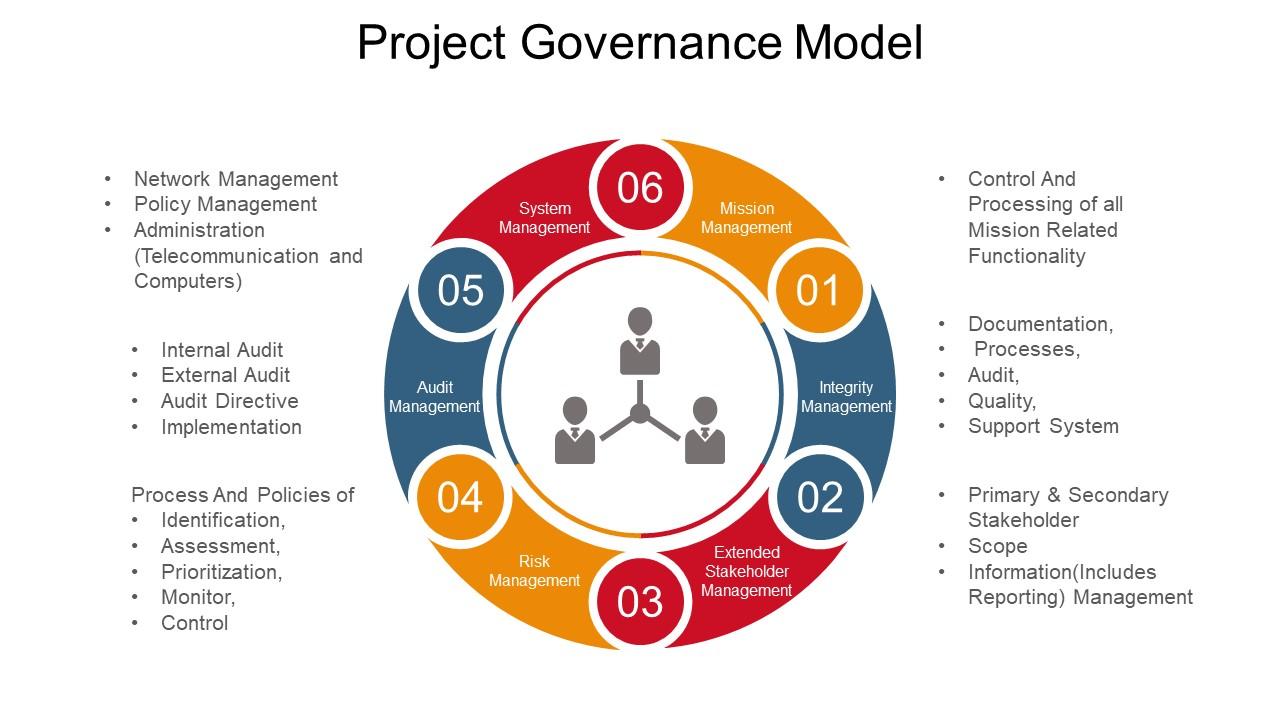
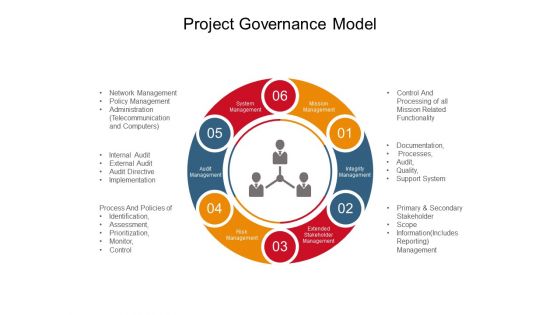
This slide is designed to supervise various projects through impressive graphics. Six elements can be governed by this PPT template: mission management, integrity management, extended stakeholder management, risk management, audit management, and system management. You can state the control and processing of all mission-related functionality, documentation processes, audit, quality, support system, stakeholders, network management, policy management, internal audit, external audit, identification, and assessment of processes and policies through this template. The color scheme that is used in this template is definitely impressive and captivating. Grab the template for effective project management.
In conclusion, governing the projects is critical to finding loopholes, developing innovative plans, and implementing mitigation strategies for a company's development. Keeping track of where the projects are heading is an important aspect of helping a business grow.
P.S. Get project governance framework PPT templates to have an overview of the projects.
Project governance model powerpoint slide graphics with all 5 slides:
Find anything you desire with our project governance model powerpoint slide graphics. They have no dearth of facilities.
FAQs for Project governance model
Honestly, start by figuring out who approves what at each stage - that's your foundation. You need clear roles, decision-making authority, and reporting structures that actually work. Regular check-ins and quality gates are crucial too. The governance board thing is tricky though - you want people who can make fast decisions, not committees that debate forever. Don't skip the communication framework either, that's where I've seen projects completely blow up. Oh, and build in proper change management processes from day one. Map out those decision points first, then wrap everything else around them.
So governance is like the rulebook - who gets to make decisions, what the boundaries are, all that structural stuff. Project management? That's you actually getting shit done within those rules. Governance tells you "here's who's in charge and how we operate." PM is the daily grind of hitting deadlines and managing tasks. Think of it like... governance sets up the playing field, but you're the one actually playing the game. Honestly, figuring out your governance setup first will save you so many headaches later. You don't want to be halfway through execution wondering who actually calls the shots.
So stakeholders are basically your accountability partners - they watch over things, approve budgets, and keep projects tied to what the business actually needs. You've got different types: executive sponsors handle the big money decisions, business owners tell you what they want built, and end users test if it actually works. Honestly, the good ones don't just nod along - they show up to steering meetings and milestone check-ins. Regular touchpoints are key though, maybe weekly or bi-weekly depending on your project size. Their support is what keeps funding flowing and prevents scope creep from killing you later.
Look, good governance just means everyone knows who makes what decisions - no more sitting around confused about next steps. You get regular check-ins where the right people can actually weigh in instead of those nightmare email threads where nobody's listening. Plus you'll catch problems early through consistent reporting, which honestly saves your ass way more often than you'd think. The trick is keeping it simple enough that people don't just ignore the whole system. I've seen teams create these massive frameworks that sound great on paper but everyone hates using them.
Honestly, stakeholder resistance is your biggest headache - they'll whine about "bureaucracy" and extra paperwork. Finding that sweet spot between oversight and micromanagement? Good luck with that one. Nobody wants governance killing their speed. Clear roles sound great in theory but often create bottlenecks instead. Oh, and companies love copying governance models from elsewhere without tweaking them for their own culture (spoiler: doesn't work). Start with a small pilot first. Prove it works before going company-wide or you'll face even more pushback.
Start weaving compliance into your governance right from the beginning - don't wait. Have someone on your steering committee who actually gets the regulations (not just thinks they do). Assign owners to specific requirements and document everything as you go. Honestly, I've watched too many teams panic when they're almost done and discover they missed something basic. Quick checkpoints help catch issues early. Oh, and make it ongoing instead of cramming it all at the end. Way less stressful that way.
Track both leading and lagging stuff - decision velocity, stakeholder satisfaction, project success rates before/after your new model. Budget variance and timeline adherence are obvious picks. Quality metrics matter too though - defect rates, rework percentages, that kind of thing. Oh and governance overhead is huge - basically how much time you're burning in meetings vs actual work. Trust me, nobody wants to die by committee. Pick 3-4 metrics that actually matter to your org and track them consistently for at least two project cycles. That's when you'll start seeing real trends emerge.
Honestly, tech tools are a game changer for this stuff. Project management platforms let you track everything in one place and send automatic alerts when deadlines slip. No more awkwardly chasing down your manager for approvals - workflow tools handle that routing automatically. Real-time dashboards keep stakeholders happy too. The centralized docs thing is huge though - everyone finally works off the same requirements instead of random email attachments. Makes everything way more consistent. I'd start with whatever's driving you most crazy right now, probably approval bottlenecks or status updates.
Honestly, culture will make or break your whole governance setup. When people actually value transparency and teamwork, they'll follow your processes without you having to babysit them. But those toxic, blame-heavy workplaces? Forget it - nobody's gonna escalate problems or stick to frameworks when they're scared of getting thrown under the bus. I've watched beautiful governance models crash and burn because the culture sucked. My advice? Figure out if your culture can actually support what you're trying to build first. Otherwise you're just setting yourself up for frustration.
Yeah, it totally depends on your industry! Healthcare and finance are stuck with super rigid frameworks - tons of compliance stuff and paperwork everywhere. Meanwhile tech companies get to use agile with quick decisions and way less red tape (honestly so jealous). Manufacturing usually goes with stage-gate models since they match physical product timelines. Construction's pretty old-school hierarchical because of all the safety regs and stakeholder drama. I'd check what similar companies in your space are doing first, then tweak it based on how much risk you can handle and whatever regulations you're dealing with.
So many options out there! Microsoft Project and Jira are solid for tracking stuff. Monday.com too. SharePoint handles documentation pretty well, or try Confluence. Honestly though? Sometimes a basic spreadsheet works just as good as all the expensive tools. Smartsheet's nice if you want something in between. Communication-wise, Slack or Teams obviously, but don't overthink it - even email works. The real trick is finding what your team will actually stick with. I've seen so many teams buy fancy software that just sits there unused. Start basic, see what you need, then upgrade if necessary.
Start with who makes the big strategic calls - that's your steering committee. Then figure out project sponsors for money stuff and escalations. Project managers handle the daily chaos, obviously. Map it out like layers so there's no weird overlap where two people think they're in charge of the same thing. Each person needs clear authority over their piece and knows when to kick problems upstairs. Oh, and don't forget all your stakeholder groups - they need ways to actually talk to you and give feedback. A RACI matrix sounds boring but it's honestly a lifesaver when everything hits the fan.
Look, risk management is basically your project's insurance policy. Spot potential disasters before they actually happen, you know? I'm always making lists of what could go sideways, how likely it is, then figuring out what I'd actually do about it. Your stakeholders need to know this stuff exists - trust me on that one. Weekly team check-ins help catch things early. Oh, and definitely start with a basic risk register (nothing fancy). Honestly feels like planning for failure, but it's saved my butt more times than I can count.
Totally doable! Start with shorter sprint reviews instead of those massive milestone meetings - way better visibility honestly. Your governance folks need to get comfortable reviewing progress iteratively rather than approving huge upfront plans. Keep the important stuff like budget checks and risk reviews, just make them happen more often and less formal. It feels super weird at first (trust me), but stakeholders actually love seeing real working pieces they can give feedback on. I'd pilot this on just one project initially to show it works, then expand from there. The trick is finding that sweet spot between structure and flexibility.
Honestly, I'd start with quarterly check-ins to see what's actually working. Get feedback from your project teams - not just the executives pretending everything's fine. Pick one thing everyone's constantly griping about and tackle that first. Track stuff like how fast decisions get made and whether people are happy with the process. Small tweaks work way better than blowing everything up at once. The worst thing you can do is create some massive bureaucratic nightmare that people just ignore anyway. Oh, and definitely don't try to fix everything simultaneously - that's how you end up with even bigger problems.
-
Innovative and Colorful designs.
-
Thanks for all your great templates they have saved me lots of time and accelerate my presentations. Great product, keep them up!