


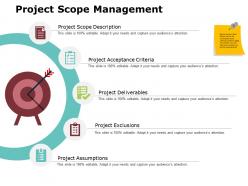
Project scope management ppt powerpoint presentation gallery grid





Try Before you Buy Download Free Sample Product
 Impress Your
 Audience
 100%
100% Editable
 Save Hours
 of Time


Add to the effect of your thoughts with our Project Scope Management Ppt Powerpoint Presentation Gallery Grid. You will come up with great anecdotes.
People who downloaded this PowerPoint presentation also viewed the following :
Project scope management ppt powerpoint presentation gallery grid with all 5 slides:
Folks feel happy to interact due to our Project Scope Management Ppt Powerpoint Presentation Gallery Grid. It ensures a joyful exchange.



FAQs for Project scope management ppt powerpoint
Okay so there's six main parts to project scope management: planning it, collecting requirements, defining scope, creating the WBS, validating scope, and controlling changes. Requirements collection takes forever because stakeholders keep adding stuff - seriously, they'll always want "just one more feature" right before launch. The WBS part is actually pretty cool though, like taking this huge project and chopping it into manageable chunks. Get your scope statement locked down and approved early or you'll spend half your time fighting scope creep. Oh and validation's important too but honestly most of your headaches come from people changing their minds mid-project.
Honestly, you've gotta nail down exactly what you're building before anything else starts. Sit with your stakeholders and map out every requirement, deliverable, and boundary - the "we're NOT doing this" part is huge because that's where scope creep sneaks in later. Break everything into user stories and acceptance criteria so it's not just vague ideas floating around. I'd also do a work breakdown structure to chunk it all out properly. Get everyone to actually sign off on the scope doc early on (like, physically sign it if you have to). Otherwise you'll be halfway through and someone will say "oh I thought we were including X too" and you're screwed.
Honestly, stakeholders are everything when it comes to nailing down project scope. Get their input upfront or you'll be shooting in the dark - trust me on this one. They know what the business actually wants, what users are expecting, and all those fun budget/time constraints you're dealing with. Plus they help you spot scope creep before it gets ugly. The key is documenting everything they tell you and getting them to formally sign off on the scope. Otherwise you'll get those awkward "wait, I thought we were including..." conversations halfway through. Been there, it's not pretty. They're basically your reality check.
Honestly, interviews are your best bet for getting the real details from key people. For bigger groups, surveys do the trick. Focus groups are solid too - people love talking in groups and you'll get way more ideas bouncing around. Workshops are clutch for getting everyone on the same page fast. Oh, and don't forget to actually watch what people do versus what they tell you they need. That gap is always wild. Mix it up depending on who you're dealing with and how messy your project is.
Okay so project scope is basically all the work you gotta do to actually deliver something. Product scope? That's what the thing you're making will actually be and do. Like if you're building a mobile app - the product scope covers the app's features and specs and all that. But project scope is every single task: gathering requirements, design work, coding, testing, getting it deployed, training people how to use it. I honestly still confuse these sometimes lol. Product scope = what you're building. Project scope = all the steps to build it. Define what you're making first, then figure out all the work to get there.
Look, most PM tools have decent scope management built in. Work breakdown structures, requirements tracking, change request workflows - the usual suspects. Change management is honestly where you'll get the most bang for your buck since that's typically where everything falls apart. Jira's solid for this stuff, same with Monday.com and MS Project. They all play nice with your other project docs too. My advice? Set up your WBS right away, then get that change request workflow locked down. Trust me, you don't want to be figuring that out when scope creep inevitably shows up at your door.
Honestly, scope creep is sneaky but you'll catch it when requests pop up that definitely weren't in your original docs. My biggest tip? Set up regular check-ins with stakeholders and make everyone go through a formal process for changes. Every single request needs to be written down, reviewed, and actually approved first. Don't let people pull that "oh it's just one tiny thing" nonsense - I swear that's how projects die! Keep a running log of all these requests too. Being firm about boundaries from day one saves you so much headache later.
Honestly, get your deliverable criteria nailed down first and make stakeholders actually sign off on them. I do weekly scope reviews because that stuff creeps up on you fast. Write everything down - and I mean everything, especially when things change mid-project. A traceability matrix sounds fancy but it's just mapping deliverables back to requirements so you don't lose track. Oh, and set up milestone check-ins with stakeholders now. Trust me on this one. Catching problems early beats scrambling at the end when everyone's suddenly got "feedback."
Yeah, scope changes are budget killers - they'll push your timeline out every single time. Adding new features means more work, more resources, more headaches. Even tiny changes can mess up everything else (seriously, I once watched a simple logo swap completely wreck a two-week sprint). You really need a change control process though. Before anyone says "yes" to changes, figure out what it'll actually cost in time and money. Document everything upfront and make stakeholders sign off on it. Otherwise you're just setting yourself up to get blamed when things go sideways - which they will.
Dude, scope creep is the absolute worst - requirements just keep growing without any real control process. Also, fuzzy initial requirements will bite you later. Make sure stakeholders are actually involved from the start, not just rubber-stamping things. Write everything down! I can't stress this enough because everyone suddenly gets amnesia when crunch time hits. Teams also struggle with what's actually required vs. wishlist items - that miscommunication is brutal. Here's what works: nail down your scope statement early, set up formal change procedures, and don't feel bad about saying "nope, that's extra."
Honestly, a WBS is a lifesaver because it turns your giant scary project into bite-sized pieces that actually make sense. You know how overwhelming big projects feel? This fixes that. Break everything down into clear deliverables so your team knows exactly what they're building. It also forces you to think through all the details early, which stops scope creep from sneaking up on you later. Way easier to assign tasks too since everything has clear boundaries. Start with your main deliverables, then keep chopping them up until you hit tasks that'll take 8-80 hours each. Trust me on this one.
Honestly, I'd start by watching your budget variance - that's usually the first red flag when scope starts creeping. Track how many change requests you're getting and which ones actually get approved. Your timeline's another dead giveaway since extra work always pushes deadlines. Oh, and compare what you planned to deliver versus what you're actually working on. If there's a big gap, you've got drift happening. Work completion ratios help too - falling behind usually means something expanded without you realizing it. Weekly check-ins are clutch for catching this stuff early. Trust me, it's way easier to course-correct than backtrack later.
Look, communication literally makes or breaks scope management. Without it, you'll get those nightmare "wait, I thought we were doing Y instead" conversations halfway through. Get everyone aligned upfront on what's actually included, document the hell out of it, then keep checking in regularly. Trust me on this one - I've watched projects completely implode because people just assumed they were all thinking the same thing. Scope creep is sneaky, but if you're talking to stakeholders consistently and writing stuff down, you'll spot it way earlier. Start with a solid scope conversation and don't skip the documentation part.
Oh man, remote scope management is such a pain! You miss all those random desk-side chats where scope creep usually sneaks in. Documentation becomes your best friend since you can't just yell across the room for clarification. Different time zones make getting quick approvals a nightmare too. And don't get me started on stakeholders who feel left out - they'll drop "tiny" requests that blow up your whole timeline. Honestly, I'd set up weekly scope check-ins and use Google Docs or something where everyone can comment live. Works way better than email chains.
Think of lessons learned as your project's post-mortem - they'll show you exactly where things went sideways. I always dig into old retrospectives first to spot patterns. Did requirements suck from the start? Were stakeholders constantly throwing in "just one more thing"? Communication breakdowns are huge too, honestly. Check what derailed past projects and bake those insights into your planning. Create a simple checklist you can reference when defining scope - it's a lifesaver for catching red flags early. The patterns repeat more than you'd think.
No Reviews