


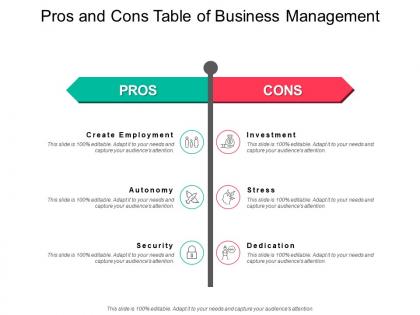
Pros and cons table of business management





Try Before you Buy Download Free Sample Product
 Impress Your
 Audience
 100%
100% Editable
 Save Hours
 of Time


Get on a firm footing to grow with our Pros And Cons Table Of Business Management. They ensure achievements are galore.
People who downloaded this PowerPoint presentation also viewed the following :
Pros and cons table of business management with all 5 slides:
Bring cheer to the heavy hearted with our Pros And Cons Table Of Business Management. Give them a chance to find happiness.




FAQs for Pros and cons table
Honestly, it comes down to talking to your team like actual humans and planning stuff that makes sense. Set goals you can actually measure - none of that vague "do better" nonsense. Don't hover over everyone's shoulder (trust me, learned this the hard way when half my team wanted to quit). Build real relationships with people since they're doing most of the heavy lifting anyway. Use data when you're making decisions, but also... just pick one thing this week? Maybe fix how you communicate about projects or cut out some annoying process that wastes time.
Look, strategic planning is honestly just about getting everyone on the same page instead of running around like headless chickens. You'll waste way less time and money when people actually know what they're supposed to be doing. It forces you to think ahead too - like what could go wrong before it smacks you in the face. I've watched companies completely turn things around once they got their priorities straight. Oh, and don't overcomplicate it. Pick 3-5 solid goals for the next few months and figure out the basic steps to get there.
Honestly, leadership makes or breaks everything in business. You can have the smartest team, but without good direction they'll just spin their wheels. Clear expectations are huge - people need to know what you actually want from them. And here's the thing: when you genuinely support your people and help them grow, they'll work way harder for you. I've seen it happen so many times. Making tough calls comes with the territory too. Oh, and building trust? That's not some soft skill - it directly impacts your bottom line. Focus on being straightforward with your team and actually caring about their development. That's where you'll see real results.
Honestly, pulse surveys work pretty well - just don't make them annual things that everyone dreads. Monthly check-ins are way better. Anonymous feedback tools are clutch because people actually tell the truth when their name isn't attached. Track stuff like turnover and productivity too, but the real gold is in those one-on-ones with your team. For improving things? Recognition programs are huge. Career development paths that aren't total BS. Oh, and actually DO something with the feedback - nothing kills morale faster than asking for input then ignoring it completely.
Honestly, overcommunication is your best friend here. Set super clear expectations upfront and do regular check-ins - but not pointless meetings, you know? Get everyone on the same project management tool and decide response times for different stuff. Don't micromanage though, that kills trust fast. Focus on what gets done, not how many hours people sit at their desk. Oh, and actually invest in decent tech for your team - cheap equipment backfires. I'd start with weekly one-on-ones to catch problems early. Maybe audit where your communication's breaking down first, then pick one tool to get everyone using.
Look, good financial management is honestly like having insurance for your business. Cash flow tracking, smart budgeting, decent reserves - this stuff keeps you alive when things get rough. I've watched solid companies crash just because they hit a cash crunch at the worst possible time. Pretty brutal to see, actually. When you stay on top of costs and plan for different scenarios, you're not just surviving anymore - you're actually positioning yourself to grow. Markets change, economies tank, but businesses with their finances dialed in? They make it through and often come out stronger. Track your cash weekly if you aren't already doing that.
Honestly, agile is a game-changer because you're not locked into some massive plan that'll probably be wrong anyway. Your team can actually respond when customers say "hey, we hate this feature" instead of spending months building stuff nobody wants. Launches happen way faster too. Plus the whole team collaborates better - I've seen it work at my company and it's pretty dramatic. Sure, the "fail fast" thing sounds like buzzword BS, but it genuinely helps you pivot quickly. Maybe try it on one small project first? You'll see what I mean.
Honestly, start with whatever manual task is driving you crazy right now. Workflow software can handle the repetitive stuff automatically. Cloud systems are worth it - your team can actually work together without those insane email threads we all hate. Project management platforms help too, and AI chatbots are decent for customer service now. The trick is making your current systems talk to each other so info moves between departments smoothly. I'd avoid getting distracted by fancy new tools though. Pick something that fixes your actual problems first, then you can expand from there once it's working.
Honestly, start with making people feel safe to mess up - nobody's gonna think outside the box if they're terrified of getting fired. I'd try something like "innovation Fridays" where people can work on random projects. Google does that 20% time thing for a reason, right? Celebrate the smart failures, not just wins. Mix up your hiring too - different backgrounds = different ideas. And actually listen to everyone, not just the executives who think they know everything. Maybe set up a simple way for people to submit ideas that won't just disappear into a black hole. Cross-team projects work great since fresh eyes catch things you miss.
So CRM basically pays for itself through better sales and keeping customers around longer. Your sales team gets way better conversion rates when they can see someone's full history and actually personalize their pitch. Follow-ups happen automatically which is huge - I can't tell you how much stuff used to slip through the cracks before we had that. Customer service gets faster too since they don't have to dig around for info. But honestly? The biggest win is understanding what people actually buy so you can suggest relevant stuff and keep them happy long-term. Just pick one thing to measure first.
Oh man, you're gonna run into some fun stuff! Language barriers are real - even when everyone speaks English, things get lost in translation. Time zones suck for meetings too. Different cultures handle feedback totally differently, like some people are brutally direct while others dance around everything. Honestly the holiday thing trips me up every time - someone's always out for some festival I've never heard of. Work-life balance expectations are all over the map too. Start by figuring out how each person likes to communicate. Spend time learning their backgrounds - it actually helps way more than you'd think.
Honestly, data analytics just turns your hunches into actual proof. You know those gut feelings you have about your business? Now you can check if they're right by looking at real sales patterns, how customers actually behave, operational costs - whatever matters for your situation. I used to wing it way too much before I started doing this. The cool thing is you'll catch trends that were totally invisible before and spot problems coming instead of scrambling after they hit. Plus you'll finally know what's genuinely moving the needle vs what just feels like it's working. Just pick one decision you're stuck on and dive into those numbers first.
Honestly, the biggest thing is listening - like really listening, not just waiting for your turn to talk. Don't let stuff fester because that always makes it worse later. Focus on what people actually want, not just their stubborn positions. I'd talk to each person separately first to get the real story, then bring them together. Create space where they won't get attacked for being honest. Use "I" statements so nobody gets defensive, and ask questions that dig into the actual problem. The whole "separate the issue from the person" thing sounds cheesy but it works. Stay neutral even when someone's clearly being ridiculous.
Look, your supply chain is basically what makes or breaks how smoothly stuff gets from your suppliers to customers. Fix the bottlenecks and you'll cut costs while keeping customers happy. Mess it up? You're stuck with either too much inventory sitting around or running out of products when people want them - both scenarios suck for your cash flow. The best part is you can actually respond way faster when the market shifts if your supply chain isn't a disaster. Honestly, just map out what you're doing now first. That's where you'll spot the obvious problems killing your efficiency.
Look, everyone expects companies to give a damn about more than just money these days. Your brand gets torched on social media if you don't - I've seen it happen way too fast. Employees want to work somewhere meaningful, and investors are paying attention too. Pick causes that actually make sense for your business though, not just whatever's trending. Put real money behind it, not just some half-hearted PR campaign. Done right, it helps with hiring good people and honestly just makes customers like you more.
No Reviews