


Pumped Storage Hydro Power Plant Clean Energy Ppt Powerpoint Presentation Icon Slides





Try Before you Buy Download Free Sample Product
 Impress Your
 Audience
 100%
100% Editable
 Save Hours
 of Time


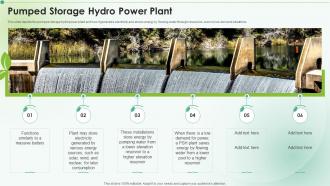
This slide depicts the pumped storage hydropower plant and how it generates electricity and stores energy by flowing water through reservoirs,even in low demand situations.
People who downloaded this PowerPoint presentation also viewed the following :
Pumped Storage Hydro Power Plant Clean Energy Ppt Powerpoint Presentation Icon Slides with all 6 slides:
Use our Pumped Storage Hydro Power Plant Clean Energy Ppt Powerpoint Presentation Icon Slides to effectively help you save your valuable time. They are readymade to fit into any presentation structure.





FAQs for Pumped Storage Hydro Power Plant Clean Energy Ppt Powerpoint
You'll need two water reservoirs at different heights, reversible pump-turbines, and a penstock connecting everything. Plus generators/motors and a transformer station. It's basically a giant water battery - pump water uphill when you don't need power, then let it flow back down through turbines when you do. Those reversible pump-turbines do all the heavy lifting in both directions, which is pretty clever if you ask me. Oh, and when you're checking out potential sites? Elevation difference and water supply are make-or-break factors. Everything else builds around those two things.
So it's basically a two-step thing. When there's extra power, you pump water uphill to store it. Pretty simple concept but honestly kind of genius. The water sits there in the upper reservoir with all that potential energy - like a massive water battery. Then when people need electricity, you let it flow back down through turbines. Gravity does its thing, spins the generators, boom - you've got power again. Only catches about 75-85% efficiency though, so you do lose some energy in the process. Still way better than most storage options.
So basically you're buying cheap electricity when nobody needs it to pump water uphill, then when everyone's cranking their AC you let it flow back down and sell at peak prices. Like flipping electricity, which sounds weird but actually works. These plants also get paid for grid services - frequency regulation, spinning reserves, all that technical stuff utilities need. Honestly the ancillary service contracts are where you'll make bank if you can lock them in early. Oh and they last forever, like 80+ years with barely any maintenance costs. Pretty decent long-term play.
Think of pumped storage like massive grid batteries - they soak up extra power when there's too much floating around, then dump it back out during demand spikes. Super helpful for smoothing out renewables since wind and solar can be all over the place. These things can ramp up or down in seconds (way faster than coal plants), plus they keep the grid humming at exactly 60Hz. Oh, and they're lifesavers during blackouts - they can actually restart the whole system. Honestly pretty clever engineering. If you're doing any grid planning, you'll want them for both daily peaks and those random supply hiccups that always seem to happen.
So basically you're looking at habitat disruption when they build the reservoirs, plus it messes with natural water flow and fish migration patterns. Construction's gonna be noisy and dusty - you know how these big projects go. Water temps can get weird between the upper and lower reservoirs too, which screws with downstream ecosystems. Honestly though, at least nowadays they make you do those massive environmental impact studies before breaking ground. My advice? Get your environmental people involved super early - like, before you even finalize the site. They'll catch stuff you wouldn't think of.
Yeah so pumped storage is actually worse efficiency-wise - like 70-85% compared to regular hydro hitting 90%+. But here's the thing, they're doing totally different jobs. Regular hydro just generates power from flowing water. Pumped storage is more like a massive battery - it uses extra grid power to pump water uphill, then drops it back down when you need juice. You definitely lose energy in that cycle, but honestly the grid balancing stuff it does is pretty valuable. Don't just look at efficiency numbers when comparing them - check what each one actually does for the grid.
Think of pumped storage like a massive battery for the power grid. Excess energy from wind and solar gets used to pump water uphill into reservoirs. Later, when renewable output drops (which honestly happens way more than you'd want), that water flows back down through turbines to generate electricity. It smooths out all those crazy ups and downs that make renewables tricky to manage. Tons of utilities are now building these alongside new solar projects - my cousin works for one and says it's becoming pretty standard. Makes the whole system way more reliable.
Dude, the biggest pain is gonna be finding spots with decent topography and water access. Upfront costs are absolutely insane - like billions for anything worth building. Environmental permits? Total nightmare, especially near protected areas or fish routes. Regulatory approval drags on forever (seriously watched one project sit for 3 years). You've also got transmission studies and grid connection headaches. Oh, and community pushback kills more projects than bad engineering ever will. Start your environmental assessments super early and actually talk to locals from the beginning. Trust me on that last part.
Dude, water management is make-or-break for pumped storage. You've gotta nail the balance between your upper and lower reservoirs to max out that hydraulic head difference - that's what drives your turbine efficiency. Screw this up and you're either wasting potential energy or going dry right when the grid desperately needs juice. Honestly, the economics can tank fast if you're not careful. Build solid forecasting that factors in seasonal changes, evaporation, demand patterns - all that fun stuff. Oh, and audit your current water balance calcs first. Might catch some low-hanging fruit there.
So basically the mountainous countries crush it - Austria, Switzerland, Japan, and China lead the pack. Mountains are everything here since you need that elevation drop between reservoirs to make it work economically. China's been building these things like crazy lately, honestly it's pretty impressive. Dense populations help too because there's huge electricity demand but not much room for other storage types. That's why flat places like the Great Plains are kinda screwed - no hills, no pumped storage. Geography really is destiny with this stuff.
Okay so the biggest thing right now is variable-speed pump turbines - they react super fast to grid changes which is huge. Underground systems are getting better too since you don't need perfect terrain anymore. There's this wild seawater storage thing happening where they just use the ocean instead of building reservoirs up top. New turbine designs are hitting like 85%+ efficiency which is honestly pretty impressive. They're also doing smaller modular setups for local grids. But yeah, definitely watch the variable-speed stuff - that's where all the flexibility improvements are coming from.
Dude, pumped storage costs way more upfront - like hundreds of millions. But here's the thing: those systems last 50+ years while batteries crap out after maybe 10-15. Your ongoing costs are basically nothing since you don't keep replacing equipment like with lithium-ion. The permitting process is such a nightmare though, takes forever. But yeah, if you run the math over 30 years, pumped storage usually comes out ahead for big projects. Short answer: higher upfront, way better long-term economics.
Check out Bath County in Virginia - it's huge at 3,003 MW, probably the biggest in the world. Japan has Kannagawa at 2,820 MW. Wales has this cool one called Dinorwig (they nicknamed it "Electric Mountain" which sounds like something from a movie). Goes from zero to full power in 16 seconds, which is crazy fast. China's building a ton of them lately, especially around Guangdong. The whole concept is pretty smart - store extra wind/solar power when there's too much, then dump it back during peak hours. Really saves the grid from going haywire.
Dude, regulations will absolutely destroy your timeline if you're not careful. FERC licensing takes like 5-7 years minimum - it's insane. Then you've got environmental reviews, grid connection requirements, plus whatever your state throws at you. Honestly, the whole process is pretty broken. Some countries actually fast-track storage projects, but here? Nah, they treat it like old-school hydro with all the same bureaucratic nightmare. Get regulatory consultants involved right away - I can't stress this enough. Building relationships with these agencies early is everything, because going it alone is basically project suicide.
Dude, the pumped storage space is getting wild right now. Underground facilities are popping up everywhere, plus they're finally figuring out how to sync these things properly with solar and wind. Turbine tech keeps getting better too. Coastal areas are experimenting with seawater systems which is kinda cool. But honestly? The real game-changer is just how desperately we need storage for renewables - like, countries are scrambling because solar and wind are so unpredictable. Keep an eye on grid modernization policies though, that's where the money's gonna flow in the next few years.
-
Such amazing slides with easy editable options. A perfect time-saver.
-
Easily Editable.