


Quantum Computing IT Powerpoint Ppt Template Bundles




Try Before you Buy Download Free Sample Product
 Impress Your
 Audience
 100%
100% Editable
 Save Hours
 of Time


Our Quantum Computing IT Powerpoint Ppt Template Bundles are topically designed to provide an attractive backdrop to any subject. Use them to look like a presentation pro.
People who downloaded this PowerPoint presentation also viewed the following :
Content of this Powerpoint Presentation
Slide 1: This slide introduces Quantum Computing (IT). State Your Company Name and begin.
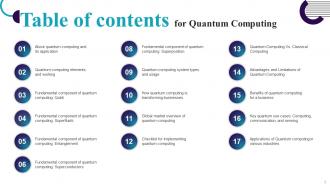
Slide 2: This slide shows a Table of Contents for the presentation.
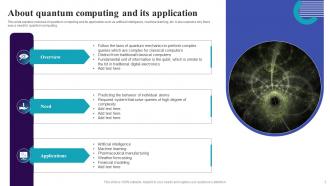
Slide 3: This slide explains quantum computing and its application.
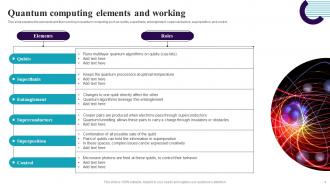
Slide 4: This slide portrays Quantum computing elements and working.
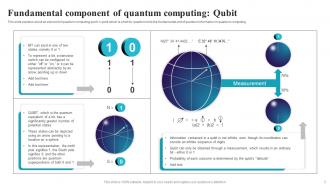
Slide 5: This slide describes an element of quantum computing qubit.
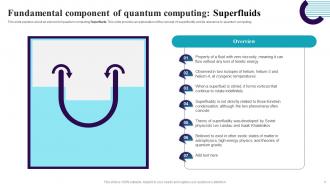
Slide 6: This slide entails an element of quantum computing Superfluids.
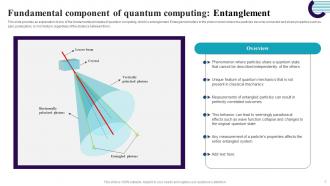
Slide 7: This slide explains one of the fundamental principles of quantum computing, which is entanglement.
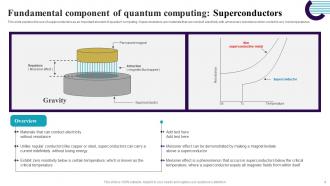
Slide 8: This slide showcases the use of superconductors as an important element of quantum computing.
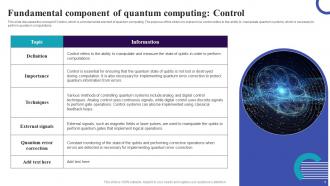
Slide 9: This slide discusses the concept of Control, which is a fundamental element of quantum computing.
Slide 10: This slide illustrates the concept of superposition, which is a fundamental element of quantum computing.
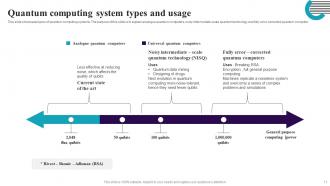
Slide 11: This slide entails types of quantum computing systems.
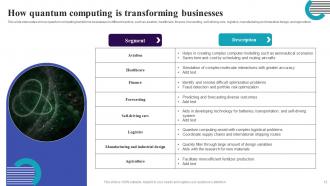
Slide 12: This slide elaborates on how quantum computing is transforming businesses.
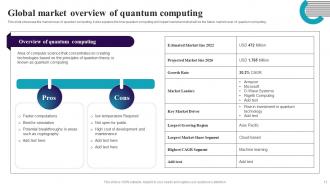
Slide 13: This slide showcases the market cover of quantum computing.
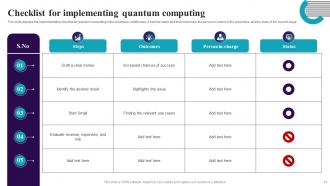
Slide 14: This slide displays the implementation checklist for quantum computing in the workplace.
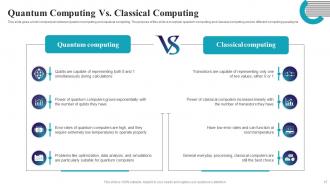
Slide 15: This slide gives a brief comparison between quantum computing and classical computing.
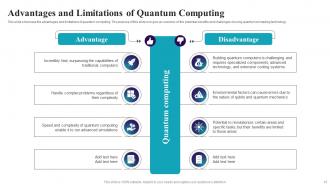
Slide 16: This slide illustrates the advantages and limitations of quantum computing.
Slide 17: This slide provides various benefits of quantum computing for a business.
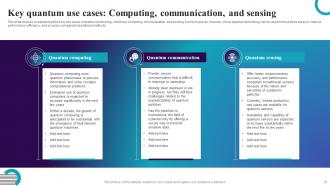
Slide 18: This slide focuses on explaining three key use cases of quantum technology, which are computing, communication, and sensing.
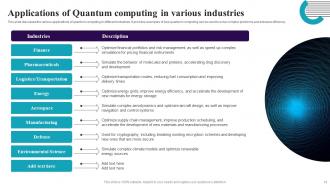
Slide 19: This slide discusses the various applications of quantum computing in different industries.
Slide 20: This slide is a thank-you slide with address, contact numbers, and email address.
Quantum Computing IT Powerpoint Ppt Template Bundles with all 25 slides:
Use our Quantum Computing IT Powerpoint Ppt Template Bundles to effectively help you save your valuable time. They are readymade to fit into any presentation structure.







FAQs for Quantum Computing IT Powerpoint
So basically, a qubit can be in multiple states at once - like both 0 and 1 simultaneously. Wild, right? Regular bits are stuck being either 0 or 1, period. Picture a spinning coin vs one that's already landed. That's the difference. This whole superposition thing is why quantum computers are so powerful - one qubit handles multiple possibilities at the same time. Honestly, wrapping your head around this concept first will make everything else way easier. Don't jump into entanglement yet, it'll just confuse you more.
Yeah, quantum entanglement is actually being used for super secure communication right now through something called quantum key distribution. Basically, you entangle photons and send them between locations - if anyone tries to intercept them, the entanglement breaks and you know someone's snooping. It's honestly pretty mind-blowing physics. The quantum states create encryption keys that can't be cracked. IBM and Google are working on commercial systems, though they're pricey and distance is still an issue. If you're dealing with really sensitive stuff, might be worth looking into QKD providers soon.
So quantum gates are like the basic tools for messing with qubits - kinda like logic gates but way more mind-bending. They do these unitary operations that rotate qubit states around something called the Bloch sphere, which changes probabilities and creates entanglement. The cool part? They're reversible and can make superposition states happen. You've got your X gate for bit flips, Z for phase flips, Hadamard gates... that's literally how you build quantum algorithms! Start with single-qubit gates though - trust me, don't jump straight into CNOT gates or you'll hate yourself.
Ugh, quantum error correction is such a pain right now. Environmental noise kills your quantum states instantly - like, the tiniest vibration ruins everything. You need hundreds of physical qubits just to make one decent logical qubit, which is honestly ridiculous overhead. Error rates are still way higher than what the correction algorithms can actually fix. The worst part? Trying to correct errors actually creates more errors sometimes. It's this annoying cycle. Current systems can't even run corrections fast enough to keep up with how quickly things break down. I'd stick with error mitigation techniques for now until the hardware gets less terrible.
So quantum computing is gonna be huge for both those fields. Risk analysis and fraud detection in finance could go from hours to minutes - that's pretty wild when you think about it. Drug discovery gets way more interesting too since you can actually simulate how molecules interact at crazy scales. The protein folding stuff is honestly what gets me most excited. Yeah, we're still looking at 5-10 years before it's really practical, but I'd start learning quantum algorithms now if I were you. Companies are gonna need people who actually get this technology.
Hey! So there are three big ones you absolutely need to know. Shor's algorithm breaks encryption by factoring huge numbers - honestly kind of scary when you think about it. Grover's is for searching databases way faster than normal computers can. Then there's Deutsch-Jozsa, which figures out if functions are constant or balanced. They're all foundational because they actually beat classical computers by huge margins. Shor's gives exponential speedup, Grover's gives quadratic. Start with these three and you'll get how quantum computers use superposition and entanglement to be so much faster.
So quantum computers aren't just better versions of regular computers - they're weirdly specialized. Your laptop crushes general stuff, but quantum machines could theoretically blow past them on specific problems like breaking encryption or complex optimization. It's like comparing a Ferrari to a submarine, you know? Both cool, totally different purposes. The catch is they're still super experimental and break constantly. I was reading about this the other day actually - most experts think we're looking at another 10-20 years before quantum computers reliably beat classical ones for real applications.
Dude, the quantum space is moving crazy fast right now. IBM just dropped their 1000+ qubit Condor chip - that's insane. Meanwhile Google's going all-in on logical qubits that can actually stay coherent. Error rates are finally getting low enough that we might see real applications soon, which is wild to think about. Oh and those photonic quantum computers from Xanadu? Totally caught me off guard how quickly they're advancing. Honestly if you're thinking about any quantum projects, I'd definitely watch IBM's roadmap - they're being super transparent about where they're headed.
So gate model quantum computing works with discrete steps - you manipulate qubits one gate at a time, kinda like regular programming but quantum. Adiabatic is totally different. It slowly shifts the whole quantum system until it finds the best solution. Honestly, I think of it like taking stairs versus riding a smooth elevator. Gate model's way more flexible for general stuff, but adiabatic is laser-focused on optimization problems. Since you're starting out, I'd dive into gate model first - most frameworks use that approach anyway, so you'll have more resources to work with.
So quantum supremacy is when quantum computers can crack problems that would take regular computers like thousands of years to solve - but quantum does it in minutes. Google said they hit this in 2019 (though IBM was like "nah, we don't think so" lol). The cool part is it proves this stuff actually works now, not just in theory. Once they move past these test problems into real applications - drug discovery, breaking encryption, financial stuff - it's gonna completely flip how we tackle complex problems. Honestly worth thinking about what in your field might get that kind of exponential boost.
So quantum computing could be a game-changer for ML - basically it processes huge datasets way faster than regular computers. Instead of checking solutions one by one, quantum parallelism lets you explore tons of them at once. Those optimization problems that take weeks? Could be done much quicker. Algorithms like QAOA might totally change how we train neural networks. Honestly though, the hardware is still pretty noisy and experimental. I'd mess around with PennyLane or Qiskit if I were you - even basic stuff now will put you ahead when this tech actually matures.
Dude, quantum computing is honestly kinda scary for cybersecurity. It'll basically crack RSA and AES encryption like they're nothing once these computers get powerful enough. The weird thing is quantum tech isn't evil by itself - it's just that suddenly all our secrets become readable. Companies are already working on post-quantum crypto, which is smart since we're probably still years out from the real threat. But yeah, you don't want to wait until quantum computers are everywhere and then panic. Better to upgrade your security stuff now while there's time.
So decoherence is basically what ruins everything in quantum computing - your qubits start acting like regular bits instead of staying quantum. Picture trying to balance a pencil on its tip while someone shakes the table, that's what environmental noise does to these systems. Temperature changes, electromagnetic interference, all that stuff messes with it. And it happens crazy fast too, like microseconds. That's why error correction is so huge right now. You've got to work within that tiny window before your quantum advantage just... disappears.
So quantum computers are pretty much built for specific heavy-lifting stuff - breaking encryption codes, simulating how molecules interact (huge for drug research), and crunching massive financial models. They're also solid for certain machine learning problems with tons of data. But here's the thing - they suck at normal computing tasks. Like, your phone could probably beat one at running basic software right now. The magic happens when you need to test thousands of possible solutions at once or simulate actual quantum physics. That's their sweet spot.
Honestly, you're looking at three main technical hurdles. Quantum repeaters are still super unreliable - they can't maintain entanglement over long distances without everything falling apart. Error correction for networked qubits is another mess entirely, way trickier than what we deal with in isolated quantum computers. Plus we desperately need standardized protocols so different quantum systems can actually communicate without building custom interfaces every single time (such a pain). The repeater problem is definitely where I'd throw most resources right now since that's the real chokepoint. Once we crack that, the rest becomes more manageable.
-
“Excellent information with easy access.”
-
Great quality slides in rapid time.