

Edge Computing Technology IT Powerpoint Ppt Template Bundles




Try Before you Buy Download Free Sample Product
 Impress Your
 Audience
 100%
100% Editable
 Save Hours
 of Time


Our Edge Computing Technology IT Powerpoint Ppt Template Bundles are topically designed to provide an attractive backdrop to any subject. Use them to look like a presentation pro.
People who downloaded this PowerPoint presentation also viewed the following :
Content of this Powerpoint Presentation
Slide 1: This slide introduces Edge Computing Technology (IT). Commence by stating Your Company Name.
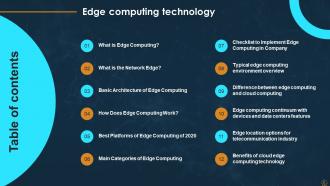
Slide 2: This slide incorporates the Table of contents.
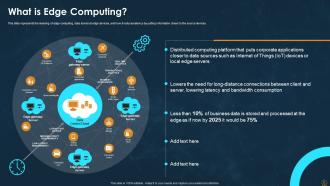
Slide 3: This slide represents the meaning of edge computing.
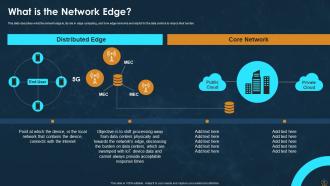
Slide 4: This slide describes what the network edge is.
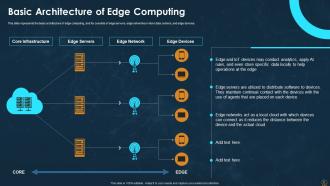
Slide 5: This slide shows the Basic Architecture of Edge Computing.
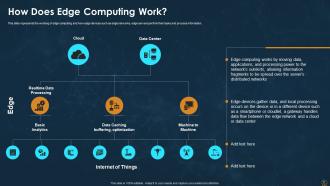
Slide 6: This slide presents the working of edge computing and how edge devices.
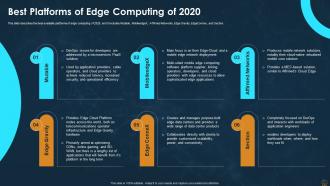
Slide 7: This slide talks about the Best Platforms of Edge Computing of 2020.
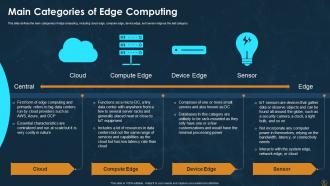
Slide 8: This slide states the Main Categories of Edge Computing.
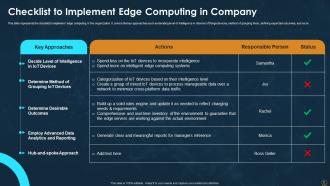
Slide 9: This slide reveals the checklist to implement edge computing in the organization.
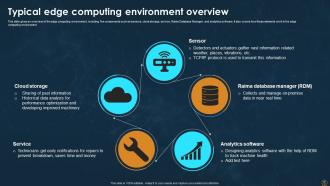
Slide 10: This slide gives an overview of the edge computing environment.
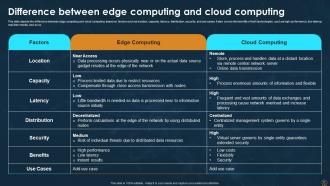
Slide 11: This slide depicts the difference between edge computing and cloud computing.
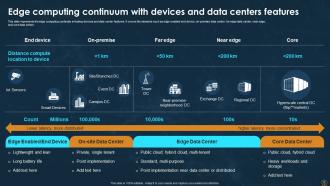
Slide 12: This slide highlights the edge computing continuity including devices and data center features.
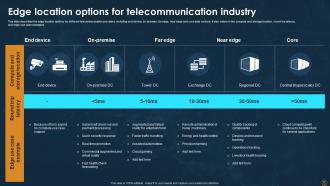
Slide 13: This slide describes the edge location options for different telecommunication providers.
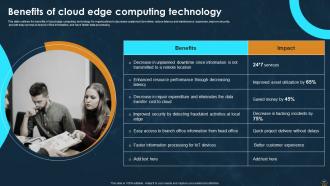
Slide 14: This slide outlines the benefits of cloud edge computing technology for organizations.
Slide 15: This is the Thank you slide for acknowledgement.
Edge Computing Technology IT Powerpoint Ppt Template Bundles with all 20 slides:
Use our Edge Computing Technology IT Powerpoint Ppt Template Bundles to effectively help you save your valuable time. They are readymade to fit into any presentation structure.






FAQs for Edge Computing Technology IT Powerpoint
So basically edge computing handles data right where it happens - your factory floor, store locations, whatever. Cloud computing? That's sending everything off to some data center miles away first. Edge is crazy fast since there's no round trip, plus it doesn't die when your internet gets wonky. Perfect for anything real-time. Though honestly, cloud still wins for the heavy lifting and massive storage stuff. If you're messing around with IoT gadgets or need instant responses, edge is probably your best bet for the critical stuff.
So basically edge computing processes stuff right where you need it instead of shipping data off to some far-away server. Your IoT devices and apps can handle things locally - no more waiting for that round trip to a data center that's like 500 miles out. Game changer for anything real-time. Autonomous cars, VR, factory stuff - they all break down if you've got 50-100ms delays hitting them constantly. Honestly, if you need response times under 20ms, edge is pretty much your only option. Worth looking into for sure.
Honestly, edge computing is huge in manufacturing right now - they process sensor data locally instead of waiting for the cloud, which prevents those costly equipment failures. Healthcare uses it for real-time patient monitoring. Retail does instant inventory updates and personalized ads (kind of creepy but whatever). Gaming companies are obsessed with it because it cuts lag, and trust me, gamers will lose their minds over even tiny delays. The big wins? Way faster responses, lower bandwidth costs, and it won't crash when your internet decides to be terrible. I'd say start with a small pilot project if you're considering it.
So edge computing basically keeps your sensitive stuff local instead of shipping it off to some random cloud server halfway across the world. Way fewer places for hackers to grab your data in transit, you know? Processing locally also makes those GDPR compliance headaches way easier to handle - your data stays put where it needs to. Honestly, the speed boost is cool but the security angle is what really matters here. I'd start by figuring out which data streams you absolutely can't afford to lose, then move that processing to edge nodes first. Makes the most sense that way.
Honestly, IoT is what's really driving edge computing right now. All those devices pump out data 24/7, and if you send everything to the cloud? You'll hit massive delays and bandwidth problems. Processing locally fixes that mess. Smart factories need instant responses - same with self-driving cars and medical devices. The cloud just can't keep up when milliseconds matter. Plus you get less network traffic and better security since your data doesn't travel as far. Oh, and if you're planning an IoT project, don't make the mistake I see everywhere - build in edge computing from the start or you'll regret it later.
So basically, your architecture choice is gonna make or break your latency. Distributed edge rocks for performance since everything's closer to users, but honestly? Managing all those nodes is a nightmare. Centralized is way simpler to deal with but you'll get hit with higher delays. Hybrid's pretty solid though - run your critical stuff locally and send the rest to central nodes. I'd probably start by figuring out what your users actually care about speed-wise, then work backwards from there. Traffic patterns will tell you everything you need to know.
Honestly, the infrastructure stuff gets messy fast. Distributed systems are such a pain to debug compared to regular cloud setups. You're juggling spotty connections, limited hardware at each location, and suddenly you've got like 50 different places hackers can try to break in. Your team will need to learn completely new monitoring tools too - which, fair warning, takes forever. Security becomes this whole thing because there's just so many more weak points. I'd definitely test everything on one small site first before you go crazy and deploy everywhere at once.
So edge computing is what makes smart cities actually function in real-time. Traffic lights, sensors, cameras - they process data locally instead of sending everything to distant servers. Traffic adjusts instantly when there's congestion. Emergency alerts happen without lag. Energy grids optimize themselves automatically. It's wild how much faster everything gets when you're not waiting for that cloud round-trip. My buddy who works in city planning always says this - build the edge infrastructure from the start. Don't try adding it later, it's such a headache.
Honestly, latency is where you'll see the biggest wins - start there. Track response times and how much data you're processing locally vs shipping to the cloud. Uptime matters too since edge stuff breaks in weird ways. Cost per transaction will surprise you (edge gets pricey quick if you're not watching). Page load times and app responsiveness are solid user metrics. Oh, and bandwidth usage - can't forget that one. Pick like 3-4 metrics that actually matter to your business first, then add more later. Don't try to measure everything at once or you'll go crazy.
So basically, edge computing processes your data right where it's created instead of shipping it off to some far-away cloud server. Way faster since you're not waiting around for data to travel back and forth. You can also filter out the junk before it even leaves your setup - honestly, this part saves so much bandwidth it's not even funny. Real-time decisions happen instantly because the analytics are right there at the source. Means you'll catch problems immediately, keep sensitive stuff local (compliance teams love this), and your costs stay reasonable.
So edge computing is usually better for the environment than those massive data centers, but there's a catch. You save energy because data doesn't have to travel as far, and processing happens right where you need it. But then you're spreading everything out instead of having one super-efficient hub - kinda like having a bunch of corner stores instead of one Walmart, if that makes sense. The trade-off is real though. For your stuff, I'd go with edge if you can actually cut down on data transfer or if doing the processing locally uses way less power overall.
So first off, get your APIs sorted - REST, MQTT, or gRPC work great for getting edge devices talking to the cloud. Docker containers are clutch here because they package everything consistently no matter where you deploy. JSON's pretty much the standard for data formats, so stick with that. Honestly, the biggest mistake I see is people waiting too long to test integration - do it early and often or you'll hate yourself later. Oh, and definitely start small with a pilot setup first. Way easier to debug issues when you're not dealing with a massive rollout from day one.
So the big ones are real-time patient monitoring and medical imaging stuff. ICUs use it tons because patient vitals need instant analysis - can't wait for cloud processing when someone's crashing. Radiology departments love it too since those massive MRI scans take forever to upload. Remote surgery is crazy impressive, though I still can't wrap my head around operating on someone from across the country. Edge keeps patient data local which helps with all those healthcare compliance headaches. Oh, and IoT device management is huge now. I'd figure out which apps absolutely can't handle delays first.
So ML and edge computing work really well together - you can run models right on the device instead of shipping everything to the cloud. Way less lag that way, plus sensitive stuff stays local (security people are obsessed with that). Perfect for things like fraud detection on ATMs or self-driving cars recognizing objects instantly. Can't really wait around for cloud processing with that stuff. The tricky part is your edge devices don't have much computing power. You'll want to look into model quantization and pruning - basically shrinking your models down so they actually run properly on smaller hardware.
Edge computing's about to get wild with AI baked right in. Devices won't need to constantly check with the cloud anymore - they'll just handle stuff locally. 5G is gonna change everything once it actually rolls out everywhere (still waiting on that in some areas, honestly). Manufacturing and healthcare are building their own specialized edge setups instead of using generic solutions. Security's trickier now since you're spreading processing all over the place. Worth thinking about which of your current projects could work better if you moved some tasks closer to where the data actually sits.
-
The presentations are very helpful. I am always able to get appropriate templates for the different topics related to my profession.
-
I was never satisfied with my own presentation design but SlideTeam has solved that problem for me. Thank you SlideTeam!