


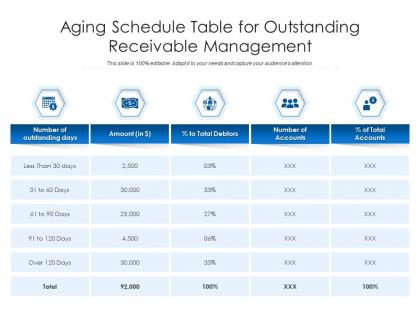
Aging schedule table for outstanding receivable management




Try Before you Buy Download Free Sample Product
 Impress Your
 Audience
 100%
100% Editable
 Save Hours
 of Time


Our Aging Schedule Table For Outstanding Receivable Management are topically designed to provide an attractive backdrop to any subject. Use them to look like a presentation pro.
People who downloaded this PowerPoint presentation also viewed the following :
Aging schedule table for outstanding receivable management with all 2 slides:
Use our Aging Schedule Table For Outstanding Receivable Management to effectively help you save your valuable time. They are readymade to fit into any presentation structure.

FAQs for Aging schedule table for
An aging schedule is a financial report that categorizes accounts receivable by the length of time invoices have been outstanding, typically in 30-day intervals. This tool enables businesses to assess collection risks, prioritize follow-up efforts, and maintain healthy cash flow by identifying overdue accounts early, ultimately improving working capital management and reducing bad debt expenses.
An aging schedule helps assess accounts receivable by categorizing outstanding invoices into time periods, typically 30, 60, 90, and 120+ days past due, enabling businesses to identify payment patterns and potential collection issues. This systematic approach streamlines cash flow management, enhances credit decision-making, and minimizes bad debt risk, with many organizations finding that regular aging analysis ultimately delivers improved collection efficiency and stronger financial control.
Key components in an aging schedule include customer names, invoice numbers, invoice dates, total amounts due, and time-based aging buckets like current, 30-60-90 days past due. This comprehensive breakdown enables finance teams to prioritize collection efforts, assess credit risks, and maintain healthy cash flow, with many organizations finding that detailed aging analysis significantly improves their accounts receivable management and reduces bad debt losses.
Aging schedules enable businesses to improve cash flow management by identifying overdue accounts, prioritizing collection efforts, and forecasting incoming payments more accurately. Through systematic tracking of receivables by age categories, companies streamline collections, reduce bad debt exposure, and optimize working capital allocation, with many financial teams finding that proactive aging analysis ultimately delivers faster payment cycles and enhanced liquidity planning.
Aging schedules typically use intervals of 0-30 days (current), 31-60 days, 61-90 days, 91-120 days, and over 120 days past due. These standardized timeframes enable businesses to systematically track payment patterns, prioritize collection efforts, and assess credit risk across customer portfolios, with many organizations finding that shorter intervals reveal critical cash flow trends more effectively.
The aging schedule impacts credit risk assessment by categorizing outstanding receivables by time periods, revealing payment patterns, identifying high-risk accounts, and enabling proactive collection strategies. Through detailed aging analysis, financial institutions and businesses can accurately assess customer creditworthiness, adjust credit limits accordingly, and minimize potential losses, ultimately enhancing portfolio management and reducing overall credit exposure.
An aging schedule guides collection prioritization by categorizing outstanding receivables by time periods, enabling businesses to identify overdue accounts requiring immediate attention, allocate collection resources strategically, and escalate follow-up procedures systematically. This structured approach streamlines collection workflows, reduces bad debt exposure, and improves cash flow management, with many organizations finding that aging-based collection strategies significantly enhance recovery rates and operational efficiency.
Businesses should update their aging schedules monthly, with many organizations finding that weekly updates during high-volume periods enhance cash flow visibility and collection effectiveness. This regular cadence enables finance teams to identify overdue accounts promptly, prioritize collection efforts strategically, and maintain accurate financial reporting, ultimately delivering improved working capital management and reduced bad debt exposure.
Accounts receivable aging tracks money owed to your company by customers, categorizing outstanding invoices by age to identify collection risks and cash flow timing. Accounts payable aging monitors money your company owes suppliers, helping prioritize payments, manage cash flow, and maintain vendor relationships, with both enabling strategic financial planning and operational efficiency.
An aging schedule assists in inventory management by identifying slow-moving stock, preventing obsolescence, and optimizing turnover rates through systematic categorization by time periods. This approach enables retailers and manufacturers to implement strategic markdowns, adjust procurement schedules, and reallocate warehouse space more effectively, ultimately reducing carrying costs while maintaining optimal stock levels.
Businesses often face challenges including incomplete or inaccurate customer data, complex payment terms across different clients, manual tracking systems prone to errors, and difficulty categorizing disputed invoices. These obstacles can lead to delayed collections, inaccurate cash flow forecasting, and missed follow-up opportunities, with many organizations finding that streamlined automated systems significantly enhance accuracy and operational efficiency.
Aging schedules significantly influence financial forecasting by providing detailed insights into receivables collection patterns, cash flow timing, and potential bad debt provisions. Through this analysis, organizations can accurately predict working capital requirements, plan for liquidity needs, and adjust credit policies, ultimately enabling more precise budgeting and strategic financial planning across operations.
Businesses should design aging schedules with consistent time intervals, clear classification criteria, automated data integration, and regular review cycles to ensure accuracy and actionable insights. These practices enable organizations to streamline collections processes, identify payment patterns early, and optimize cash flow management, with many financial services and retail companies finding that standardized aging schedules significantly enhance operational efficiency.
**INPUT**: Can technology and software solutions enhance the effectiveness of aging schedules? **OUTPUT**: Technology significantly enhances aging schedule effectiveness through automated data collection, real-time updates, predictive analytics, and integrated reporting dashboards. These solutions streamline accounts receivable management by reducing manual errors, accelerating collection processes, and providing actionable insights, with many financial services and healthcare organizations finding that automated aging schedules ultimately deliver faster cash flow and improved customer relationships. [Word count: 58 words]
Aging schedules benefit small businesses by providing crucial cash flow visibility, enabling proactive collection efforts, and preventing bad debt accumulation that could severely impact operations. While larger corporations have dedicated credit departments and sophisticated systems, small businesses can leverage aging schedules to compete effectively by maintaining tighter customer relationships, faster response times, and more personalized collection approaches.
-
Best Representation of topics, really appreciable.
-
Helpful product design for delivering presentation.
-
Thanks for all your great templates they have saved me lots of time and accelerate my presentations. Great product, keep them up!
-
Great quality product.
-
Excellent design and quick turnaround.