

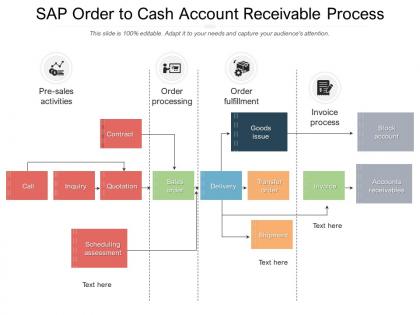
Sap order to cash account receivable process




Try Before you Buy Download Free Sample Product
 Impress Your
 Audience
 100%
100% Editable
 Save Hours
 of Time


Our SAP Order To Cash Account Receivable Process are topically designed to provide an attractive backdrop to any subject. Use them to look like a presentation pro.
People who downloaded this PowerPoint presentation also viewed the following :
Sap order to cash account receivable process with all 2 slides:
Use our SAP Order To Cash Account Receivable Process to effectively help you save your valuable time. They are readymade to fit into any presentation structure.
FAQs for Sap order to cash
So the O2C process breaks down into five main chunks: order management (capturing and validating what customers want), fulfillment (picking, packing, shipping), invoicing (sending bills), payment collection (chasing down money), and cash application (matching payments to invoices). Honestly, it's just tracking everything from "I want this thing" to "sweet, money's in the bank." Each step has its own headaches though. When you're trying to figure out what's broken, focus on how long each stage takes and where errors keep popping up - that's usually where the biggest wins are hiding.
Start with the boring stuff - automate invoice creation, payment reminders, all that repetitive work. Your CRM, ERP, and accounting systems need to talk to each other or you'll go crazy with manual data entry (learned this the hard way). Map out what you're doing now first, then hit the worst bottlenecks. Digital payments are a game changer for getting paid faster. Oh, and make sure everyone's following the same process - sounds obvious but you'd be surprised how many teams wing it differently. Quick wins help sell the bigger changes later.
Look, automation is your best friend here. Start with the boring stuff - order entry through EDI, automatic credit checks, invoice generation. Most ERP systems already have this built in, you just need to turn it on. The AI payment prediction thing is actually pretty cool once you get it running - tells you who's gonna be late before they even know it themselves. Honestly, just map out where your team spends the most time on mindless tasks first. That's your goldmine right there. Your current software probably does way more than you think.
Dude, real-time analytics are honestly a game changer. Instead of waiting weeks for reports, you'll catch problems right when they happen. Like if customers start paying late or orders get stuck somewhere weird. Suddenly popular products? You'll know immediately and can actually do something about it. Adjust credit limits, rush shipments, move inventory around - whatever. The trick is building dashboards that show stuff you actually care about, not just numbers that make executives feel good. I mean, who has time to dig through vanity metrics when there's real money on the line?
Ugh, the worst part is when your departments can't talk to each other - sales promises one thing, fulfillment does another. Manual processes will kill you too. Plus you'll have zero clue where orders actually are half the time. Don't even get me started on disputed invoices... those things drag on forever. Here's what I'd do: connect your systems first so everyone's on the same page. Automate the boring stuff like validating orders. Real-time dashboards are a game changer for catching problems early. Oh, and tackle whatever's driving you most crazy first - there's always that one thing that makes you want to scream.
So every industry tweaks their Order to Cash stuff differently, right? Manufacturing companies give way longer payment terms for big equipment deals - makes sense. Retail's all about speed though, like same-day everything. Software companies? Total nightmare with subscription billing and usage pricing (seriously, it gets messy). Healthcare moves super slow because of all the compliance BS they deal with. B2B services won't even send invoices until you hit project milestones. Honestly, you can't just copy what works elsewhere. Figure out how your customers actually pay and what they expect, then build around that.
Good credit management totally speeds up your whole order-to-cash process. You approve the right customers fast and set smart credit limits upfront, which means way fewer payment headaches down the road. Think of it like screening customers early instead of chasing bad debt for months - honestly, collections calls are the worst part of anyone's day. Your DSO drops, cash comes in faster, and you're not constantly putting out fires. The trick is getting credit decisions baked into your sales process early. Don't wait until after you've shipped stuff to realize someone can't pay.
Hey! So first thing - get those invoices out way faster and double-check they're perfect. Nothing worse than customers using tiny errors as excuses to delay payment (trust me on this one). Run credit checks upfront too, saves you headaches later. Set up automatic payment reminders because honestly, people forget. The real game-changer though? Cut down how long it takes to collect payment. Even dropping 5-10 days makes your cash flow so much better. I'd start by figuring out where invoices are getting stuck in your current process - that's usually the bottleneck.
Think of your CRM as mission control for the whole order-to-cash thing. It connects everything - from that first sales call to when you actually get paid. You're already tracking customer stuff there anyway, so might as well use it, right? Payment history, credit limits, who's being weird about invoices - it's all there. The real win happens when your CRM actually connects to your billing system (which honestly should be table stakes by now but whatever). Then you can catch problems before they blow up and tailor your approach based on how each customer actually behaves. Way better than flying blind.
Honestly, order tracking is a game changer for keeping customers chill. Nobody wants to sit there wondering where their package went - that anxiety is real. Real-time updates from processing through delivery basically eliminate all those "where's my order?" support calls. Your team will thank you for that one. Set up automatic notifications at each step so people know what's happening before they even start worrying. The more detailed you get, the better. I learned this the hard way when I forgot to track a birthday gift once. Customers just want to feel in the loop, you know?
Honestly, just pick a handful of metrics that actually matter - don't go crazy with data. DSO is your main one (how long it takes to get paid after selling something). Invoice accuracy rate is huge too, plus cash conversion cycle and what percentage of payments come in on time. Order fulfillment time is pretty obvious. Dispute resolution time can really mess things up if you're not watching it. I'd say stick to maybe 5-7 metrics tops or you'll drown in numbers. Start with DSO and invoice accuracy though - those two will show you where you stand right now.
Dude, speed and transparency are everything. Get your order processing automated so you're not taking forever to ship stuff out. Real-time tracking is huge too - people go crazy when they can't see where their package is, trust me. Make returns super simple because weirdly, easy returns actually make people more likely to buy in the first place. Multiple payment options help a lot. So does giving flexible delivery choices. Map out your current process first though and see where customers complain the most - that's your starting point. It's all about cutting out the annoying parts while keeping people updated.
Don't treat returns like some separate nightmare - build it right into your O2C process. Set up automated RMA generation and be super clear about return criteria upfront. Speed matters here because nobody wants their refund sitting in limbo forever. Your system should automatically update inventory and trigger credit memos without anyone touching it manually. Restocking fees and return windows? Spell those out from day one or you'll get burned. Oh, and make sure return data flows into your AR reports - your finance people will actually love you for once. Trust me, seamless integration beats cobbling together workarounds every time.
Honestly, the secret is getting everyone on the same page with shared dashboards - nobody wants to play phone tag all day trying to figure out where an order is. Map out your handoffs first and see where things are falling through the cracks. Sales needs to check with fulfillment before promising crazy delivery dates (learned that one the hard way). Set up regular sync meetings so teams can flag problems early. Billing and customer service should definitely coordinate on payment drama. Oh, and automated alerts are a lifesaver - they'll ping teams when orders hit key milestones so you can jump on issues before customers start calling angry.
Ugh, compliance is such a pain but you can't ignore it. Basically you're adding tons of controls and paperwork to your whole order-to-cash process. Invoice formats have to be perfect, tax calculations need to be spot-on, and you'll be documenting everything for audit trails. SOX, GDPR, whatever industry rules you have - they all dictate how you handle customer data and revenue stuff. My advice? Build it into your process from day one instead of scrambling later. Map out which regulations actually hit your business first, then work with legal to figure out where they touch your O2C workflow.
-
Informative presentations that are easily editable.
-
Graphics are very appealing to eyes.
-
Presentation Design is very nice, good work with the content as well.
-
Commendable slides with attractive designs. Extremely pleased with the fact that they are easy to modify. Great work!