


Recruitment training to improve selection process powerpoint presentation slides




Try Before you Buy Download Free Sample Product
 Impress Your
 Audience
 100%
100% Editable
 Save Hours
 of Time


Recruitment training is a form of ongoing education that assists recruiters in being more effective in their duties and progressing in their careers. The goal of recruiting training is to improve the skills and capabilities of newly hired applicants. Check out our competently designed template on Recruitment Training to Improve Selection Process that will determine the current situation of the companys selection process, identify the critical requirements of the new recruitment training program, analyze the efficiency of the companys selection process and take required steps to improve the efficiency. This template provides the details on the companys current selection process, the companys employee on-boarding program, current issues in the recruitment process, and potential solutions for eliminating the problems. This module also covers details on recruitment training programs, employee skill gap analysis, and company hiring budget analysis. Additionally, this template provides information on the employee recruitment process model, analysis of key recruitment metrics, important actions to improve recruitment outcomes, schedule, and agenda of recruiting training plan and recruiting training strategies and methods. Also, this presentation provides information on key metrics using dashboards. Get access now.
People who downloaded this PowerPoint presentation also viewed the following :
Content of this Powerpoint Presentation
Slide 1: This slide displays the title 'Recruitment Training to Improve Selection Process'.
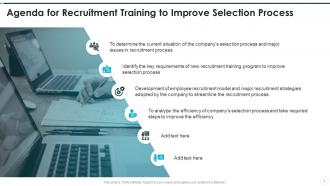
Slide 2: This slide presents the agenda.
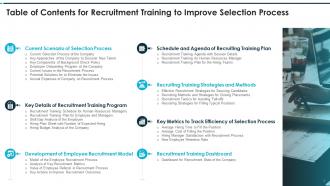
Slide 3: This slide displays the table of Contents for Recruitment Training to Improve Selection Process.
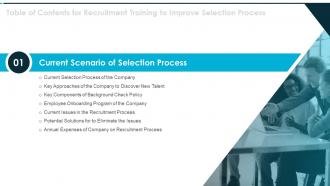
Slide 4: This slide displays seven topics under 'Current Scenario of Selection Process' to be covered in the template.
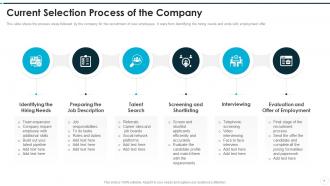
Slide 5: This slide shows the steps followed by the company for the recruitment of new employees.
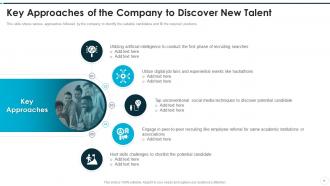
Slide 6: This slide shows various approaches followed by the company to identify the suitable candidates and fill the required positions
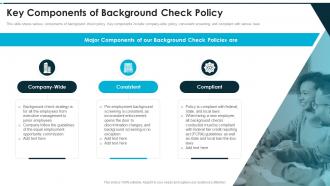
Slide 7: This slide shows various components of background check policy.
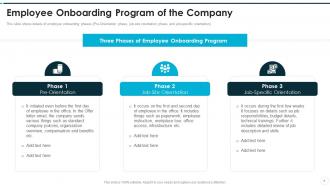
Slide 8: This slide shows details of employee onboarding phases.
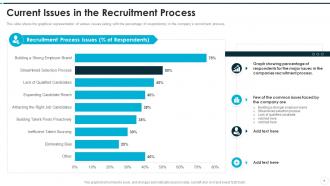
Slide 9: This slide shows the graphical representation of various issues in the company’s recruitment process.This graph is linked to excel.
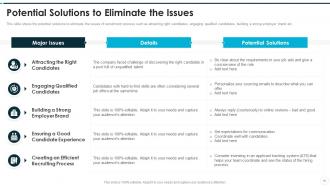
Slide 10: This slide shows the potential solutions to eliminate the issues of recruitment process.
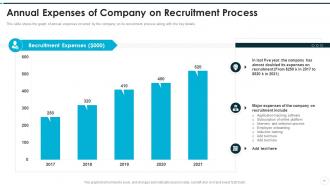
Slide 11: This slide shows the graph of annual expenses incurred by the company on its recruitment process.This graph is linked to excel.
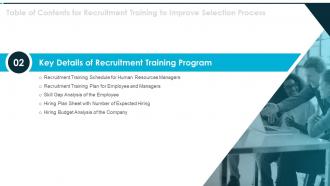
Slide 12: This slide displays five topics under 'Key Details of Recruitment Training Program' to be covered in the template.
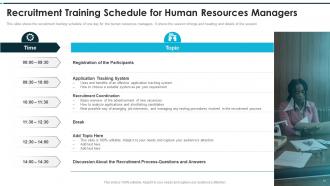
Slide 13: This slide shows the recruitment training schedule of one day for the human resources managers.
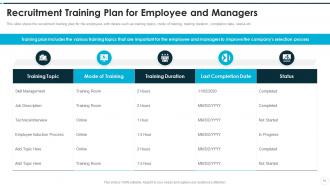
Slide 14: This slide shows the recruitment training plan for the employees with details such as training topics etc.
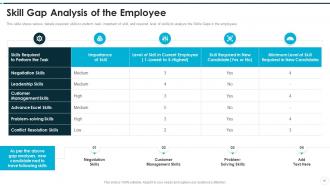
Slide 15: This slide shows various details to analyze the Skills Gaps in the employees.
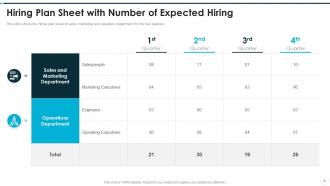
Slide 16: This slide shows the Hiring plan sheet of sales, marketing and operation department for the four quarters.
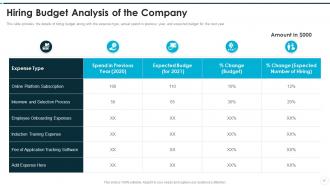
Slide 17: This slide provides the details of hiring budget along with the expense type etc.
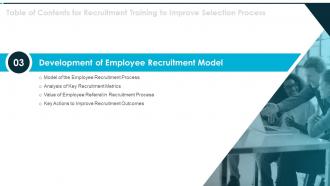
Slide 18: This slide displays four topics under 'Development of Employee Recruitment Model' to be covered in the template.
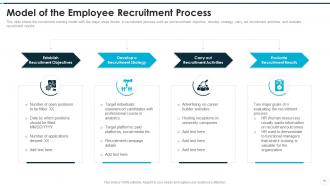
Slide 19: This slide shows the recruitment training model with the major steps involve in recruitment process.
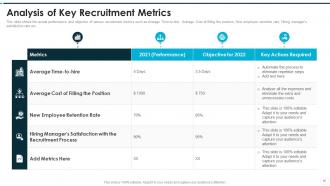
Slide 20: This slide shows the actual performance and objective of various recruitment metrics such as Average Time-to-hire tc.
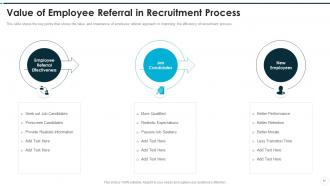
Slide 21: This slide presents the key points that shows the value and importance of employee referral approach in improving the efficiency of recruitment process
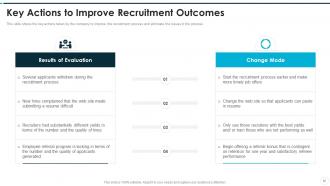
Slide 22: This slide shows the key actions taken by the company to improve the recruitment process.
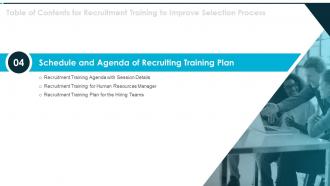
Slide 23: This slide displays three topics under 'Schedule and Agenda of Recruiting Training Plan' to be covered in the template.
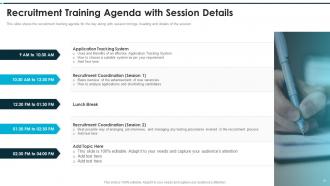
Slide 24: This slide shows the recruitment training agenda for the day along with session timings, heading etc.
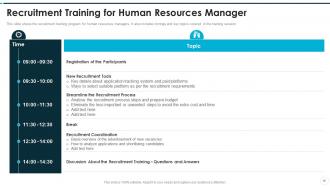
Slide 25: This slide shows the recruitment training program for human resources managers.
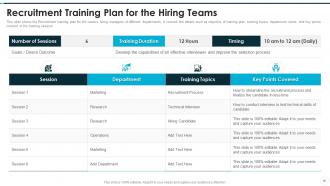
Slide 26: This slide shows the Recruitment training plan for the various hiring managers of different departments.
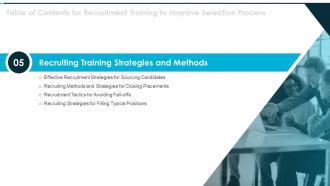
Slide 27: This slide displays four topics under 'Recruiting Training Strategies and Methods' to be covered in the template.
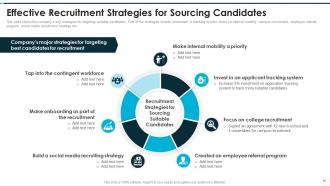
Slide 28: This slide shows the company’s key strategies for targeting suitable candidates.
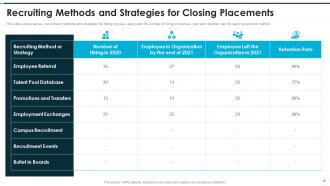
Slide 29: This slide shows various recruitment methods and strategies for hiring process.
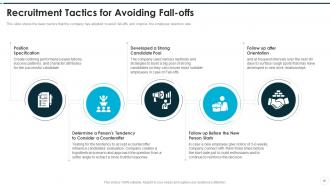
Slide 30: This slide shows the basic tactics that the company has adopted to avoid fall-offs and improve the employee retention rate.
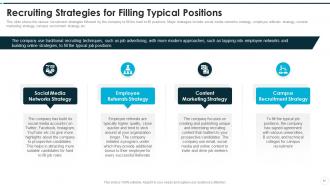
Slide 31: This slide shows the various recruitment strategies followed by the company to fill the hard to fill positions.
Slide 32: This slide displays four topics under 'Key Metrics to Track Efficiency of Selection Process' to be covered in the template.
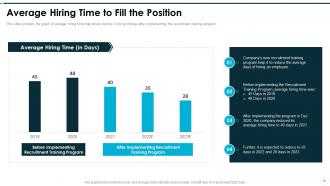
Slide 33: This slide provides the graph of average hiring time. This graph/chart is linked to excel.
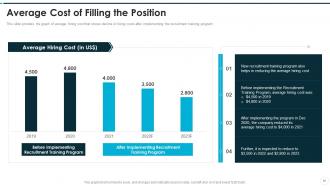
Slide 34: This slide provides the graph of average hiring cost. This graph/chart is linked to excel.
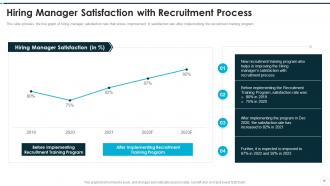
Slide 35: This slide provides the line graph of hiring manager satisfaction rate.This graph/chart is linked to excel.
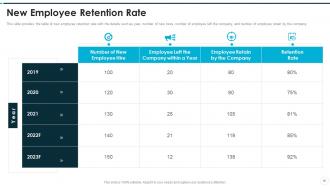
Slide 36: This slide provides the table of new employee retention rate with the details such as year, number of new hires etc.
Slide 37: This slide displays a topic under 'Recruitment Training Dashboard' to be covered in the template.
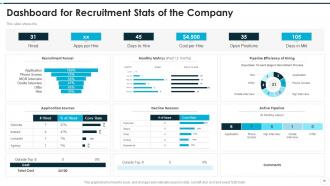
Slide 38: This slide shows the various recruitment statistics of the company.
Slide 39: This is the icons slide.
Slide 40: This slide presents the title additional Slides.
Slide 41: This slide shows the about Us information.
Slide 42: This slide depicts three 30, 60 and 90 days plans.
Slide 43: this slide displays a puzzle.
Slide 44: This slide shows a timeline process over four years.
Slide 45: This is an Important Notes slide.
Slide 46: This is thank you slide & contains contact details of company like office address, phone no., etc.
Recruitment training to improve selection process powerpoint presentation slides with all 46 slides:
Use our Recruitment Training To Improve Selection Process Powerpoint Presentation Slides to effectively help you save your valuable time. They are readymade to fit into any presentation structure.

FAQs for Recruitment training to improve selection process
So you'll want to hit five main areas for recruitment training. Structured interviews are huge - behavioral questions that actually tell you if someone can do the job. Bias training too because we're all guilty of making snap judgments. Assessment skills help you compare candidates fairly instead of going with gut feelings (which honestly suck most of the time). Don't skip legal compliance stuff either - one wrong question and you're screwed. Oh, and candidate experience matters since good people have choices. I'd start by figuring out where your current process is weakest first.
Honestly, video platforms are where I'd start - let your trainees do mock interviews and watch themselves back. Builds confidence like crazy. LMS systems are solid for tracking who's progressing and keeping training consistent. You can teach better candidate screening with AI tools, and CRM systems are great for pipeline management stuff. VR is getting pretty wild for interview practice too, though maybe that's jumping ahead a bit. My advice? Pick one thing first, see how your team actually uses it, then add more. No point building some massive tech setup if half of it just sits there collecting digital dust.
Honestly, most hiring managers mess up with unconscious bias and rushing through interviews. Also asking sketchy questions they shouldn't - even experienced people do this! Good training teaches you structured approaches and helps you recognize your own biases. Plus the legal stuff you absolutely can't ask about. Instead of going with your gut, you learn to actually evaluate candidates systematically. Takes longer but way better results. Oh, and don't just do training once - bad habits sneak back in if you're not careful. Refresher courses are clutch because hiring mistakes get expensive fast.
Oh man, recruitment training is a game-changer for D&I! It helps hiring teams spot unconscious bias and actually do something about it. You'll pick up stuff like structured interviews and diverse panels. Writing inclusive job descriptions is harder than you'd think - we used to accidentally turn people away without realizing it. The sourcing part blew my mind honestly, showed me we were fishing in the same tiny pond forever. Plus you get real tools to evaluate everyone fairly. I'd start by checking your job posts for sketchy language, then standardize those interview questions.
So employer branding is how you sell your company to potential hires, right? Your team needs to know what makes your workplace special - the culture, perks, growth stuff. Don't just rely on those polished office photos everyone posts now. Train your recruiters to be genuine brand ambassadors who can actually explain why people love working there. Have them practice specific talking points and real success stories. They should know how to tackle the usual candidate concerns too. Honestly, I'd start with elevator pitches about company culture - sounds basic but it works.
Look at the basic stuff first - time-to-fill, cost-per-hire, quality scores. Compare before and after training. Track how many candidates people are finding and their interview-to-offer ratios. Retention at 6 and 12 months tells you if they're actually hiring good people. Confidence levels matter more than most people think, especially when recruiters are selling roles to candidates. Check in regularly to see what's working and what isn't. The real proof? When you can show actual improvement in both speed and hire quality after training. Oh, and don't forget the softer metrics - they're surprisingly telling.
So basically internal recruitment training is all about succession planning and figuring out who's ready to move up - you'll learn how to read performance data and deal with office politics (which honestly can be brutal). External training is totally different though. That's where you master job postings, sourcing candidates, and employer branding stuff. Different tools too - HRIS systems for internal moves vs ATS platforms for external hires. Interview techniques are way different when you don't know the person already. I'd definitely get trained on both since most jobs mix internal and external hiring anyway.
Honestly, scenario-based stuff works way better than boring lectures. Put your team in situations they'll actually deal with - like when a candidate's shopping around multiple companies or some hiring manager keeps flip-flopping on what they want. Mock interviews are great for this. Role-play those awkward conversations too. I've found the more realistic you make it, the better they get at handling the real thing. Oh, and always debrief after - that's where the good stuff comes out. Maybe start small with just one scenario next time?
Start with active listening - that's honestly the game changer. Get them doing role-plays where they actually pause and ask follow-up questions instead of just waiting to jump in. Once that clicks, work on ditching the corporate jargon when explaining roles. Emotional intelligence stuff helps too - like reading the room and adapting to different personalities. Oh, and throw in some storytelling techniques so they can actually sell the company culture instead of just listing benefits. I've seen recruiters completely transform once they nail the listening part first. Everything else just flows better from there.
Behavioral interviewing is your best bet here - get your recruiters asking situational questions instead of the obvious stuff. Like "tell me about a time you dealt with a difficult coworker" rather than "are you a team player?" (seriously, what's anyone gonna say to that?). The trick is teaching them to dig deeper when candidates give examples. They need to follow up on the actual thought process and actions, not just accept surface-level answers. Oh, and definitely do mock interviews with your team so they can practice spotting the difference between real competencies and people just telling them what they want to hear.
Honestly, the best approach is diving deep into whatever industry they're hiring for. Tech screening looks totally different from healthcare or manufacturing - different compliance stuff, different candidate pools, you know? I always grab real job descriptions from their sector and use those as practice material. Works way better than generic examples. Case studies should mirror actual scenarios they'll hit daily. Manufacturing recruiters don't need to hear about startup culture fits, right? Research their specific pain points first. Then build everything around what they'll actually face when they're back at their desk recruiting.
Look, data analytics is a game-changer for recruitment - you can finally track what's actually moving the needle. Start with basics like time-to-hire and which job boards give you quality candidates. Most recruiters are allergic to spreadsheets initially (can't blame them), but they come around fast when they see results. Train your team on reading ATS reports and testing different job descriptions. Predictive analytics helps too - shows you which candidates are worth your time. Oh, and don't overwhelm anyone. Pick one metric per person and expand slowly. Trust me on this one.
Honestly, just don't be a jerk about it. Respond to questions quickly and tell people what's happening next - even if you're running behind schedule. Nobody wants to sit there wondering if they bombed the interview or if you forgot they exist. Make the actual interview feel like a conversation instead of some weird interrogation. Oh, and please have a application system that doesn't make people want to throw their laptop out the window. Small stuff helps too - like actually remembering what they told you last time or giving them a heads up about what to expect. I'd walk through your whole process like you're applying and see where it sucks the most.
Hey! So you want feedback throughout the whole thing, not just at the end. Quick surveys after each module are solid. Then circle back 30-60 days later to see if they're actually using this stuff when they recruit. Also - and this might be obvious but whatever - get the hiring managers involved too. They'll tell you straight up if candidate quality improved or if nothing changed. Monthly check-ins beat waiting around for quarterly reviews. People forget everything by then. Just make sure you actually do something with their feedback fast, otherwise they'll stop being honest with you.
Cultural fit matters way more than most people realize - you want folks who'll genuinely click with your team's vibe. Train your recruiters to dig into behavioral stuff: how candidates handle collaboration, what actually drives them at work, their communication style. Role-playing scenarios help too (sounds cheesy but it works). Just make sure everyone gets that "cultural fit" isn't code for "hire people exactly like us" - that's how you end up with zero diversity. Focus on shared values and work approaches instead. Someone who adapts well and aligns with company values will usually crush it, even if they're different from the current team.
-
Thanks for all your great templates they have saved me lots of time and accelerate my presentations. Great product, keep them up!
-
Amazing product with appealing content and design.
-
Colors used are bright and distinctive.
-
Visually stunning presentation, love the content.
-
Attractive design and informative presentation.