


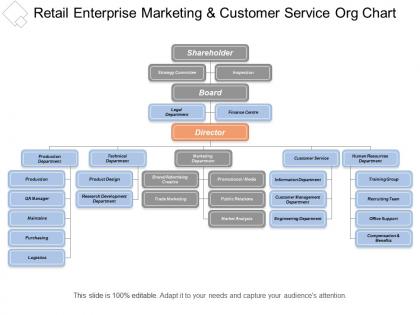
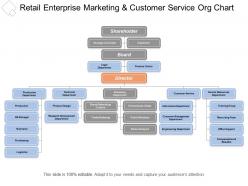
Retail enterprise marketing and customer service org chart




Try Before you Buy Download Free Sample Product
 Impress Your
 Audience
 100%
100% Editable
 Save Hours
 of Time


Get through admirably with our Retail Enterprise Marketing And Customer Service Org Chart. The audience will find your ideas completely absorbing.
People who downloaded this PowerPoint presentation also viewed the following :
Retail enterprise marketing and customer service org chart with all 5 slides:
Develop all round competency with our Retail Enterprise Marketing And Customer Service Org Chart. Extend your expertise to other areas.


FAQs for Retail enterprise marketing and customer
**INPUT**: What are the key roles typically found in a retail marketing organizational chart? **OUTPUT**: Key roles include Marketing Director, Brand Manager, Digital Marketing Specialist, Customer Experience Manager, and Merchandising Coordinator, along with roles in social media, email marketing, and analytics. These positions work collaboratively to drive customer acquisition, enhance brand positioning, and optimize omnichannel experiences, with many retail organizations finding that this integrated structure delivers improved campaign effectiveness and stronger customer loyalty. *[Word count: 60 words]*
Small retail marketing teams typically combine multiple roles, with individuals handling diverse functions like social media, email marketing, and promotions simultaneously. Large organizations feature specialized departments with dedicated teams for digital marketing, brand management, customer analytics, and campaign development, while smaller retailers often rely on generalists and outsourced services, ultimately requiring more cross-functional collaboration versus the structured hierarchies found in enterprise retail environments.
**INPUT**: What are the main functions of a marketing manager within a retail context? **OUTPUT**: Marketing managers in retail oversee brand positioning, customer acquisition campaigns, promotional strategies, inventory marketing alignment, and omnichannel experience coordination. These professionals streamline operations by analyzing consumer behavior, optimizing seasonal campaigns, and integrating digital with in-store experiences, with many retail organizations finding that strategic marketing management ultimately delivers enhanced customer loyalty and sustainable revenue growth. [Word count: 56 words]
Collaboration between merchandising and marketing teams ensures product selections align with promotional strategies, customer demand, and seasonal trends. This strategic partnership enables retailers to optimize inventory management, create compelling campaigns that drive sales, and deliver consistent customer experiences across all touchpoints, ultimately enhancing revenue performance and competitive positioning.
A retail marketing org chart enhances communication by establishing clear reporting lines, defining role responsibilities, eliminating workflow bottlenecks, and creating structured information channels across departments. This strategic framework streamlines decision-making processes, reduces project delays, and improves campaign coordination, with many retail organizations finding that structured hierarchies ultimately deliver faster time-to-market and enhanced operational efficiency.
Emerging retail marketing roles include Customer Experience Analysts, Social Commerce Managers, Marketing Automation Specialists, Sustainability Communications Leaders, and Personalization Strategists. These positions enable organizations to navigate omnichannel customer journeys, leverage AI-driven insights, and manage social selling platforms, with many retail companies finding that specialized roles deliver enhanced customer engagement and competitive differentiation.
Digital marketing influences traditional retail marketing org structures by creating specialized roles like social media managers, data analysts, and e-commerce coordinators, while flattening hierarchies for faster decision-making. Many retailers now integrate cross-functional teams that blend traditional merchandising with digital expertise, enabling seamless omnichannel campaigns, real-time customer engagement, and data-driven strategies that ultimately deliver enhanced customer experiences and competitive advantage.
Key performance metrics include conversion rates, customer acquisition costs, brand awareness scores, campaign ROI, and customer lifetime value across different marketing roles. Marketing managers track revenue attribution and lead generation, while digital specialists monitor engagement rates, social media specialists measure reach and sentiment, and content creators evaluate traffic and conversion metrics, ultimately delivering measurable business growth and competitive market positioning.
A retail marketing org chart adapts for e-commerce by incorporating digital-first roles like SEO specialists, social media managers, conversion optimization analysts, and customer acquisition specialists alongside traditional marketing functions. This structure emphasizes data-driven decision making, omnichannel customer experience, and rapid campaign iteration, with many online retailers finding that cross-functional teams between marketing, technology, and analytics ultimately deliver higher conversion rates and customer lifetime value.
Customer insights serve as the strategic foundation for retail marketing organizations, informing team structure, campaign development, personalization strategies, and channel optimization decisions. These insights enable marketing teams to create targeted segmentation approaches, develop data-driven customer journey maps, and allocate resources more effectively, with many retail organizations finding that insight-driven structures ultimately deliver higher conversion rates and stronger customer loyalty.
Technology and automation streamline retail marketing roles by enhancing data analytics, automating campaign management, and enabling personalized customer targeting across digital channels. These advancements allow marketing teams to focus on strategic decision-making while automated systems handle routine tasks, with many retail organizations finding that integrated marketing technologies deliver faster campaign deployment, improved customer insights, and significantly enhanced operational efficiency.
Professional development strategies include mentorship programs, cross-functional project rotations, industry conference attendance, skills-based workshops, and certification courses in emerging marketing technologies. These approaches enhance team capabilities by fostering knowledge sharing, expanding strategic thinking, and building technical expertise, with many retail organizations finding that structured development programs ultimately deliver improved campaign performance and stronger employee retention.
Social media marketing integration transforms retail marketing org charts by creating cross-functional collaboration needs, establishing dedicated social media roles, and requiring closer coordination between customer service, content creation, and brand management teams. This restructuring enables retailers to respond faster to customer feedback, maintain consistent brand messaging across channels, and leverage real-time data insights, ultimately delivering more personalized customer experiences and competitive advantage in an increasingly digital marketplace.
A dedicated analytics team enables retail marketing organizations to transform customer data into actionable insights, optimize campaign performance, and measure ROI across channels with precision and speed. This strategic capability helps retailers identify emerging trends, personalize customer experiences, and allocate marketing budgets more effectively, ultimately delivering competitive advantage in an increasingly data-driven marketplace.
Cross-functional teams improve retail marketing effectiveness by combining diverse expertise, accelerating decision-making, and ensuring consistent customer experiences across all touchpoints. Through strategic collaboration between merchandising, digital marketing, and customer service teams, retailers streamline campaign execution, enhance product positioning, and deliver personalized experiences, with many organizations finding that integrated approaches significantly boost conversion rates and customer loyalty.
No Reviews