


Retail marketing mix retail enterprise organizational chart ppt powerpoint styles structure




Try Before you Buy Download Free Sample Product
 Impress Your
 Audience
 100%
100% Editable
 Save Hours
 of Time


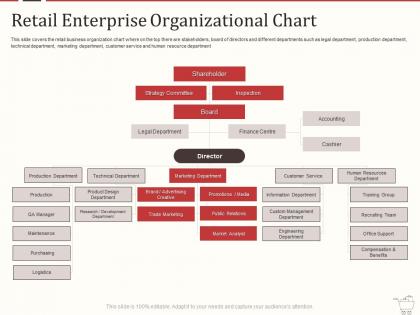
This slide covers the retail business organization chart where on the top there are stakeholders, board of directors and different departments such as legal department, production department, technical department, marketing department, customer service and human resource department.
People who downloaded this PowerPoint presentation also viewed the following :
Retail marketing mix retail enterprise organizational chart ppt powerpoint styles structure with all 2 slides:
Use our Retail Marketing Mix Retail Enterprise Organizational Chart Ppt Powerpoint Styles Structure to effectively help you save your valuable time. They are readymade to fit into any presentation structure.
FAQs for Retail marketing mix retail enterprise organizational chart ppt
The four key elements include product assortment, pricing strategies, promotional activities, and place/distribution channels. These components work synergistically, with pricing strategies supporting product positioning, promotional campaigns driving traffic to strategic locations, and distribution channels enhancing customer accessibility, ultimately delivering cohesive brand experiences and competitive advantage across retail touchpoints.
Retail businesses can effectively utilize the 7Ps by strategically aligning product assortment, competitive pricing, omnichannel placement, integrated promotion, optimized processes, skilled people, and compelling physical evidence to create cohesive customer experiences. This comprehensive approach enables retailers to streamline operations, enhance customer satisfaction, and deliver competitive advantages across multiple touchpoints, with many finding that synchronized implementation of all seven elements ultimately drives higher conversion rates and sustainable growth.
Pricing strategies significantly shape consumer perception through psychological anchoring, perceived value assessment, and quality assumptions, with higher prices often signaling premium quality while competitive pricing suggests value. Through strategic positioning, retailers influence purchase decisions, brand perception, and customer loyalty, with many finding that dynamic pricing, bundling, and promotional strategies ultimately enhance perceived value and drive competitive advantage.
Placement in retail marketing mix encompasses strategic store location, product positioning within stores, shelf placement, traffic flow optimization, and checkout area design. Through data-driven layout decisions, retailers enhance customer navigation, increase product visibility, and maximize impulse purchases, with many supermarkets and department stores finding that strategic placement ultimately drives higher conversion rates and average transaction values.
Retailers can leverage digital channels by integrating social media marketing, email campaigns, mobile apps, e-commerce platforms, and targeted online advertising into their promotional strategies. These digital touchpoints enable personalized customer experiences, real-time inventory management, and data-driven decision making, with many retail organizations finding that omnichannel approaches significantly enhance customer engagement and drive measurable sales growth.
Best practices include targeted social media campaigns, influencer partnerships, seasonal promotional content, personalized email marketing, and cross-platform advertising strategies. These approaches enhance customer engagement by leveraging data-driven insights, creating authentic brand connections, and optimizing ad spend across channels, with many retailers finding that integrated campaigns deliver higher conversion rates and stronger customer loyalty.
Product assortment significantly impacts customer experience and sales by offering variety, meeting diverse preferences, encouraging cross-selling, and reducing shopping trips to competitors. Strategic assortment planning enables retailers to optimize shelf space, increase basket size, and enhance customer satisfaction, with many stores finding that well-curated product ranges drive both loyalty and revenue growth.
Retailers can enhance customer service through personalized shopping experiences, omnichannel support, staff training programs, loyalty rewards, and efficient complaint resolution systems. These strategies streamline customer interactions by improving response times, creating seamless experiences across touchpoints, and building lasting relationships, with many retail organizations finding that superior service delivery ultimately drives customer retention and competitive advantage.
Retailers can measure promotional effectiveness through sales data analysis, conversion rate tracking, customer acquisition costs, return on investment calculations, and brand awareness surveys. These metrics enable businesses to assess campaign performance across different channels, optimize future marketing spend, and demonstrate measurable impact on revenue growth, with many retail organizations finding that integrated measurement approaches deliver clearer insights into customer behavior and promotional ROI.
Emerging retail marketing trends include omnichannel personalization, social commerce integration, AI-driven customer analytics, sustainability messaging, and voice commerce optimization. These approaches enhance customer engagement by delivering seamless experiences across touchpoints, leveraging real-time data insights, and meeting evolving consumer expectations, with many retailers finding that strategic adoption drives higher conversion rates and competitive advantage.
Seasonal changes significantly reshape retail marketing mix through dynamic product assortment shifts, promotional pricing cycles, and inventory optimization strategies. Retailers leverage seasonal demand patterns by introducing weather-appropriate merchandise, implementing time-sensitive discount structures, and adjusting price points to maximize revenue during peak periods, ultimately delivering enhanced customer relevance and competitive market positioning.
Brand positioning significantly influences all retail marketing mix elements by shaping product selection, pricing strategies, promotional messaging, and store placement decisions to maintain consistent brand identity. Through strategic positioning, retailers enhance customer perception, differentiate from competitors, and drive purchasing decisions, with luxury brands like Nordstrom and value retailers like Target successfully aligning their entire marketing mix to reinforce their distinct market positions.
Retailers adapt their marketing mix by modifying product assortments for local preferences, adjusting pricing strategies for regional economic conditions, selecting culturally appropriate promotional channels, and establishing distribution networks that align with local shopping behaviors. Through market research and localization strategies, retailers in sectors like fashion, electronics, and food successfully navigate cultural differences, regulatory requirements, and competitive landscapes, ultimately delivering relevant customer experiences while maintaining brand consistency.
Retailers can leverage consumer feedback to optimize their marketing mix by analyzing purchase patterns, survey responses, and social media insights to refine product offerings, adjust pricing strategies, enhance store locations, and improve promotional campaigns. Through customer reviews and behavioral data, retailers identify preferences that guide inventory decisions, competitive pricing adjustments, and targeted advertising, ultimately delivering personalized experiences and stronger market positioning.
Technology influences retail marketing mix development through AI-powered customer analytics, omnichannel inventory management, dynamic pricing algorithms, personalized digital experiences, and automated supply chain optimization. These technologies enable retailers to streamline product positioning, enhance pricing strategies, and deliver seamless customer experiences across multiple touchpoints, ultimately providing competitive advantage in an increasingly digital marketplace.
-
Great experience, I would definitely use your services further.
-
Excellent design and quick turnaround.