


Risk and opportunities powerpoint presentation slides




Try Before you Buy Download Free Sample Product
 Impress Your
 Audience
 100%
100% Editable
 Save Hours
 of Time


Feature your business challenge and achievements with our professionally designed PPT sample on risk and opportunities PowerPoint presentation slides. Make use of this PPT design to graphically represent the business success and its related hurdles for the audiences. You can use this PPT layout to define various relevant factors affecting the growth of your business and the factors which helps in developing your business structure. While our PowerPoint design will help your business with taking a competitive edge over your business competitors in the market by working over the controlled or systematic condition. Thus, essentially download this peculiar outline and start exploring with this PPT layout to arrange every one of the exercises of business applications in an extremely profitable way which guarantees the achievement and development of your business with your ability and endeavors. Approach it differently with our Risk And Opportunities Powerpoint Presentation Slides. Be able to achieve a change of focus.
People who downloaded this PowerPoint presentation also viewed the following :
Content of this Powerpoint Presentation
Slide 1: This slide introduces Risk And Opportunities. State Your Company Name and begin.
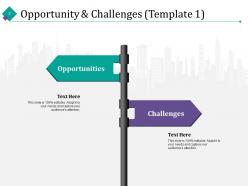
Slide 2: This is Opportunity & Challenges (Template 1) Opportunities, Challenges.
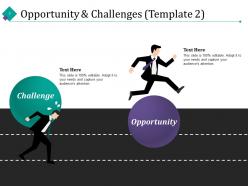
Slide 3: This is Opportunity & Challenges (Template 2) Opportunities, Challenges.
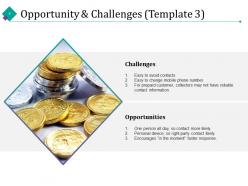
Slide 4: This is Opportunity & Challenges (Template 3) Opportunities, Challenges.
Slide 5: This is Opportunity & Challenges (Template 4) Opportunities, Challenges.
Slide 6: This is Opportunity & Challenges (Template 5) Opportunities, Challenges.
Slide 7: This is Opportunity & Challenges (Template 6) Opportunities, Challenges.
Slide 8: This is Opportunity & Challenges (Template 7) Opportunities, Challenges.
Slide 9: This is Opportunity & Challenges (Template 8) Opportunities, Challenges.
Slide 10: This is Opportunity & Challenges (Template 9) Opportunities, Challenges.
Slide 11: This is Risk And Opportunities Icon Slide. Use the icons as per need.
Slide 12: This is a Coffee Break slide to halt. You can change the image as per requirement/need.
Slide 13: This slide is titled Charts & Graphs to move forward. You can alter/change the image as per requirement/need.
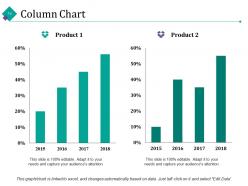
Slide 14: This is a Column Chart slide to show product/entity comparison, specifications etc.
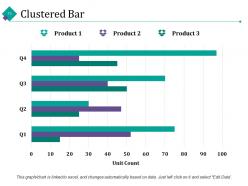
Slide 15: This is a Clustered Bar slide to show product/entity comparison, specifications etc.
Slide 16: This slide is titled Additional Slides to move forward. You can change the slide content as per need.
Slide 17: This is Our Goal slide. State them here.
Slide 18: This is Our Mission slide. State it here.
Slide 19: This is Our Team slide with names, designation and image boxes.
Slide 20: This is an About Us slide. State company/team specifications here.
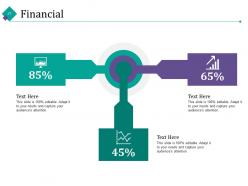
Slide 21: This is a Financial score slide. State finanacial aspects here. 1
Slide 22: This is a Thank You slide with Address # street number, city, state, Contact Numbers, Email Address.
Risk and opportunities powerpoint presentation slides with all 22 slides:
Our Risk And Opportunities Powerpoint Presentation Slides ensure the ice is broken. Folks feel encouraged to indulge in conversation.








FAQs for Risk and opportunities
So you'll want to map out everything that could go sideways first - what risks exist, how likely they are, impact level, all that. Then rank them by priority. Here's the thing though: most people half-ass the actual mitigation plans, which is why their risk management sucks. Be specific about who owns what and create detailed action steps for your biggest threats. Oh, and don't forget monitoring - you need regular check-ins to catch new risks or see if old ones have shifted. Basically treat it like a living document that actually gets used, not filed away somewhere.
Honestly, the best way is getting your teams together for brainstorming sessions - they see stuff you'll miss since they're dealing with the day-to-day chaos. Go through your main processes and ask "what could go wrong here?" at every step. Sounds basic but most people skip it! Past incidents are goldmines too, plus industry reports show what's biting other companies. Your customers will tell you things that keep them up at night if you ask. Oh, and don't make it a once-a-year thing - monthly reviews catch problems before they explode.
Honestly, most people start with basic qualitative stuff - high/medium/low ratings work fine. Risk matrices are super popular too, where you plot likelihood against impact on a grid. Gets visual fast. For number-crunchers, there's quantitative analysis using historical data and probability math. Monte Carlo simulations sound fancy but they're way overkill unless you're doing something really complex. FMEA and bow-tie analysis exist for the heavy-duty scenarios. My take? Just start with a simple risk matrix. Everyone gets it immediately, and you can always add fancier methods later once people aren't rolling their eyes at risk meetings anymore.
So basically, quantitative uses actual numbers and data while qualitative just uses ratings like "high risk" or "low risk." Quantitative means you're digging into real statistics and financial data - way more accurate but honestly such a pain to collect everything. Qualitative is just your team sitting around rating stuff based on gut feeling and experience. Much faster though. I'd go quantitative if you need exact numbers for budgets or compliance stuff. But if you're just doing a quick check or don't have solid data yet? Qualitative works fine. Really depends what you need it for.
Honestly, risk communication can make or break everything. I've watched perfectly good plans crash because nobody bothered explaining things properly. Here's the thing - you might nail the risk assessment, but if your team has no clue what they're facing or how to handle it, you're screwed anyway. Map out who needs to hear what first. Then customize your approach: executives care about bottom-line impact, while your ops people need the actual step-by-step stuff. Oh, and don't forget the front-line workers - they're usually the ones who'll spot problems first but get overlooked in briefings.
Honestly, tech can be a game-changer for risk management if you do it right. AI spots weird patterns you'd never catch, and automated alerts save your butt when things go sideways. Real-time dashboards actually make sense of all your data instead of drowning you in spreadsheets. The predictive stuff is where it gets interesting though - you're catching problems before they blow up rather than scrambling afterward. I'd start by figuring out where you're totally blind right now, then find tools that fill those specific gaps. Way better than trying to fix everything at once.
Ugh, leadership buy-in is going to be your biggest headache. Nobody wants to own risk management until disaster strikes - then suddenly it's everyone's problem. Your data will probably be a mess too, especially if departments aren't talking to each other. Plus you'll be constantly fighting for budget since risk doesn't make money directly (which is frustrating but whatever). Start with small wins first. Show them quick results, then expand once people actually see it working. Oh, and expect some serious turf wars between departments - that silo mentality runs deep.
So basically, risk management stops you from making decisions blindfolded. You get to see what could actually blow up in your face and how much damage it'd do. Way better than just hoping for the best, right? When you're weighing different moves - like jumping into a new market - you can actually compare the downsides objectively instead of guessing. Here's the thing though: most people get so paranoid about risks that they miss good opportunities. The trick is baking this stuff into your planning right from the start, not scrambling to think about it later.
Regulatory stuff is basically your minimum bar - you've got to hit those requirements no matter what. Think mandatory capital reserves, reporting deadlines, specific risk frameworks. But here's the thing: regulations are always behind the curve on actual market risks, so just ticking boxes won't cut it. Honestly, some of these rules feel outdated the moment they're written. Build compliance as your foundation, then add extra controls based on what risks you're actually comfortable taking. I'd start by comparing current regulations against what you're already doing to find the gaps.
Honestly, I'd go with ServiceNow, MetricStream, or LogicGate if you can swing it - they cover governance, risk, and compliance in one shot. Budget tight? A good spreadsheet works too (auditors might roll their eyes though). Resolver and Riskonnect are decent middle-ground options that won't destroy your wallet. Here's the thing - pick whatever your team will actually stick with. The fanciest tool is useless if nobody opens it. Map out your risks first, then find something that fits how you already work. Trust me on this one.
Make risk talks just part of regular work stuff - not something that only pops up during disasters. Have your managers actually discuss what they're worried about and tough calls they're making. Shows everyone it's smart to think ahead, not neurotic. Training helps, but skip the generic compliance crap honestly. Real industry examples work way better. People need to feel safe bringing up concerns without getting shot down or blamed later. Oh, and definitely reward folks who catch potential problems early, even if nothing bad ends up happening. That's how you get people to actually speak up.
Dude, skip the boring PowerPoint thing - nobody remembers that stuff anyway. Use real scenarios from your actual industry instead of those generic textbook cases. Interactive workshops work way better. Have people identify risks they deal with every day, throw in some role-playing for crisis situations. You'll want both the technical assessment stuff and communication skills covered. Oh, and don't forget regular refreshers since everything changes so fast these days. Always grab feedback afterward too. The whole point is making it practical enough that they'll actually use it later.
Look at probability vs impact - that's your starting point. Map everything on a basic grid and tackle the high-prob, high-impact stuff first. Pretty straightforward there. Don't overthink it though, because weird risks you never saw coming will still bite you. Put your energy into whatever could actually mess up your operations or make you look bad. Oh, and grab the easy wins while you're at it - if there's low-effort stuff that still makes a decent difference, why not? Just handle the things that genuinely stress you out before moving to the smaller headaches.
So you need both hard numbers and softer stuff to really know if your risk management's working. Track how often incidents happen, how bad they are when they do, plus what they cost you. Time to fix problems matters too. Honestly, the financial stuff like risk-adjusted ROI tells you the most. But don't skip employee surveys about risk awareness - that cultural piece is huge. Compliance audit scores help round it out. I'd pick maybe 3-4 of these for a monthly dashboard. Makes it way easier to catch trends before they bite you.
Honestly, you've got to ditch the whole quarterly planning thing right now. Daily check-ins are where it's at during a crisis - maybe weekly if you're lucky. Everything changes so fast that your usual monitoring schedule becomes totally useless. We learned this the brutal way during our system meltdown last year, ugh. Tackle your biggest risks first, then be ready to completely flip your approach when new data comes in. Oh, and set up direct lines to your key people so you're not waiting around for approvals when things hit the fan.
-
Very unique, user-friendly presentation interface.
-
Top Quality presentations that are easily editable.