


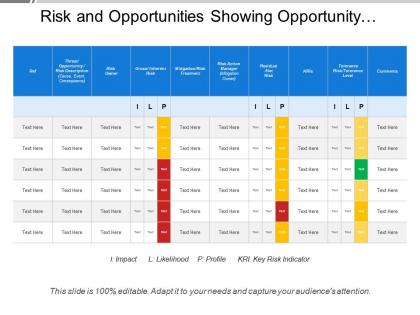
Risk and opportunities showing opportunity risk description with risk treatment




Try Before you Buy Download Free Sample Product
 Impress Your
 Audience
 100%
100% Editable
 Save Hours
 of Time


Our Risk And Opportunities Showing Opportunity Risk Description With Risk Treatment familiarize folks with your business. They will become aware of facilities available.
People who downloaded this PowerPoint presentation also viewed the following :
Risk and opportunities showing opportunity risk description with risk treatment with all 5 slides:
Exploit the advantage our Risk And Opportunities Showing Opportunity Risk Description With Risk Treatment give. Come out ahead in any close fight.




FAQs for Risk and opportunities showing opportunity risk description
Key components include risk identification, assessment, mitigation strategies, monitoring systems, and governance structures. These elements work together by establishing clear accountability, enabling proactive threat detection, and creating systematic response protocols, with many organizations finding that integrated frameworks significantly enhance operational resilience and strategic decision-making capabilities.
Organizations can identify potential risks through comprehensive risk assessments, process mapping, stakeholder interviews, historical data analysis, and regular audits of operational workflows. These systematic approaches enable businesses to uncover vulnerabilities in supply chains, financial processes, and customer interactions, with many companies finding that proactive identification significantly reduces costs and enhances operational resilience.
Technology enhances risk management through automated monitoring systems, predictive analytics, real-time data integration, artificial intelligence algorithms, and comprehensive reporting dashboards. These technologies streamline risk identification, assessment, and mitigation by enabling faster threat detection, improving decision-making accuracy, and automating compliance processes, ultimately delivering enhanced operational efficiency and competitive advantage.
Risk assessment integrates into strategic planning through systematic identification of potential threats, comprehensive scenario analysis, stakeholder impact evaluation, and continuous monitoring frameworks. Organizations across sectors like financial services, healthcare, and manufacturing embed these assessments into their planning cycles, enabling proactive mitigation strategies, resource optimization, and ultimately stronger competitive positioning in increasingly volatile markets.
Common risk management mistakes include inadequate risk assessment, poor communication across departments, over-reliance on historical data, insufficient scenario planning, and lack of regular strategy updates. These oversights often result from siloed approaches and reactive rather than proactive mindsets, with many organizations finding that comprehensive, integrated risk frameworks significantly enhance operational resilience and competitive positioning.
Organizations can measure risk management effectiveness through key performance indicators like incident frequency, financial losses, compliance audit results, response time metrics, and stakeholder confidence surveys. These measurements enable companies to track progress across operational, financial, and strategic risks, with many financial institutions and healthcare organizations finding that regular assessment helps optimize resource allocation, reduce costs, and maintain competitive advantage in increasingly regulated environments.
Qualitative risk analysis uses descriptive assessments like probability rankings and impact categories, while quantitative risk analysis employs numerical data, statistical models, and financial calculations. Qualitative approaches enable faster initial assessments through risk matrices and expert judgment, whereas quantitative methods deliver precise cost estimates and measurable projections, with many organizations combining both approaches for comprehensive risk management strategies.
Agile risk management applies iterative planning, continuous monitoring, cross-functional collaboration, and adaptive response strategies to identify and mitigate risks dynamically. Through sprint-based risk assessments and regular stakeholder feedback, organizations in sectors like software development, financial services, and healthcare can respond faster to emerging threats, reduce project failures, and ultimately deliver more resilient outcomes.
Effective risk communication strategies include visual dashboards, regular stakeholder briefings, tiered reporting systems, scenario planning presentations, and standardized risk matrices. These approaches enhance transparency by translating complex data into actionable insights, tailoring messages to different stakeholder levels, and providing clear impact assessments, ultimately enabling informed decision-making and stronger organizational resilience.
Businesses balance risk-taking and innovation by implementing structured risk assessment frameworks, establishing innovation budgets with defined limits, and creating pilot programs that test new ideas at smaller scales. Through strategic risk management processes, organizations can pursue breakthrough opportunities while maintaining operational stability, with many companies finding that measured experimentation ultimately delivers competitive advantage without jeopardizing core business functions.
Companies should consider compliance with industry-specific regulations, data protection laws, employment standards, environmental requirements, and financial reporting obligations in their risk management strategies. These legal frameworks vary significantly across sectors like healthcare, financial services, and manufacturing, with many organizations finding that proactive compliance monitoring and regular legal audits ultimately deliver reduced liability exposure and stronger operational resilience.
Risk management varies significantly across industries due to distinct regulatory requirements, operational complexities, and stakeholder expectations, with financial services focusing on credit and market risks, healthcare emphasizing patient safety and compliance, and manufacturing prioritizing operational hazards. These sector-specific approaches enable organizations to streamline risk identification, enhance regulatory compliance, and deliver tailored mitigation strategies, ultimately providing competitive advantage through industry-optimized protection frameworks.
Best practices for developing a risk response plan include conducting thorough risk assessments, establishing clear response strategies, defining roles and responsibilities, creating communication protocols, and implementing regular monitoring systems. These practices enable organizations to minimize operational disruptions, reduce financial losses, and maintain business continuity, with many companies finding that proactive planning delivers faster recovery times and competitive advantage.
Organizations foster risk awareness through comprehensive training programs, regular communication initiatives, leadership modeling, clear accountability frameworks, and employee engagement strategies. These approaches work by establishing transparent risk reporting channels, incorporating risk metrics into performance evaluations, and creating cross-departmental collaboration, with many companies finding that empowered employees become proactive risk identifiers, ultimately delivering stronger organizational resilience.
Organizations should prepare for trends including artificial intelligence-driven risk assessment, climate-related financial risks, cybersecurity threats, regulatory technology adoption, and supply chain vulnerability management. These evolving challenges require strategic combinations of advanced analytics, real-time monitoring systems, and adaptive frameworks, with many financial institutions and healthcare organizations finding that proactive risk intelligence delivers competitive advantage and operational resilience.
-
Innovative and Colorful designs.
-
Great designs, really helpful.