

Risk Management In Commercial Building Development Project Powerpoint Presentation Slides




Try Before you Buy Download Free Sample Product
 Impress Your
 Audience
 100%
100% Editable
 Save Hours
 of Time


Risk assessment creates the accident or risk awareness and forms an integral part of the safety management plan and occupational health. Grab our efficiently designed Risk Management in Commercial Building Development Project template for determining your risk response strategy. Businesses can keep an eye on the job and its efficiency through Gantt charts and timelines for each task. It aims to prevent the unexpected rise in material cost, ensure minimum disruption, and maintain quality standards at work. The template displays details about projecting risks, deliverables, budget, and milestones. One can acknowledge facts related to key people working on the project. The proposal presents information for risk impact and probability assessment for construction projects. Organizations can showcase the impact of identified critical risks using charts and graphs on overall project performance. The template highlights building specifications, work design, and construction material quality assurance guidelines. Firms can set responsibilities and define work for each worker or team member based on the testing plan. Download it now.
People who downloaded this PowerPoint presentation also viewed the following :
Content of this Powerpoint Presentation
Slide 1: This slide introduces Risk Management in Commercial Building Development Project. State Your Company Name and begin.
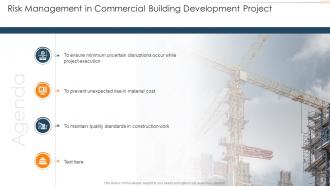
Slide 2: This slide states Agenda of the presentation.
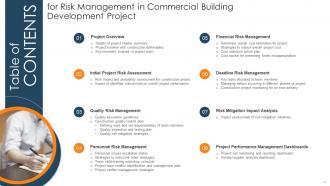
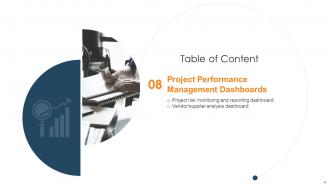
Slide 3: This slide presents Table of Content for the presentation.
Slide 4: This slide highlights title for topics that are to be covered next in the template.
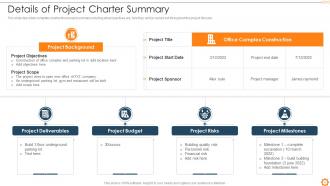
Slide 5: This slide displays complete construction project summary including what objectives are, how they will be carried out, etc.
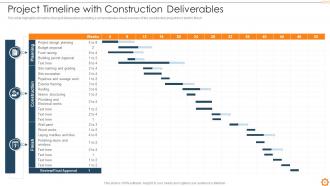
Slide 6: This slide highlights a timeline of project deliverables providing a comprehensive visual overview of the construction project.
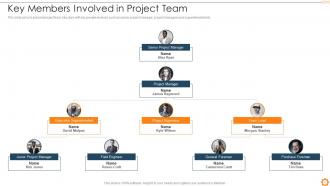
Slide 7: This slide aims to present project team structure with key people involved such as senior project manager, project managers and superintendent etc.
Slide 8: This slide highlights title for topics that are to be covered next in the template.
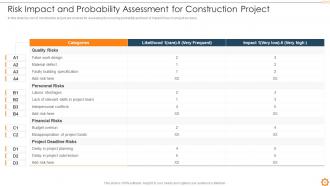
Slide 9: This slide shows Risk Impact and Probability Assessment for Construction Project.
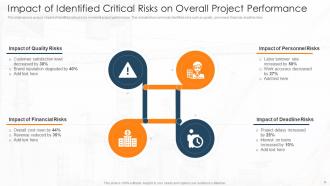
Slide 10: This slide displays Impact of Identified Critical Risks on Overall Project Performance.
Slide 11: This slide highlights title for topics that are to be covered next in the template.
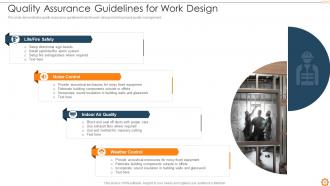
Slide 12: This slide demonstrates quality assurance guidelines to tackle Work Design risks for project quality management.
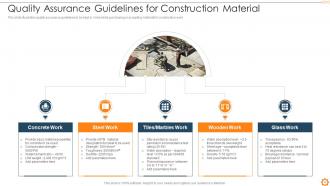
Slide 13: This slide presents quality assurance guidelines to be kept in mind while purchasing or accepting material for construction work.
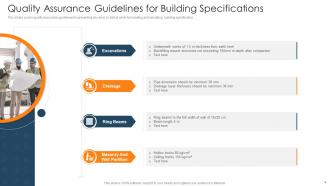
Slide 14: This slide shows Quality Assurance Guidelines for Building Specifications.
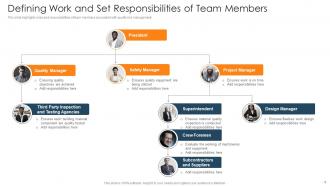
Slide 15: This slide highlights roles and responsibilities of team members associated with quality risk management.
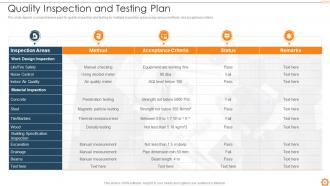
Slide 16: This slide depicts a comprehensive plan for quality inspection and testing for multiple inspection areas.
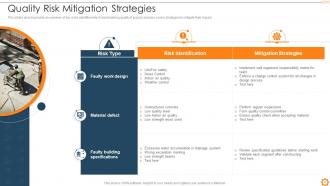
Slide 17: This slide aims to provide an overview of key risks identified which are hindering quality of project.
Slide 18: This slide highlights title for topics that are to be covered next in the template.
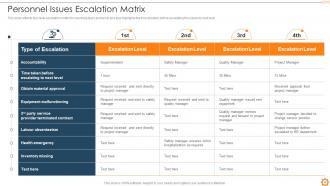
Slide 19: This slide reflects four level escalation matrix for resolving team problems and also highlights the time duration.
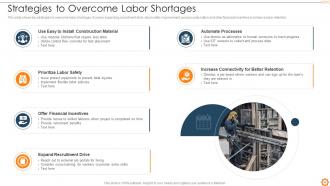
Slide 20: This slide displays key strategies to overcome labor shortages.
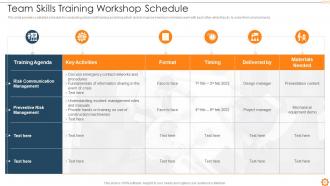
Slide 21: This slide provides a detailed schedule for conducting a team skill training workshop which aims to improve how team members.
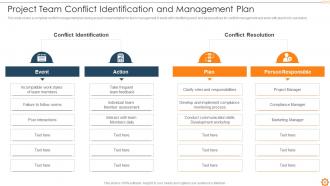
Slide 22: This slide covers a complete conflict management plan during project implementation for team management.
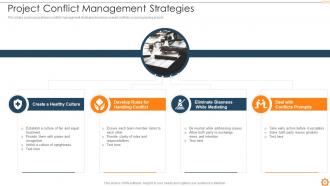
Slide 23: This slides presents project team conflict management strategies to reduce overall conflicts occurring during project.
Slide 24: This slide highlights title for topics that are to be covered next in the template.
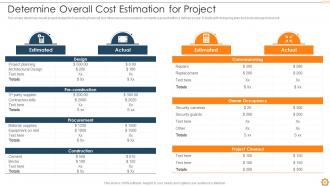
Slide 25: This slides displays overall project budget for forecasting financial and other resources needed to complete a project.
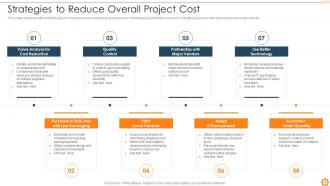
Slide 26: This slides describes different strategies for reducing overall construction project cost by minimizing project hidden cost.
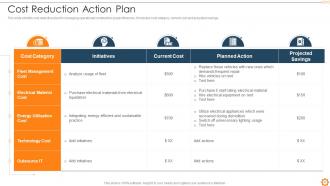
Slide 27: This slide exhibits cost reduction plan for managing operational construction project finances.
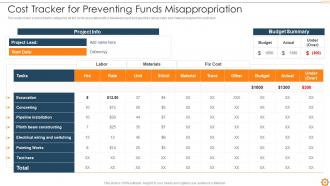
Slide 28: This slide presents Cost Tracker for Preventing Funds Misappropriation.
Slide 29: This slide highlights title for topics that are to be covered next in the template.
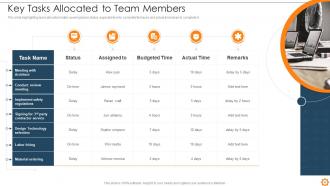
Slide 30: This slide highlighting tasks allocated matrix covering tasks status, expected time to complete the tasks and actual time taken.
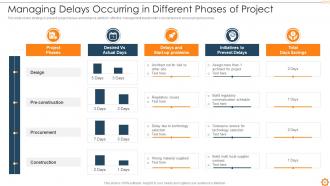
Slide 31: This slide shows Managing Delays Occurring in Different Phases of Project.
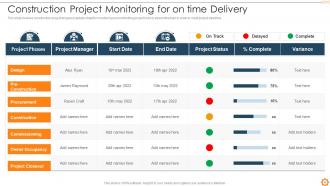
Slide 32: This slide involves construction project progress update sheet for monitoring and controlling project risks.
Slide 33: This slide highlights title for topics that are to be covered next in the template.
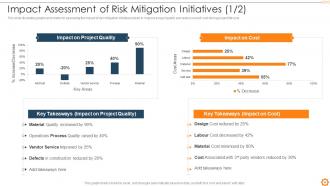
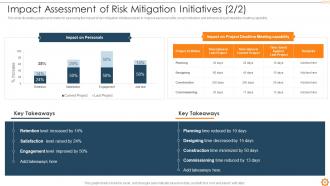
Slide 34: This slide illustrates graphs and charts for assessing the impact of risk mitigation initiatives taken to improve project quality.
Slide 35: This slide displays Impact Assessment of Risk Mitigation Initiatives.
Slide 36: This slide highlights title for topics that are to be covered next in the template.
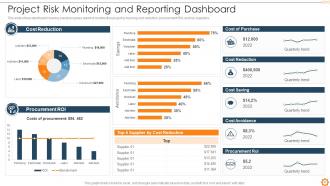
Slide 37: This slide shows dashboard covering overall progress report of construction project by tracking cost reduction, procurement ROI, etc.
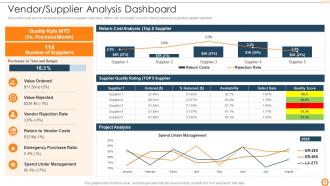
Slide 38: This slide presents Vendor/Supplier Analysis Dashboard.
Slide 39: This slide displays Icons for Risk Management in Commercial Building Development Project.
Slide 40: This slide is titled as Additional Slides for moving forward.
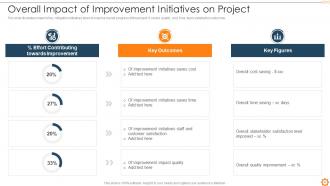
Slide 41: This slide shows Overall Impact of Improvement Initiatives on Project.
Slide 42: This is About Us slide to show company specifications etc.
Slide 43: This is Our Mission slide with related imagery and text.
Slide 44: This is Our Team slide with names and designation.
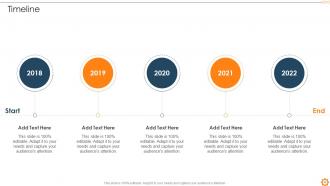
Slide 45: This is a Timeline slide. Show data related to time intervals here.
Slide 46: This slide depicts Venn diagram with text boxes.
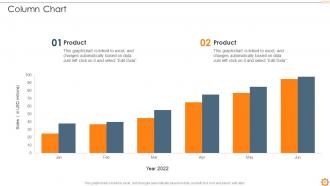
Slide 47: This slide displays Column chart with two products comparison.
Slide 48: This is an Idea Generation slide to state a new idea or highlight information, specifications etc.
Slide 49: This slide presents Roadmap with additional textboxes.
Slide 50: This slide shows Post It Notes. Post your important notes here.
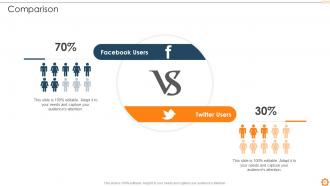
Slide 51: This is a Comparison slide to state comparison between commodities, entities etc.
Slide 52: This is a Thank You slide with address, contact numbers and email address.
Risk Management In Commercial Building Development Project Powerpoint Presentation Slides with all 57 slides:
Use our Risk Management In Commercial Building Development Project Powerpoint Presentation Slides to effectively help you save your valuable time. They are readymade to fit into any presentation structure.









FAQs for Risk Management In Commercial Building Development Project
You'll want to start by figuring out what could actually blow up in your face - both the obvious stuff and those weird edge cases that nobody thinks about until it's too late. Then figure out how likely each thing is and how badly it'd mess you up. That helps you know where to spend your time first. Create actual plans for the big risks and put someone in charge of each one. Oh, and set up some way to spot problems early before they get out of hand. Honestly, the biggest mistake is treating this like homework - you gotta keep updating it or it's useless.
So basically you want to do regular risk assessments - like every quarter, not yearly because things move too fast now. Get your teams together for brainstorming since they actually know their day-to-day stuff. Look at what went wrong before, those close calls, and what's happening in your industry. Supply chains are huge right now, don't skip those. Also check your tech systems and any new regulations coming down the pipe. Document everything you find and rank it by how likely it is versus how bad it'd be. That way you're not wasting time on tiny stuff when there's bigger fires to put out first.
Look, risk assessment is where you map out everything that could screw you over before it actually happens. Start by listing all the ways things might go sideways - don't just think about the obvious stuff either. Then rank each risk by how likely it is and how much damage it'd cause. That gives you a clear picture of where to focus your energy and money. Without doing this upfront, you're basically flying blind and hoping for the best. I learned this the hard way on a project last year - wish I'd been more thorough with my initial assessment.
Yeah, tech totally changes the game here. AI can catch patterns and predict problems before you'd ever notice them manually. Those real-time dashboards? Complete game changer - like having x-ray vision into your whole operation instead of squinting at spreadsheets all day. Automated alerts ping you the second something's off, plus predictive stuff helps you prep for scenarios you wouldn't think of. Honestly though, don't go crazy at first. Just pick one blind spot you have and throw some basic monitoring at it. Way easier to build from there.
Culture totally changes how teams think about risk. Some groups are cool with uncertainty and taking chances, while others want every step mapped out beforehand. Communication styles vary too - certain cultures will flag problems immediately, but others try to fix things quietly first to avoid looking bad. Power dynamics matter as well since junior people might not feel comfortable speaking up in hierarchical environments. Honestly, the biggest mistake is assuming everyone approaches risk like you do. You've got to figure out your team's cultural mix first, then adjust your processes to match how different people actually operate.
Track both early warning signs and actual outcomes. Near-miss reports and training completion rates help catch issues early - honestly this stuff saves your butt way more than people think. Then measure the real damage: incident rates, financial losses, how long recovery takes. I'd also compare what you spend on prevention versus what you actually save. Don't go overboard though. Pick maybe 3-4 metrics that actually matter to your specific situation rather than tracking everything under the sun. You'll just end up ignoring half the data anyway.
Honestly, just throw together a risk matrix - plot probability vs impact and you'll see what's actually urgent. High-probability, high-impact stuff first obviously, since that's what'll wreck you. The tricky part is those medium risks though. You gotta weigh mitigation costs against potential damage, which is kind of a pain. Get your department heads involved when you're scoring everything - they know their stuff way better than you do. Oh and don't try tackling every single risk at once. Pick your top 3-5 and actually finish those instead of spreading yourself too thin.
Honestly, the worst thing companies do is turn risk management into some bureaucratic nightmare that sits on a shelf collecting dust. Don't overthink it from the start - I've seen way too many organizations build these elaborate systems that are impossible to actually use. Getting different departments to talk to each other is huge too, instead of everyone doing their own thing in silos. Oh, and people get tunnel vision with just financial stuff while completely missing cyber threats or reputation issues. My advice? Keep it dead simple at first, make sure the important people are actually on board, then add layers once it's working.
Get your stakeholders involved from day one - seriously, this makes or breaks everything. Figure out who actually cares: internal teams, customers, suppliers, maybe regulators. Run workshops where they can tell you what scares them about their part of the business. I've found finance people want hard numbers while ops teams just want to know real impacts. Keep everyone in the loop with regular updates because surprises suck. Oh, and treat them like actual partners in solving problems, not just people you dump reports on. Makes a huge difference in buy-in.
Dude, you really don't want to mess around with regulatory stuff. The fines alone can be brutal - like, business-ending brutal. But honestly? The reputation damage might hurt even more long-term. Once regulators have you on their radar, they'll be watching everything you do with a microscope. Fixing things after you're already in trouble costs way more than just getting it right upfront. I learned that the hard way at my last job - what a nightmare that was. Just build those compliance checks into whatever risk stuff you're already doing. Makes life so much easier.
Look, building risk management right into your planning is like having backup plans that actually work. You won't be scrambling when stuff goes sideways - and trust me, it always does. Think of it as your business having multiple escape routes mapped out beforehand. Decision-making gets way faster because you've already thought through the "what if" scenarios. Honestly, it's kind of like playing chess but actually knowing your next three moves. Operations can shift gears smoothly instead of grinding to a halt. Start simple though - just pick your biggest 3-5 risks and sketch out response plans for each one.
Honestly, the worst part is watching your risk models completely fall apart when everything hits the fan. Markets start moving in ways that make zero sense - volatility goes nuts, assets that never moved together suddenly do, and good luck finding buyers when you need them. It's wild how fast things can change. The pressure to act quickly while everyone's freaking out? That's where people mess up big time. I've learned you gotta have your game plan ready way before the chaos starts. Set your stop-losses ahead of time and actually stick to them instead of trying to be a hero.
So scenario analysis is basically running "what if" experiments on your decisions. You pick 3-5 realistic worst-case situations - market crashes, operational mess-ups, new regulations, whatever keeps you up at night. Then you model how your portfolio or business would actually handle each one. Honestly, most people just wing it and react after problems hit, but this way you're spotting weak spots early. You can build backup plans before you need them. It's way better than crossing your fingers and hoping everything works out fine.
Start by figuring out what could actually mess up your business - cyber attacks, natural disasters, losing key people, whatever. Map out who does what when things go sideways and how everyone stays in touch. Here's the thing most places get wrong: they write this stuff down and then never practice it. Run some fake scenarios with your team so people don't panic when it's real. Oh, and have backup ways to communicate since phones/email might be down. Keep your plan simple enough that stressed-out people can actually follow it. Update it whenever you spot holes or your business shifts around.
Honestly, risk management can actually boost innovation if you do it right. Instead of just preventing problems, use it to get creative about solutions. When you spot risks early, your team has to brainstorm new ways around them - that's where the good ideas come from. It's kinda like how design constraints force you to think outside the box. Having a solid framework also gives people confidence to try bolder stuff they'd normally shy away from. I always tell teams to flip the question: "how can we innovate our way out of this mess?" Works way better than traditional risk assessments, trust me.
-
SlideTeam, Please don’t stop sharing discount coupons! I love your occasional discounts and tend to buy your products around that corner.
-
I am not the best at presentations but using SlideTeam’s PPT template made it easier for me. Thank you SlideTeam!