


Risk mitigation chart ppt inspiration themes





Try Before you Buy Download Free Sample Product
 Impress Your
 Audience
 100%
100% Editable
 Save Hours
 of Time


Allow your customers to have a great experience with our Risk Mitigation Chart Ppt Inspiration Themes. Etch the event in their minds.
People who downloaded this PowerPoint presentation also viewed the following :
Content of this Powerpoint Presentation
Description:
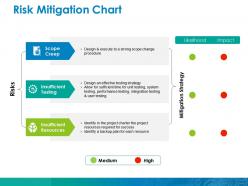
The image displays a "Risk Mitigation Chart," a tool used to identify project risks and propose strategies to reduce their likelihood and impact. There are three primary risk factors listed on the left side of the chart, namely:
1. Scope Creep:
Mitigation Strategy: Design & execute a strong scope change procedure to avoid expanding the project scope without proper reviews and adjustments, which can cause delays and budget overruns.
2. Insufficient Testing:
Mitigation Strategy: Design an effective testing strategy and allow for sufficient time for various testing phases (unit, system, performance, integration, and user) to ensure that the project meets its quality goals.
3. Insufficient Resources:
Mitigation Strategy: Identify in the project charter the resources required for success and develop a backup plan for each resource to prevent resource shortages from impacting the project timeline or quality.
The chart also includes a two-dimensional risk assessment metric with "Likelihood" on the horizontal axis and "Impact" on the vertical one. Risks are rated with colored dots representing their severity; green for medium and red for high in either dimension.
Use Cases:
This risk mitigation strategy is applicable across various industries:
1. Information Technology:
Use: For managing software development project risks.
Presenter: IT Project Manager.
Audience: Development Team and Stakeholders.
2. Construction:
Use: For addressing risks in construction project planning.
Presenter: Construction Manager.
Audience: Project Team, Investors, and Contractors.
3. Manufacturing:
Use: Managing risks in product development and manufacturing processes.
Presenter: Operations Manager.
Audience: Manufacturing Team and Department Leads.
4. Healthcare:
Use: Handling risks in healthcare project implementations like new system deployments.
Presenter: Clinical Project Manager.
Audience: Medical Staff and Administrative Personnel.
5. Finance:
Use: Risk mitigation for financial projects & services implementation.
Presenter: Risk Management Officer.
Audience: Finance Team and Compliance Staff.
6. Event Planning:
Use: Mitigating risks in organizing and executing large events.
Presenter: Event Coordinator.
Audience: Event Planners and Venue Staff.
7. Aerospace:
Use: Minimizing risks in aerospace projects and product development.
Presenter: Aerospace Engineer.
Audience: Project Team and Safety Analysts.
Risk mitigation chart ppt inspiration themes with all 5 slides:
Introduce an air of jubilation with our Risk Mitigation Chart Ppt Inspiration Themes. Inject a joyous feeling into the event.


FAQs for Risk mitigation chart
Effective risk assessment processes include hazard identification, probability analysis, impact evaluation, control measure assessment, and continuous monitoring protocols. These elements work systematically by mapping potential threats, quantifying likelihood scenarios, and prioritizing resource allocation, with many organizations finding that comprehensive frameworks ultimately deliver enhanced operational resilience and strategic decision-making capabilities.
Organizations can prioritize risks by conducting comprehensive risk assessments that evaluate probability, potential impact, regulatory requirements, and strategic business implications. Through risk matrices and scoring systems, companies systematically rank threats, with many finding that focusing on high-probability, high-impact scenarios first delivers immediate operational protection while building stronger resilience frameworks.
Communication serves as the foundation of effective risk mitigation by enabling early warning systems, facilitating cross-departmental coordination, ensuring stakeholder alignment, and maintaining transparent reporting channels. Through structured communication protocols, organizations streamline incident response, enhance decision-making speed, and minimize operational disruptions, with many financial services and healthcare institutions finding that proactive communication ultimately delivers faster crisis resolution and stronger stakeholder confidence.
Technology enhances risk management through predictive analytics, automated monitoring systems, artificial intelligence, real-time data processing, and integrated reporting platforms. These solutions streamline risk assessment by identifying patterns earlier, automating compliance tracking, and delivering comprehensive dashboards, with many financial institutions and healthcare organizations finding that technology-driven approaches significantly reduce operational risks while improving decision-making speed.
Businesses can implement diversification strategies, hedging techniques, insurance coverage, robust internal controls, and regular risk assessments to manage financial risks effectively. Through portfolio diversification and derivative instruments, companies across sectors like manufacturing and retail minimize exposure to market volatility, ultimately delivering enhanced stability and competitive advantage in increasingly uncertain economic environments.
Organizations ensure compliance while mitigating operational risks by implementing integrated governance frameworks, automated monitoring systems, regular audits, cross-functional risk committees, and comprehensive training programs. Through strategic alignment of compliance protocols with operational workflows, companies streamline regulatory adherence while minimizing disruptions, ultimately delivering enhanced transparency, reduced penalties, and sustainable competitive advantage in increasingly regulated business environments.
Cybersecurity risk mitigation best practices include multi-factor authentication, regular security audits, employee training programs, data encryption, and incident response planning. These strategies enhance organizational resilience by reducing vulnerabilities, accelerating threat detection, and minimizing breach impacts, with many financial institutions and healthcare organizations finding that comprehensive security frameworks ultimately deliver stronger customer trust and regulatory compliance.
Risk mitigation strategies can be tailored by aligning resource allocation, regulatory complexity, and operational scale with business size and capabilities. Small businesses often focus on cost-effective insurance policies, simplified compliance frameworks, and streamlined vendor relationships, while large corporations implement comprehensive enterprise risk management systems, advanced analytics, and multi-layered governance structures, ultimately delivering proportionate protection and competitive advantage.
Employee training contributes to risk mitigation by enhancing hazard identification skills, improving compliance with safety protocols, building crisis response capabilities, and fostering a proactive safety culture across organizations. Through targeted programs, companies in manufacturing, healthcare, and financial services significantly reduce workplace accidents, regulatory violations, and operational disruptions, while ultimately strengthening overall organizational resilience and competitive positioning.
Common pitfalls in developing risk management plans include underestimating interdependent risks, failing to regularly update assessments, inadequate stakeholder involvement, and over-relying on historical data without considering emerging threats. These oversights often result in gaps where organizations, particularly in financial services and healthcare, find their plans ineffective during actual crises, ultimately compromising operational resilience and competitive positioning.
Companies should approach global risk mitigation through comprehensive assessment frameworks, diversified geographic operations, cross-cultural compliance strategies, and adaptive contingency planning that accounts for regional variations. This strategic combination enables organizations to navigate political instability, currency fluctuations, and regulatory differences across markets, while many multinational corporations find that localized risk management ultimately delivers enhanced operational resilience and sustainable competitive advantage.
Key metrics include risk reduction percentage, incident frequency rates, financial impact assessments, compliance scores, and recovery time objectives. These measurements enable organizations to evaluate strategy performance through quantifiable data, with many financial institutions and healthcare systems finding that regular metric analysis enhances operational resilience and delivers measurable competitive advantage.
Companies can balance risk-taking with risk aversion by implementing portfolio diversification, scenario planning, staged investment approaches, and establishing clear risk tolerance thresholds across different business units. Through strategic risk frameworks, organizations in sectors like technology and finance find that measured experimentation in innovation while maintaining conservative approaches in core operations ultimately delivers sustainable growth and competitive advantage.
Insurance serves as a critical financial safety net in comprehensive risk mitigation, transferring potential losses from organizations to insurance providers through premiums, coverage policies, and claims processes. This strategic approach enables businesses across sectors like manufacturing, healthcare, and retail to maintain operational continuity during disruptions, while protecting capital reserves and ensuring stakeholder confidence, ultimately delivering financial stability and competitive resilience.
Industry-specific regulations directly shape risk mitigation strategies by mandating compliance frameworks, reporting requirements, data protection standards, and operational controls tailored to sector vulnerabilities. Financial services implement stringent anti-money laundering protocols, healthcare organizations prioritize patient data security under HIPAA, and manufacturing companies focus on safety regulations, with each sector developing specialized risk management approaches that ensure regulatory adherence while maintaining competitive advantage.
-
Excellent Designs.
-
Best Representation of topics, really appreciable.