

Roles and responsibilities ppt summary infographic template






Try Before you Buy Download Free Sample Product
 Impress Your
Audience
 100%
Editable
 Save Hours
of Time


Get into gear with our Roles And Responsibilities Ppt Summary Infographic Template. Accelerate away along the course.
People who downloaded this PowerPoint presentation also viewed the following :
Content of this Powerpoint Presentation
In any business, there will always be no shortage of work, and people will go about doing what suits their role best. In addition, the concept of responsibility makes enterprises unique. Hence, roles and responsibilities are shared business and entrepreneurial concepts.
These come to the fore as businesses expand and many people work in tandem and cooperate to produce business value. A roles and responsibilities chart, along with an operational matrix on Responsible, Accountable, Consulted, and Informed (RACI), defines the way power lines are drawn across a business's length and breadth.
Roles and responsibilities are dynamic, so here’s a hierarchal growth chart of employee roles and responsibilities.
A roles and responsibilities diagram serves as a valuable tool, guiding you on who to consult, who to inform, and who is accountable in your business. Its practicality and clarity can significantly enhance your understanding of the complex business machine.
Most businesses find it challenging to draw up a roles and responsibility diagram, as the tasks may be too numerous and tedious to document. SlideTeam resolves that issue as it understands some of the standard tasks that have to be performed in a business setting.
Master the roles and responsibilities of the marketing management team here.
Our templates offer a seamless experience. They are not only 100% editable and customizable, but also provide a structured starting point. This flexibility allows you to tailor them to your specific business needs with ease.
Let’s explore!
Template 1 Roles and Responsibilities Slide with RACI Matrix PPT

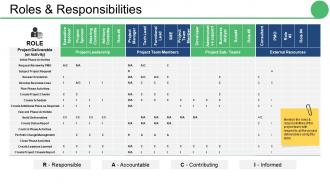
In all, this PPT Template is a comprehensive representation of how work and roles are assigned across an organization. These are all roles and tasks that can be universally applied and are, thus, broadly applicable across businesses and industries. The slide also mentions the roles and responsibilities of the project team with respect to all project deliverables using this table. The people and teams tracked include project leadership, project team members, project sub-teams, and external resources. The matrix tool of Responsible, Accountable, Contributing, and Informed (RACI) is also duly used to ensure that roles and responsibilities and the extent to which each individual is involved in the task are well-communicated and understood. There are at least two dozen activities and tasks, such as developing business cases and creating lessons learned, et al., that are tracked and mapped to roles and responsibilities in this clutter-free, well-designed template.
WORK IS ALWAYS WORSHIP
Roles and responsibilities work well only when the entire organization considers their work a worship and tasks a means to complete that worship. Without a template, this becomes easy.
PS Access team member roles and responsibilities PPT Themes with a click here.
Roles and responsibilities ppt summary infographic template with all 5 slides:
Acquaint folks with the actual intention through our Roles And Responsibilities Ppt Summary Infographic Template. Be able to decode journalese.



FAQs for Roles and responsibilities ppt
So you've got four main players here. Project manager coordinates everything - that's probably you, right? Then there's the sponsor who holds the purse strings and gives you authority. Stakeholders are anyone affected by what you're building. Team members do the grunt work. Honestly, being a PM feels like juggling sometimes. You're constantly translating between groups - sponsors want updates, stakeholders keep changing their minds, and your team needs clear direction. The trick is figuring out early who's who in your project. Communication breaks down fast if you don't know whether someone's just interested or actually calling the shots.
Honestly, half the workplace drama I've seen comes from people not knowing whose job is whose. You avoid those super awkward "wait, I thought YOU were doing that" moments. Plus your team stops tripping over each other or letting things slip through the cracks entirely. People get way more confident when they actually know what they're responsible for. Decisions happen faster too. I'd literally just start by mapping out who owns what on your current project - sounds boring but it's such a relief once it's done. No more guessing games.
Honestly, just be super direct about who's doing what and when. No wiggle room there. I'd set up weekly check-ins so stuff doesn't get forgotten - maybe those quick one-on-ones work better than big team meetings, depends on your people. Shared tracking tools are clutch because nobody wants to look bad in front of everyone else. Oh, and decide consequences ahead of time! High-fives for good work, real talks when someone flakes. Don't let anything slide or they'll keep pushing. Start simple though - try a weekly huddle thing first and see how it goes.
Your org structure totally controls who makes decisions and how info moves around. Hierarchical stuff gives you clear bosses but everything takes forever to decide. Flat orgs let people run with things more, though sometimes nobody knows who's actually responsible (been there, it's annoying). Matrix structures are honestly a nightmare - you end up with like three different managers. Network setups work well for projects since you can shift people around based on what you need. Just figure out your decision-making process first before changing everything up, or you'll make things way worse.
Honestly? Start by mapping out who's responsible for what - it's like magic for stopping fights before they even start. No more "wait, I thought YOU were doing that" drama. Once everyone knows their lane, you can actually figure out if the real problem is overlapping jobs or just crappy communication. People get way more comfortable saying no to extra work too when they're clear on their actual role. I mean, half the time conflicts aren't even about the work itself, just confusion about boundaries. Try it next time things get messy.
Honestly, you've got to be that translator between the big picture stuff and what people actually do every day. I've watched teams completely fall apart when leadership doesn't spell things out clearly - people either duplicate work or think someone else has it covered. Bad news either way. So yeah, define who owns what and actually check that everyone gets their role. Don't just assume they do! Have them tell you back what they think they're responsible for. Boundaries between roles matter way more than most leaders realize.
Don't just hand them the role description and call it done - walk through it together in week one. Have them shadow someone actually doing the work. Honestly, I've watched too many people hit month three still confused about priorities! Schedule check-ins at 30 and 60 days to compare what's really happening vs what's written down. Here's the thing though - let new hires update those descriptions when they spot stuff you've missed. Fresh eyes catch gaps we don't see anymore. Oh, and treat it like a living doc, not some HR thing that disappears into a filing cabinet.
Dude, it's a total mess when nobody knows their role. Tasks get dropped because everyone thinks someone else is on it. Or worse - three people do the same thing and waste time. I've watched teams literally fight over responsibilities while missing every deadline (so painful to watch). Plus you get that annoying scope creep since no one owns their piece. And when things go wrong? Good luck figuring out who's accountable - it turns into a blame game real quick. Just write it all down beforehand. Who's doing what and when. Get everyone to actually agree to it too.
Watch your team like a hawk and adjust on the fly. Experienced devs who hate being micromanaged? Back off and just clear their roadblocks. Junior folks need way more hand-holding and frequent check-ins. It's basically coaching - you wouldn't train a rookie the same as a veteran, right? When deadlines are breathing down your neck, be more direct. During brainstorming sessions though, let everyone collaborate freely. Here's the thing people miss - actually ASK your team what support they want instead of guessing. Saves everyone a headache.
Honestly, one-on-ones are your best bet - just ask people straight up how they're feeling about their workload. Performance reviews are fine but they're kinda slow to catch real problems. I'd track who's actually hitting deadlines too. Oh, and try having everyone write down what they think their job is - you'd be surprised how differently people interpret the same role lol. Peer feedback helps a ton. Mix the formal stuff with casual check-ins so you're not blindsided by issues later.
Oh man, this stuff gets tricky fast. Some cultures are super hierarchical - people literally won't move without their boss saying so. Others are like "everyone just figure it out together." And don't get me started on deadlines... some teams treat them as suggestions (which honestly drives me nuts), while others stress if they're 5 minutes late. Direct communicators will straight-up tell you when roles are messy. But indirect ones? They'll just sit there confused and say nothing. I'd have those awkward "what do you actually expect from me" conversations upfront. Then check in a lot because assumptions kill everything.
Honestly, just pick a project management tool like Asana or Monday and actually stick with it - half the battle is consistency. You can assign tasks with clear deadlines so nobody's confused about who does what. RACI matrices sound fancy but they're just shared docs that spell out who's responsible for each thing. Set up Slack channels by project (way better than endless email chains, trust me). Notion's great for role docs that people actually update, unlike those org charts that sit there gathering dust. The key is choosing something your team will use consistently rather than downloading every shiny new app.
Agile teams are super fluid compared to traditional projects - you're constantly switching between different roles. One sprint you're writing requirements, then you're testing stuff or helping with docs. The whole point is cross-functional collaboration where everyone owns the final product together. Your core skills still matter, but honestly the best results happen when devs can chat directly with users and BAs jump in to test things. Each sprint, just look at what gaps your team has and volunteer where you can help. It's way more dynamic but actually pretty fun once you get used to it.
Honestly, you've gotta stay on top of role reviews because everything changes so fast. What someone was doing six months ago? Probably totally irrelevant now. Without updates, people get confused about who's responsible for what - I've watched entire teams spend weeks just sorting out basic accountability stuff. Super frustrating. Quick quarterly check-ins work well to catch gaps before they blow up. Plus it helps with performance reviews since everyone actually knows what they're supposed to be doing. Otherwise you get that awkward situation where critical tasks just... disappear because nobody owns them.
Honestly, I'd nail down the "what" and "why" for each role but let people figure out their own "how." Like, be super clear about core responsibilities and outcomes, but don't dictate every step. Weekly check-ins work great - people can pivot their approach if something's not clicking. You definitely want to set boundaries around who can make what decisions though. Otherwise it gets messy fast. I'd start by writing out your absolute must-haves for each position, then see where you can actually give people room to breathe. It's way better than micromanaging everyone to death.
-
Great experience, I would definitely use your services further.
-
Good research work and creative work done on every template.