

Saas customer life value dashboard




Try Before you Buy Download Free Sample Product
 Impress Your
 Audience
 100%
100% Editable
 Save Hours
 of Time


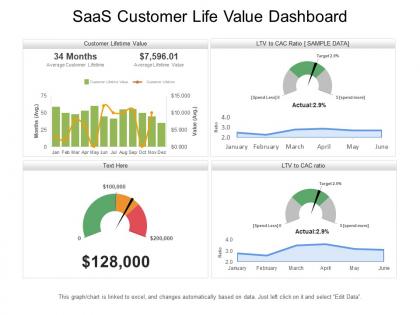
In SaaS business, customer life value is one of the key metric indicators which is measured by customer acquisition cost. So therefore, we have come up with our Saas customer life value dashboard PowerPoint slide to help you out with your business needs. You can use this Saas customer life value dashboard PPT slideshow as a marketing monitor for your business organization. Customer acquisition cost is designed to measure and maintain the profitability of your acquisition teams. If you want your business to be viable then you need to think of ways to reduce the customer acquisition cost and increase the customer lifetime value. Our Saas customer life value dashboard PowerPoint visual provides a simple visual overview of your customer acquisition cost and customer life time value. Editable bar charts and speedometers along with text boxes have been used to craft this professional Saas customer life value PPT slide. Use the slide now. Clear the air of any controversy with our Saas Customer Life Value Dashboard. It will help close the debate.
People who downloaded this PowerPoint presentation also viewed the following :
Saas customer life value dashboard with all 6 slides:
Delve on inspirational experiences with our Saas Customer Life Value Dashboard. Enlighten folks on jazz.



FAQs for Saas customer
A SaaS CLV dashboard should include monthly recurring revenue (MRR), customer acquisition cost (CAC), churn rate, average customer lifespan, gross margin per customer, and expansion revenue metrics. These components work together to provide comprehensive visibility into customer profitability patterns, enabling subscription businesses to optimize pricing strategies, improve retention initiatives, and ultimately maximize long-term revenue growth across their customer base.
Businesses can effectively segment customers by analyzing purchase frequency, transaction values, engagement levels, geographic locations, and behavioral patterns across different touchpoints. Through advanced analytics tools, organizations streamline customer profiling by demographic characteristics, usage patterns, and lifecycle stages, with many retail and subscription-based companies finding that targeted segmentation strategies ultimately deliver improved retention rates and higher lifetime values.
Churn rate directly impacts CLV calculations by determining how long customers remain active subscribers, with higher churn rates significantly reducing projected lifetime value through shorter retention periods. SaaS companies use churn data to segment customers by risk levels, optimize retention strategies, and adjust CLV forecasts, ultimately enabling more accurate revenue projections and strategic resource allocation decisions.
Predictive analytics enhances CLV accuracy by analyzing historical customer behavior patterns, identifying usage trends, and forecasting future engagement through machine learning algorithms. These advanced models enable SaaS companies to predict subscription renewals, upselling opportunities, and churn risks with greater precision, ultimately delivering more reliable revenue forecasting and strategic customer investment decisions.
Methods to reduce customer acquisition costs while maximizing CLV include targeted content marketing, referral programs, freemium models, customer segmentation, and retention-focused onboarding processes. These strategies streamline acquisition by leveraging existing satisfied customers, optimizing marketing spend through precise targeting, and enhancing early customer experiences, with many SaaS companies finding that strategic retention investments ultimately deliver lower acquisition costs and higher lifetime value.
Upselling and cross-selling significantly boost SaaS customer lifetime value by increasing monthly recurring revenue per account, extending subscription duration, and deepening product adoption across customer organizations. These strategies enable companies to capture greater wallet share while reducing churn, with many SaaS businesses finding that customers using multiple products generate 3-5x higher CLV than single-product users.
Pricing strategies significantly impact SaaS customer lifetime value through subscription tier optimization, retention rates, and expansion revenue opportunities. Strategic pricing models like value-based tiers and usage-based billing enhance CLV by encouraging upgrades, reducing churn, and maximizing customer spending over time, with many SaaS companies finding that flexible pricing structures deliver sustained revenue growth.
SaaS businesses can leverage CLV data to optimize marketing strategies by identifying high-value customer segments, personalizing acquisition campaigns, and allocating budgets toward channels that attract profitable long-term users. This enables companies to focus resources on customers with higher lifetime value, reduce acquisition costs for low-value segments, and ultimately improve ROI while building sustainable growth through strategic customer targeting.
**INPUT**: What tools and technologies are best suited for creating a comprehensive SaaS CLV dashboard? **OUTPUT**: Essential tools include Tableau, Power BI, Looker, Mixpanel, and ChartIO, integrated with CRM platforms like Salesforce or HubSpot for comprehensive data visualization. These technologies streamline customer analytics by automating data collection, enabling real-time tracking, and delivering predictive insights, with many SaaS companies finding that strategic dashboard implementation enhances retention strategies and revenue forecasting. **Word count: 58 words**
Customer feedback can be integrated into CLV dashboards through automated survey data feeds, sentiment analysis from support interactions, and NPS score tracking alongside revenue metrics. This strategic combination enables businesses to correlate customer satisfaction with lifetime value trends, helping SaaS companies identify at-risk accounts, optimize retention strategies, and ultimately enhance customer experiences while maximizing long-term revenue potential.
Common pitfalls when interpreting SaaS CLV data include ignoring churn timing variations, relying on historical data without considering market changes, overlooking cohort differences, and failing to segment customers by acquisition channels or usage patterns. These interpretation errors can mislead strategic decisions, with many SaaS companies finding that contextualizing CLV within customer segments, market conditions, and product evolution cycles delivers more accurate forecasting and resource allocation strategies.
Companies should adjust their business model by reallocating resources toward high-CLV customer segments, refining pricing strategies based on value-delivered patterns, and restructuring service tiers to maximize long-term revenue potential. These insights enable organizations to streamline acquisition costs, enhance retention programs, and optimize product development priorities, with many SaaS companies finding that CLV-driven adjustments ultimately deliver improved profitability and sustainable competitive advantage.
NPS serves as a strong predictor of CLV by measuring customer loyalty and likelihood to recommend, directly correlating with retention rates, expansion revenue, and long-term value. Companies with higher NPS scores typically see increased CLV through reduced churn, more referrals, and greater upselling opportunities, with many SaaS organizations finding that promoters generate significantly higher lifetime value than detractors.
Cohort analysis reveals CLV patterns by tracking customer groups from acquisition through their lifecycle, identifying retention trends, revenue progression, and churn indicators across different time periods. By segmenting customers by acquisition date, marketing channel, or product tier, businesses can pinpoint which factors drive higher lifetime values, optimize acquisition strategies, and ultimately enhance revenue predictability while reducing churn rates.
SaaS companies should monitor product usage frequency, feature adoption rates, support ticket patterns, billing cycle changes, and user engagement depth across different touchpoints. These behavioral indicators enable organizations to identify expansion opportunities, predict churn risks, and optimize retention strategies, with many SaaS businesses finding that proactive monitoring delivers significantly improved customer lifetime value predictions and revenue forecasting.
No Reviews