

Sales enablement plan powerpoint presentation slides





Try Before you Buy Download Free Sample Product
 Impress Your
 Audience
 100%
100% Editable
 Save Hours
 of Time


Introducing Sales Enablement Plan PowerPoint Presentation Slides which helps you to create a strategy in order to improve your brand consistency. With the help of a sales enablement strategy PPT template, you can highlight your project purpose and scope. By using the sales enablement PowerPoint presentation complete deck, you can analyze the overall schedule and cost to complete your target. If you want to conduct a survey that showcases your performance graph in the market, then use these B2B sales enablement PPT slides. You can present an effective sales implementation strategy with the help of our professionally designed strategic sales business plan Powerpoint presentation template. Elaborate the methods like business rules, process modifications, user screen mapping, communicate change, and system roll out using this marketing enablement PPT visuals. With the help of a sales development plan PowerPoint presentation deck, you can implement a marketing automation system. Therefore, download this ready-to-use sales strategy PPT slides and achieve better sales results.
People who downloaded this PowerPoint presentation also viewed the following :
Content of this Powerpoint Presentation
Slide 1: This slide introduces Sales Enablement Plan. State Your Company Name and begin.
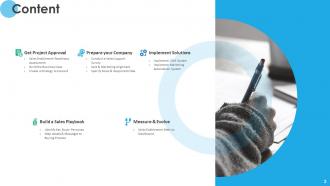
Slide 2: This slide shows Content of the presentation.
Slide 3: This slide is titled as Get Project Approval with related imagery.
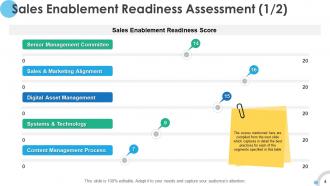
Slide 4: This slide presents Sales Enablement Readiness Assessment.
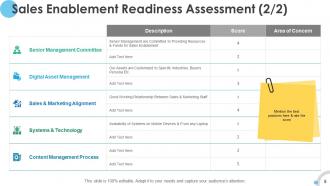
Slide 5: This is another slide on Sales Enablement Readiness Assessment.
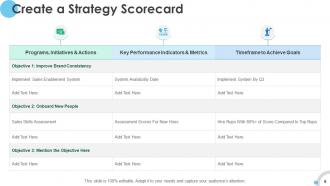
Slide 6: This slide displays Create a Strategy Scorecard in tabular form.
Slide 7: This slide is titled as Prepare your Company with related imagery.
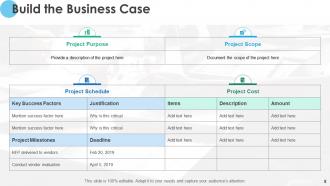
Slide 8: This slide represents Build the Business Case with project purpose, scope, schedule and cost.
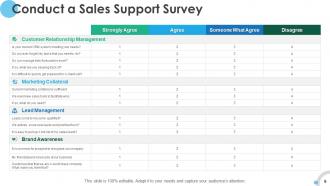
Slide 9: This slide helps to Conduct a Sales Support Survey.
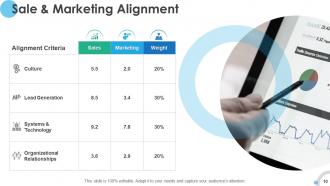
Slide 10: This slide showcases Sale & Marketing Alignment.
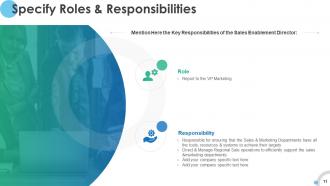
Slide 11: This slide shows Specify Roles & Responsibilities with related icons and text.
Slide 12: This slide is titled as Implement Solutions with related imagery.
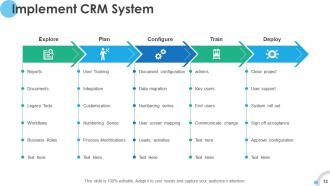
Slide 13: This slide presents Implement CRM System with categories as- Explore, Plan, Deploy, Configure, Train.
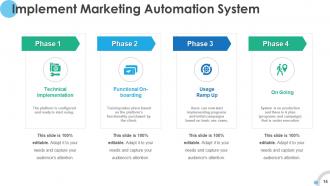
Slide 14: This slide displays Implement Marketing Automation System with phases as- Technical Implementation, Functional On-boarding, Usage Ramp Up, On Going.
Slide 15: This slide is titled as Build a Sales Playbook.
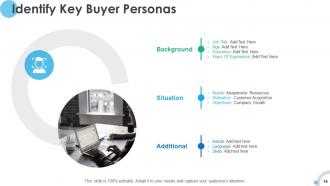
Slide 16: This slide shows Identify Key Buyer Personas with related imagery.
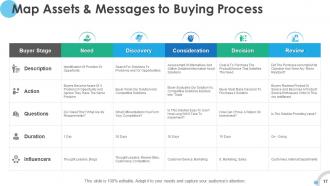
Slide 17: This slide presents Map Assets & Messages to Buying Process in tabular form.
Slide 18: This slide is titled as Measure & Evolve.
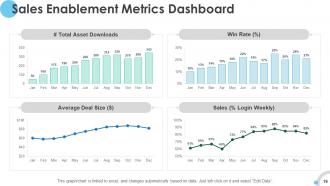
Slide 19: This slide displays Sales Enablement Metrics Dashboard.
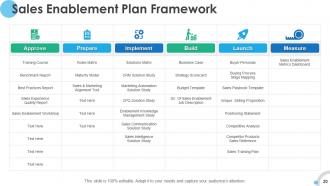
Slide 20: This slide represents Sales Enablement Plan Framework.
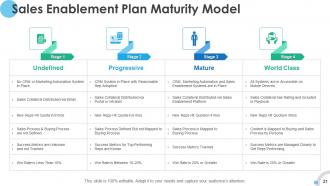
Slide 21: This slide showcases Sales Enablement Plan Maturity Model.
Slide 22: This slide shows icons for Sales Enablement Plan.
Slide 23: This slide is titled as Additional Slides for moving forward.
Slide 24: This is Our Goal slide. Show your firm's goals here.
Slide 25: This is a Timeline slide to show information related with time period.
Slide 26: This is About Us slide to show company specifications etc.
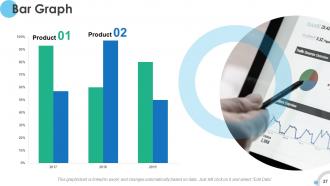
Slide 27: This slide shows Bar Graph with two products comparison.
Slide 28: This is a Thank You slide with address, contact numbers and email address.
Sales enablement plan powerpoint presentation slides with all 28 slides:
Handle any disparity with our Sales Enablement Plan Powerpoint Presentation Slides. Give importance to ensuring equality.




FAQs for Sales enablement plan
Honestly, you need four main things - content like battle cards and case studies, solid training programs, clear sales processes, and analytics to see what's working. But here's the thing: most companies nail the first part then completely bomb on coaching. Your team can't just get trained once and magically remember everything six months later, you know? They need ongoing support. Start by figuring out what gaps your sales reps are actually complaining about - like what objections keep tripping them up. Then audit what you've already got before building new stuff. Everything should connect back to your buyer's journey though.
So these sales tools basically save your team from all the random stuff that eats up their day. Content libraries, automated follow-ups, coaching insights - all centralized so reps aren't frantically digging for that one slide deck right before calls (we've all been there). The analytics piece is solid too - shows what actually converts vs. what's just noise. My advice? Figure out where your team wastes the most time on non-selling tasks first. That's your sweet spot for impact. Game-changer for productivity once you get it dialed in.
Training is honestly the make-or-break piece of your whole sales enablement thing. Look, you can have the best tools and content in the world, but if your team doesn't know how to use them properly? You're just wasting money. I've seen this happen so many times - companies dump resources on people and wonder why nothing changes. You need regular training sessions covering product knowledge, sales methods, handling objections, plus how to actually work with your tools. The ongoing part is crucial though. Those one-time training sessions everyone forgets about immediately? Don't bother. Figure out where your current gaps are first, then set up a consistent schedule that keeps reinforcing everything.
Honestly, you gotta track both the activity stuff and the actual business results. Content usage, training time, how fast new reps hit quota - that's your day-to-day tracking. But then also watch win rates, deal size, quota attainment, all that good stuff. The annoying part? Figuring out if your programs actually caused the improvements or if it's just coincidence. I'd start with maybe 3-5 metrics you can actually track consistently. Don't go crazy measuring everything - you'll burn out. If multiple metrics improve after launching something new, you're probably doing something right.
Honestly, the hardest part is getting sales reps on board - they hate changing how they do things. Your content will be scattered everywhere and nobody can find anything. Sales and marketing teams? They're probably not talking to each other at all. Companies always think training is a one-time thing when it's really ongoing work. Oh, and good luck proving ROI - connecting enablement stuff to actual revenue is nearly impossible. Start with a small pilot program first. Get your sales leaders excited about it early because they'll sell it way better than some corporate memo from above.
Oh man, your sales team will love you for this. A good CMS puts all your materials in one spot that's actually searchable - no more digging through random folders for case studies. You can see which content actually closes deals vs what's just sitting there doing nothing (honestly shocking how much stuff never gets used). Updates push automatically too, so everything stays current. Quick tip though - spend time on tagging and search from the start. Otherwise you're basically building a really expensive mess that nobody will want to use.
Build specific learning tracks for product knowledge and sales process right from the start. Shadow top performers first, then flip it so they're leading calls while getting coached. We totally bombed this once by throwing new hires straight into calls - not pretty! Your CRM has tons of real deal examples and objections they can practice with. Set clear checkpoints at 30, 60, and 90 days. Give them a buddy who's not their manager for random questions and just figuring out how things work around there. Trust me, that informal mentor makes a huge difference for the day-to-day stuff.
Honestly, buyer personas are game-changers for sales enablement. They tell you exactly what content to make and how to approach different customers. Know their pain points? Great - now you can actually create objection scripts that work instead of those generic battle cards nobody touches. I swear half our old materials just collected digital dust. Map your personas to your current content first, then spot the gaps. Short conversations work better for some buyers, detailed case studies for others. It's all about matching their decision-making style and communication preferences.
Honestly, you gotta track both the activity stuff and the actual results to really know what's working. Conversion rates at each stage are huge - plus deal velocity and average deal size. Those tell you if your enablement is actually doing anything. Win rates and quota attainment are no-brainers. Content usage analytics matter too because what's the point if reps aren't even using your stuff? Sales cycle length and how fast new hires get up to speed - those are goldmines for measuring impact. Pick maybe 4-5 metrics tops and stick with them. Trust me, you'll drown otherwise.
Honestly, the magic happens when both teams start owning the same metrics together. Set up weekly check-ins where marketing and sales review lead quality and what content's actually working. Shared dashboards are clutch here - marketing finally sees which materials close deals, sales gets better leads. No more finger pointing when things go sideways (though let's be real, it still happens sometimes). Pick one metric you both care about, like how many marketing qualified leads turn into actual revenue. Those regular touchpoints make all the difference instead of everyone working in silos.
So you've got the obvious ones - Salesforce and HubSpot for CRM stuff. Content-wise, Highspot and Seismic are solid. Gong and Chorus do that conversation intelligence thing really well. Oh, and Vidyard's killing it with personalized video outreach lately. Honestly though? There's way too many options now. Before you go crazy adding tools, figure out what gaps you actually have. Trust me on this - I've seen teams with like 12 different platforms that don't talk to each other. It's a mess. The AI analytics stuff is where things get interesting. Shows you which content actually closes deals instead of just guessing.
Map your content to each segment's pain points first. Different buyers want totally different things - some need all the technical details, others just want ROI proof. Create separate content tracks with relevant case studies and pitch decks for each type. Enterprise buyers usually want risk stories (they're so paranoid about making bad decisions), while SMB people care more about fast setup. Oh, and tag prospects in your CRM by segment so your sales team can grab the right stuff quickly. Saves everyone time instead of fumbling around during calls.
So basically, sales enablement makes your CRM way more useful because your team actually starts putting good data in there. When reps have proper training, they'll document calls instead of just sprinting to the next one (guilty as charged lol). Your contact records get way richer. Pipeline visibility improves. Forecasting becomes less of a guessing game. Plus reps can use that CRM data to personalize outreach better and spot upsell opportunities. Honestly, I'd start by checking what your team currently tracks vs what they should be tracking - the gap is usually pretty eye-opening.
Quarterly updates are your bare minimum, but some content needs way more attention than that. Product sheets? Competitive stuff? I'd hit those monthly, especially if your market moves fast. Training materials can chill for like 6 months between big changes. Don't just stick to a rigid schedule though - that's how you miss stuff. Set up notifications for product launches, new competitors, whatever. Trust me, it's way better to stay ahead of your team's questions than scrambling when they're already stuck with outdated garbage.
Honestly, gamifying your training is huge - reps actually want to do it when there's competition involved. Break everything into 5-minute chunks they can squeeze in between calls. VR demos are getting insane these days, you can show complex products without shipping anything physical. Get your top performers doing peer coaching sessions over video where they share what's actually working (not just the corporate talking points). Those AI conversation tools are pretty cool too - they'll listen to calls and flag exactly what needs coaching. Oh, and make sure it all works on mobile because nobody's parking at their desk for hour-long training sessions anymore.
No Reviews